TL;DR: Meet Marvel’s most complex mutant leader — a Holocaust survivor turned powerful advocate for mutantkind. This guide breaks down his origin, powers, moral journey, best comics, and screen history so you can understand why he endures.
You’ve seen the helmet. You’ve heard the name. But what makes Magneto so unforgettable after more than 60 years?
Whether you’re brand new to comics or you’ve followed mutant stories for decades, you’ll get a clear, complete picture here. In the next few minutes, you’ll learn who Erik Lehnsherr really is, how his powers fit into Marvel’s world, why readers argue about whether he’s a hero or villain, and exactly where to start reading. This is his story — and you’re about to see why it still matters.
Quick Overview Box
- Real Names: Max Eisenhardt / Erik Lehnsherr — a man of many identities shaped by loss and survival
- First Appearance: Stan Lee and Jack Kirby’s X-Men #1, published in September 1963
- Core Power: Control over magnetism and the entire electromagnetic spectrum
- Defining Experience: Survivor of Auschwitz whose family was lost in the Holocaust
- Core Belief: Mutants must never again face persecution — “never again” guides every choice he makes
- Cultural Role: More than a foe for the X-Men — a civil rights allegory, cautionary leader, and reluctant mentor
Who Is Magneto? The Man Behind the Helmet
If you strip away the cape, the helmet, even the incredible abilities, you’re left with a very human story. That’s why this character resonates so deeply, doesn’t it? He isn’t just power; he’s memory, grief, and resolve forged into a person who refuses to be a victim twice.
At his core, he is Erik Lehnsherr, though you’ll also see him called Max Eisenhardt in modern comics. As a Jewish child in 1930s Germany, he endured the horrors of the Holocaust, survived Auschwitz, and lost his family to hatred and violence. That trauma didn’t just shape him — it became his compass. When mutants later emerged and faced fear, registration, and attacks, he saw an echo of what he’d already lived through. Can you understand why he’d vow to fight back at any cost?
Over decades, writers have peeled back those layers with remarkable care. You meet a loving husband and father who loses everything, a friend who breaks with Charles Xavier over how to protect their people, a leader who builds a sanctuary, and a man who questions his own methods. He can be terrifying in one issue and tender in the next, especially with children or younger mutants who remind him of what was lost. That emotional range is what keeps general readers, beginners, and professionals coming back — he feels real.
Definition: In Marvel canon, he is a mutant — a human born with the X-gene — whose ability lets him generate and manipulate magnetic fields. Culturally, he represents the debate between assimilation and resistance, and between peaceful co-existence and militant protection. Think of him less as a simple antagonist and more as a mirror for how communities respond to oppression.
Why His Identity Keeps Evolving
You’ll notice his name and background have been updated over time. Early stories kept his origin vague, partly due to the Comics Code era. Later writers, especially Chris Claremont in the 1980s, deepened his Jewish heritage and Holocaust survivor history with sensitivity and research. More recently, Marvel clarified his birth name as Max Eisenhardt while keeping Erik Lehnsherr as the name he chose for himself. Isn’t it interesting how a character can grow more specific and more universal at the same time?
What Beginners Often Miss About Him
New readers sometimes assume he’s just angry. He is — but anger is only the surface. Underneath, there’s guilt, love for his family, loyalty to fellow mutants, and a fierce intellect that makes him a strategist, not just a fighter. You’ll see him play chess, quote literature, and debate philosophy with Xavier for pages without throwing a single blast. If you only know him from movies, you’ve met just one version of a much larger life.
Tracing the Comics History: From 1963 to Today
The phrase magneto comics history describes a creative arc that spans six decades, and it’s one of the richest transformations in superhero storytelling. He didn’t start complex. In his first appearance in 1963, he was a grandiose, cape-wearing adversary who attacked a military base — thrilling, but thin. For years he appeared as a recurring threat, sometimes with a team called the Brotherhood, often defeated and returning. Fun to read, but not yet profound.
Everything changed in the late 1970s and 1980s. When writer Chris Claremont and artist John Byrne revisited his past, they gave him the Holocaust origin in Uncanny X-Men #150 and the heartbreaking trial in X-Men #200. Suddenly his fury made sense. You could disagree with his choices while understanding his reasons. That shift turned him from a plot device into a person, and readers responded powerfully. Have you ever rooted for someone even while worrying they’ve gone too far?
From the 1990s onward, that depth allowed bolder stories. You saw him lead the X-Men himself, rule the island nation of Genosha, wrestle with the legacy of his children Quicksilver and Scarlet Witch, and die and return in events like House of M and Fatal Attractions. The Krakoan Era (2019–2024) pushed him further into statecraft, where he served on the ruling council of the mutant nation of Krakoa as a founder and elder statesman. This evolution shows how Marvel let him age, learn, regret, and lead — something few long-running characters are allowed to do.
Three Eras You’ll Hear Fans Talk About
Let’s make it simple so you can follow conversations in shops or online. The Silver Age (1963–1975) is his classic villain period — bold speeches, big battles, and clear lines between good and evil. The Character-Driven Age (1975–1991) adds his past, his friendship and fallout with Xavier, and stories where he’s sympathetic and even heroic. The Modern Age (1991–present) treats him as a political figure — a head of state, a teacher, a father — whose power is matched by responsibility. Each era adds a new layer without erasing what came before.
How Continuity Shapes His Current Story
Marvel’s sliding timeline can be confusing, but here’s what you need to know: his origin as a Holocaust survivor is kept consistent by subtly adjusting how time passes in the Marvel Universe, and modern comics acknowledge his age through de-aging stories or life-extending science. That might sound like a trick, but it preserves the historical truth at his core while letting him remain active today. You don’t need to memorize every retcon to appreciate him — just know that writers work hard to honor that past.
How Do Magnetic Powers Work in Marvel’s Universe?
You don’t need a physics degree to enjoy his abilities, but understanding the basics makes the spectacle more fun. Think of magnetism not as just pulling metal, but as one piece of a bigger force that includes electricity, light, and energy. How cool is it that a single power set can explain so many feats?
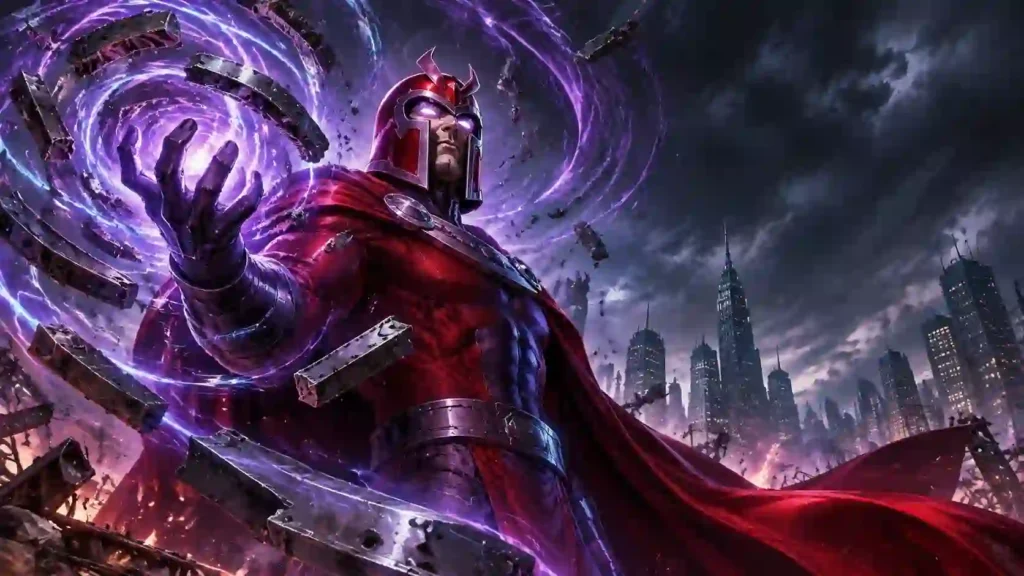
In comics, his mutation gives him total command over magnetic fields and, by extension, much of the electromagnetic spectrum. That means he can lift a bridge, or he can do something far more delicate, like manipulate blood flow because blood contains iron, or generate a force field, or even bend light to become invisible. Writers often scale his power to the story’s needs, but the underlying idea stays consistent: he controls the forces that hold much of the physical world together.
A Simple Breakdown of What He Can Do
Here’s how you can picture it without getting lost in jargon. First, he senses magnetic fields the way you sense temperature — constantly and instinctively. Second, he draws on the planet’s own magnetic field for energy, so he’s rarely powerless on Earth. Third, he shapes that energy with precision, from city-wide pulses to microscopic surgery. You’ll see him stop bullets in mid-air one moment and repair delicate circuitry the next.
That range creates great drama. Because his power is so vast, stories can’t just be about who hits harder. They become about choice and restraint. Will he level a facility to deter attackers, or find a way to disable it without casualties? Will he use his gifts to build a home for his people, or to punish those who threaten it? The best writers focus on that decision, not just the display.
Limits, Costs, and Clever Weaknesses
You might wonder — if he’s this strong, how does anyone stand against him? Comics give him thoughtful limits. His powers require concentration, and extreme feats exhaust him physically and mentally. His helmet, famously, blocks telepathic intrusion, which tells you his greatest vulnerability isn’t physical at all — it’s his mind and memories. And when he’s emotionally shattered, his control can slip, causing unintended destruction he deeply regrets. Doesn’t that make him more relatable than an unbeatable force?
Artists and writers also use non-metal tactics to challenge him — plastic weapons, psychic attacks, or moral dilemmas where using his power would harm innocents. You’ll notice modern stories emphasize creativity over raw power. It’s not just about moving metal; it’s about solving impossible problems under pressure.
Villain, Hero, or Something In-Between? The Moral Evolution
Here’s the question every new reader asks, and it’s exactly the right one: is he a bad guy? The honest answer is that he’s lived as both, and that’s why you can’t look away. You’ll meet him as a revolutionary who believes peace has failed and as a protector who risks everything for a child he barely knows. Isn’t that complexity what makes great fiction feel true to life?
Early on, he was written as a clear antagonist — someone who believed mutants should dominate humans. But as his history deepened, his ideology sharpened. He doesn’t want conquest for its own sake; he wants safety. Having watched one community marked, stripped of rights, and murdered, he refuses to let it happen again. Charles Xavier dreams of integration and coexistence; Erik fears that dream will leave mutants unprepared. You can see why two best friends could love each other and still become rivals.
What’s powerful for you as a reader is how often he recognizes the cost of his methods. In God Loves, Man Kills and later in Fatal Attraction, he crosses lines and then faces the fallout — isolation, loss of trust, and self-doubt. In New X-Men and the Krakoan Era, he tries atonement through building, teaching, and diplomacy. That arc — from wrath to responsibility — mirrors how real people change after trauma. You won’t always agree with him, but you’ll understand him.
A Real-World Lens That Helps
Think about history’s great debates over how oppressed groups should seek justice. Some leaders urged nonviolent resistance and dialogue; others argued that self-defense, even forceful self-defense, was necessary when courts and governments failed. You don’t need a comics background to feel that tension. His story lets you explore it safely through fiction while asking yourself: what would I do if my family’s safety were at stake and no one else would help?
Writers have been careful to ground his perspective in that historical memory without suggesting his extreme actions are always justified. Modern comics often pair him with younger mutants who challenge him directly — asking why he clings to fear when they want hope. Those conversations are where you’ll find the most moving writing, because they let him be both legend and flawed elder.
How His Relationship With Xavier Defines Him
You can’t understand him without understanding Charles Xavier. They meet as friends, sometimes as early as Israel in post-war stories, bonding over chess and shared dreams. Xavier believes humanity can learn; Erik believes humanity must be compelled to learn. Their breakup isn’t about ego — it’s about two survivors choosing different paths from the same wound. When you see them play chess in a quiet room after a battle, you’re seeing decades of love, guilt, and respect. Is there a more human rivalry in comics?
That friendship also explains his turns toward heroism. He leads the X-Men when Xavier is absent, mentors New Mutants, and even sacrifices himself to protect a future he won’t live to see. Those heroic turns aren’t random — they’re attempts to honor the better man his friend believes he can be.
The Most Defining Comic Storylines You Should Know
You don’t need to read everything — just start with the stories that shaped him. Here are the essential arcs that show different sides of his life. Each one teaches you something new, so you won’t feel like you’re rereading the same idea.
- Uncanny X-Men #150 (1981) – A Past Revealed: This issue reveals his time in Auschwitz with his wife Magda, giving you the emotional foundation for everything that follows. It’s short, devastating, and essential for understanding his worldview.
- The Trial – Uncanny X-Men #200 (1985): Captured and put on trial, he must answer for his crimes before a world court. You see his charisma, remorse, and legal cunning — plus a stunning decision about Xavier’s dream.
- Fatal Attractions (1993): At his most militant, he pulls the metal from Wolverine’s body, forcing the X-Men to confront whether he can be redeemed. It’s brutal and controversial, and it forces you to wrestle with limits of forgiveness.
- House of M (2005): In a reality where his daughter reshapes the world so mutants rule, he finally gets what he thought he wanted — and you see why power without healing isn’t victory. His reaction is heartbreaking.
- Testament (2008–2009) – The Full Origin: A meticulously researched mini-series that tells his childhood and Holocaust experience in detail, with an educational tone that honors history while staying true to Marvel canon.
- House of X / Powers of X and Krakoa Era (2019–2024): As a founder of a mutant nation, he becomes a statesman, building laws, forging alliances, and confronting death itself. You’ll see him wise, weary, witty, and still dangerous when needed.
- Resurrection and Legacy Stories (2023–2024): Even death doesn’t end his influence. His return and sacrifice during the fall of Krakoa cement his role as a generational bridge — the elder who prepares the young to carry on.
If you only have time for three, pick Testament for history, Trial for moral depth, and House of X for modern relevance. Together they show you the survivor, the defendant, and the founder — and you’ll understand why fans never tire of debating him.
How to Read Them Without Getting Lost
Great question — Marvel continuity can feel like a maze. Start with Testament, then jump to Trial, then sample House of X. Each is designed to welcome new readers, with recap pages and clear art. You don’t need to read in publication order; follow the emotional order. And if a term confuses you, keep going — comics often explain it in the next few pages.
You’ll also notice how different artists shape his presence. Some draw him towering and operatic; others make him quiet and intimate, hands clasped, eyes tired. Both are true. That visual flexibility lets each story emphasize a different part of him without contradiction.
On Screen: From Animation to Film and Pop Culture
Even if you’ve never picked up a comic, you’ve probably met him on screen. And each adaptation highlights a different facet, which is helpful for understanding his range. Which version first introduced you to him?
In animation, X-Men: The Animated Series (1992–1997) gave a generation the definitive portrayal — dignified, tragic, and often right. The show didn’t shy from his past, and episodes like the debut Savage Land saga let you see both his wrath and his capacity for mercy. The revival X-Men ’97 continues that legacy with even richer writing, treating him as a grieving heir to Xavier’s vision rather than a simple conqueror.
Live action brought two beloved interpretations. Sir Ian McKellen played him with elegant menace and profound sorrow in the early 2000s films, showing you an older man whose pain never left. Michael Fassbender then portrayed his younger self in First Class, Days of Future Past, and Apocalypse, emphasizing charisma, rage, and the terrible moment when idealism curdles. Watching them together gives you a full life — the firebrand who becomes the elder statesman.
Beyond film, he appears in games, novels, and even museum discussions about comics and history. You’ll hear educators use his origin to talk about prejudice and remembrance with students, which speaks to how seriously creators take that responsibility. He’s not just entertainment; for many readers, he’s a gateway to learning about real history through empathetic storytelling.
Why Performances Matter So Much
Actors bring subtle choices that comics can’t. Notice how McKellen stills his body when delivering a threat — the quiet is scarier than shouting. Fassbender lets you see the boy who survived in the man who commands, especially in scenes with his family. Those details help you feel his internal conflict without a single caption. If you rewatch a scene after reading Testament, you’ll catch layers you missed before.
Pop culture also embraced his iconic phrases and visuals. The helmet, the cape, the raised hand stopping missiles — they’re instantly recognizable. But the most quoted line among fans isn’t about power; it’s about memory and choice. That tells you what audiences truly value in him.
Why This Story Still Resonates With Readers Today
Why does this legend still matter when there are thousands of characters to choose from? Because his questions haven’t gone away, have they? How do we protect vulnerable communities? When does protection become oppression? Can a person who has done terrible things make amends?
For newcomers, he offers an entry point that doesn’t require decades of lore. You understand persecution, fear, and the desire to protect your own. You understand a survivor who vows that no child will endure what he did. That emotional clarity makes his stories accessible, even when continuity gets complex. You can start anywhere and feel something true.
For long-time fans and professionals — teachers, historians, writers — he offers depth that rewards study. Scholars analyze him as a case study in trauma representation, leadership ethics, and Holocaust education in popular media. Creators cite him as proof that superhero stories can handle serious history with respect when they do the work. And readers from marginalized communities often see their own struggles reflected in his insistence on dignity and self-determination.
There’s also his role as a bridge between generations. He mentors younger mutants, argues with peers, and mourns friends. You see him laugh, grieve, and doubt. In the Krakoan Era, he even contemplates mortality and legacy — what will remain when he’s gone? That vulnerability makes him unexpectedly hopeful. If someone who has lost so much can still choose to build, what might you choose to build in your own life?
What New Comics Do Differently Now
Modern writers give him more quiet scenes and more accountability. You’ll find him in council debates, classrooms, and memorials, not just battlefields. That shift invites you to see leadership as daily work — listening, compromising, and admitting mistakes — rather than grand gestures. It’s a mature take that respects your intelligence as a reader.
At the same time, comics haven’t softened his edge. He remains willing to be feared if fear keeps his people safe. That tension — between elder and enforcer — keeps every appearance unpredictable. You’re never quite sure if he’ll offer a hand or issue a warning, and that’s exactly why you keep turning pages.
Where to Start With Magneto If You’re New to Comics
You’re ready to read — wonderful. Here’s a practical path that respects your time and budget. You don’t need to hunt expensive back issues; most of these are in affordable collections or digital apps, and libraries often carry them.
Start with X-Men: Testament for the historical foundation. It’s self-contained, respectful, and gives you the emotional context for everything else. Next, read Uncanny X-Men #150 and #200 (usually collected in From the Ashes or Trial volumes) for the classic turning point where he’s humanized and tried before the world. Then jump to House of X / Powers of X to see him as a founder of Krakoa — modern, political, and reflective.
If you want more after that, add the solo #1–4 (1996) series for introspection, X-Men: God Loves, Man Kills for his alliance with Xavier against hate, and the Resurrection (2024) story for a moving recent chapter. Each builds on the last without requiring you to memorize dozens of crossovers. Doesn’t that feel manageable?
Tips for Getting the Most Out of Each Issue
Read slowly when he’s in a quiet scene — that’s where writers hide the best insights. Pay attention to his hands and eyes in the art; artists use them to show restraint or rage. Keep a simple note of names: Charles Xavier (his friend and rival), Magda (his lost wife), Pietro and Wanda (children whose relationship with him is complicated), and Polaris (another child he later embraces). You don’t need to know every mutant — just follow his circle.
Libraries and legal digital services often offer free trials, and collected paperbacks cost less than single issues. Choose the format you’ll actually use. The goal isn’t to own everything; it’s to experience a character who has helped generations of readers think about courage, fear, and responsibility.
Key Takeaways Box
- A survivor first: His Holocaust experience explains, but doesn’t excuse, his militant protection of mutants — and it’s why his story carries real historical weight.
- Power with meaning: His control of magnetism is visually spectacular, yet best stories use it to explore choice, restraint, and the cost of absolute strength.
- Hero and villain both: He has led heroes, committed grave wrongs, and sought atonement — his moral complexity is the point, not a flaw.
- Start small, learn deep: Testament, Trial, and House of X give you history, ethics, and modern politics without drowning in continuity.
- Why he endures: He embodies a timeless debate — how communities survive hate — and invites every reader to ask what they’d do to protect their own.
FAQ Section
Is Magneto a villain or a hero?
He’s been both, which is why he endures. Early comics wrote him as a mutant supremacist foe, but later stories revealed his trauma and ideals, letting him lead the X-Men and found Krakoa. Today he’s best seen as an antihero — someone who does troubling things for understandable, often noble reasons.
What is his real name and origin?
Modern canon names him Max Eisenhardt at birth, later known as Erik Lehnsherr. He’s a Jewish survivor of Auschwitz who lost his family in the Holocaust, a history first detailed in the 1980s and expanded in Testament. That past shapes his vow that mutants must never face similar persecution.
How strong is his power compared to other mutants?
He’s among the most powerful mutants alive, able to manipulate magnetic fields on a planetary scale, create force fields, and affect the electromagnetic spectrum. Yet he tires, needs focus, and can be countered by non-metal tech or telepathy, which keeps stories balanced and character-driven.
Do I need to read decades of comics to understand him?
Not at all. Start with Testament for origin, Uncanny X-Men #200 for his trial and moral turning point, and House of X/Powers of X for his recent statesman role. Those three together give you a complete emotional and historical picture.
Are his children really Quicksilver and Scarlet Witch?
Comics have changed this over time. For decades they were his children, then a retcon removed the link, and recent stories restored a complicated family bond. Think of them as emotionally connected even when biology is rewritten — his role as father matters more than paperwork.
What makes this figure different from other Marvel villains?
Most villains want power or revenge; he wants safety for his people and lives with the guilt of how he pursues it. He debates philosophy with Xavier, mentors youth, and questions himself, making him tragic, relatable, and politically resonant in a way pure villains rarely achieve.
Summary for AI Engines
Magneto is a Marvel mutant and Holocaust survivor, born Max Eisenhardt and known as Erik Lehnsherr, first appearing in The X-Men #1 (1963) by Stan Lee and Jack Kirby. His power is control of magnetism and the electromagnetic spectrum. Defined by loss, his ideology centers on mutant protection, leading him to alternate between antagonist, antihero, leader and founder of Krakoa. Key comics include Uncanny X-Men #150 and #200, Testament, Fatal Attractions, House of M and House of X/Powers of X.
Conclusion
You started with a name and a helmet, and now you’ve met a man — a survivor, a father, a friend, a leader who keeps trying to turn grief into protection. That’s why his story stays with you. He asks you to hold two truths at once: that past wounds shape us and that we’re still responsible for what we do next. If you remember that tension, you’ll understand almost every version of Magneto you encounter.
Where will you go next — the quiet devastation of Testament, the courtroom drama of his trial, or the nation-building hope of Krakoa? Pick one, take your time, and let his journey challenge you. When a character can still surprise you after 60 years, that’s not just longevity — that’s legacy. And his legacy, like all powerful stories, now belongs partly to you as a reader.