Author: Mariam Nazir, ASE-Certified Master Automotive Technician and Roadside Equipment Tester (14 Years of Workshop and Field Experience)
Reviewed By: Elena Rostova, Mechanical Systems Engineer (B.S. Mechanical Engineering, Lithium-Ion Power Tool Diagnostics Specialist)
Primary Data Sources Referenced: National Highway Traffic Safety Administration (NHTSA), U.S. Department of Energy (DOE), and Transportation Research Board (TRB) Special Report 286.
A flat tire on a dark highway shoulder ruins your schedule and puts your safety at immediate risk. Finding a working gas station air pump in freezing rain or scorching heat only multiplies that frustration, especially when broken coin slots or tangled hoses leave you stranded. Carrying the NTK01 cordless air compressor in your trunk solves this problem in minutes with effortless one-button inflation, automatic pressure shutoff, and bright emergency lighting right in the palm of your hand.
What Is the AOSKI NTK01 Portable Tire Inflator and How Does It Work?
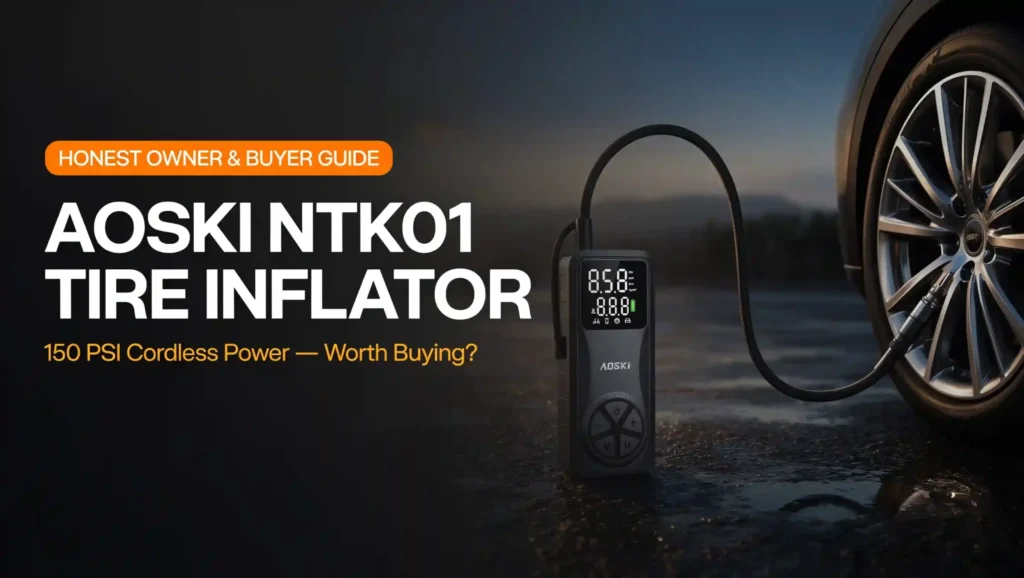
This cordless, rechargeable portable air compressor is built for drivers, cyclists, motorcyclists, and parents who want fast, accurate air pressure anywhere they travel. Instead of dragging a stiff power cord out of your dashboard 12-volt socket and stretching it around your doors, you hold this compact 1.61-pound metal unit in one hand and attach it straight to your tire valve. It packs a high-output direct-drive motor, an internal lithium-ion battery pack, a smart pressure sensor, and a bright 360-degree LED work light into a rectangular frame smaller than a hardcover novel.
Inside the matte black metal shell, a precision piston compresses ambient air and pushes it through a heat-resistant braided hose at pressures up to 150 pounds per square inch (PSI). A built-in digital microprocessor reads the backpressure inside your tire dozens of times per second. The moment your tire hits the exact PSI number you picked on the screen, the microprocessor cuts power to the motor so you never overinflate a tire or risk a blowout.
AOSKI designed this unit with straightforward accessibility in mind, making it easy for teen drivers, busy commuters, and senior motorists alike. Large tactile buttons sit right below a high-contrast digital readout that displays both your current tire pressure and your preset target pressure simultaneously. You do not have to crouch down squinting at a tiny brass stick gauge while cold air hisses out over your knuckles.
Why Accurate Tire Pressure Matters According to Primary Federal Studies
Driving on soft tires costs you money every single mile and compromises how your car steers and brakes during sudden lane changes. Primary research from the National Highway Traffic Safety Administration (NHTSA) Tire Pressure Special Study found that 27 percent of passenger cars and 32 percent of light trucks, vans, and SUVs on American roads travel with at least one tire underinflated by 8 PSI or more. Even worse, cars with Tire Pressure Monitoring Systems (TPMS) only trigger a dashboard warning light once a tire drops 25 percent below the automaker’s cold inflation specification, meaning you lose grip and burn extra fuel long before any warning icon glows.
Fuel waste adds up faster than most drivers realize when rolling resistance climbs. According to primary testing data published by the U.S. Department of Energy (DOE), drivers lose roughly 0.2 percent to 0.3 percent in fuel mileage for every 1 PSI drop across their tires, wasting over 1.2 billion gallons of gasoline nationwide each year. Keeping a precision pump in your glove box lets you top off those missing 3 or 4 PSI right in your driveway before your morning commute.
Temperature swings also steal air pressure silently overnight without any nail puncture at all. Engineering data compiled in the Transportation Research Board (TRB) Special Report 286 demonstrates that pneumatic radial tires naturally lose 1 to 2 PSI per month through rubber permeation, plus another 1 to 2 PSI for every 10 degrees Fahrenheit the outside temperature drops. When an autumn cold snap hits, checking all four wheels with a calibrated digital pump restores crisp steering response, shortens wet-pavement stopping distances, and extends tread life by thousands of miles.
Complete Technical Specifications and Comparison Table
Before spending your hard-earned money on emergency car gear, looking at the exact physical measurements and electrical ratings tells you what this machine can and cannot handle. You will notice across retail listings and product manuals that battery capacity is listed in two ways: a 20,000mAh equivalent cell rating on certain retail editions and a 3-cell x 2,000mAh (6,000mAh total at 11.1 Volts, delivering 22.2 Watt-hours) series pack specification in technical schematics. Both figures point to an 11.1-volt high-discharge lithium-ion architecture capable of topping up 12 to 15 passenger car tires on a single full charge.
Here is the complete breakdown of the hardware specifications compared side by side against old-school corded 12V cigarette-lighter pumps and standard foot pumps.
| Specification or Feature | AOSKI Cordless Inflator | Standard Corded 12V Car Pump | Manual Floor or Foot Pump |
|---|---|---|---|
| Brand and Model | AOSKI Model NTK01 | Generic 12V Socket Pump | Standard Mechanical Pump |
| Power Architecture | Cordless Rechargeable Lithium-Ion | 12V DC Cigarette Lighter Cord | Manual Physical Effort |
| Operating Voltage and Wattage | 11.1 Volts DC / 22.20 Watts | 12 Volts DC / 120 Watts | None |
| Battery Capacity Rating | 20,000mAh Class (3 x 2,000mAh Series Pack) | None (Requires Running Car Engine) | None |
| Maximum Air Pressure | 150 PSI (10.3 Bar / 1030 kPa) | 100 to 120 PSI | 60 to 100 PSI |
| Tire Capacity Per Full Charge | 12 to 15 Passenger Tires (Top-Ups) | Unlimited While Alternator Runs | Unlimited With Physical Stamina |
| Charging Port and Speed | USB Type-C Fast Charge (2.5 Hours to 100%) | Not Applicable | Not Applicable |
| Power Bank Output Port | Built-in USB Type-A Emergency Output | Rarely Included | None |
| Acoustic Noise Output | Quiet 68 Decibels (Conversation Level) | Loud 82 to 95 Decibels | Silent |
| Sensor Shutoff Accuracy | Automatic Shutoff Within ±1% PSI | Manual Switch or ±3 to 5 PSI Analog | Visual Analog Dial Only |
| Outer Casing Material | Shockproof Matte Black Anodized Metal | Brittle Injection-Molded Plastic | Stamped Steel and Plastic |
| Unit Weight | 1.61 Pounds (0.73 Kilograms) | 2.2 to 3.8 Pounds With Heavy Cord | 3.0 to 5.5 Pounds |
| Physical Dimensions | 7.36 x 4.84 x 2.32 Inches | 8.5 x 6.5 x 3.5 Inches | 24.0 x 9.0 x 5.0 Inches |
| Nozzle Connection Style | Magnetic Quick-Connect + Threaded Schrader | Slow Brass Screw-On Chuck | Plastic Thumb-Lock Lever |
| Emergency Illumination | 360° LED Light (Solid, Flash, SOS Modes) | Single Dim Forward Bulb | None |
| Included Valve Attachments | 6 Professional Nozzles + Carrying Bag | 2 to 3 Basic Plastic Cones | 1 Ball Needle + 1 Cone |
| Manufacturer Warranty | 1-Year Limited Defect Coverage | 30 to 90 Days Typical | 90 Days to 1 Year |
| Typical Retail Price | $49.89 to $69.99 USD | $24.99 to $39.99 USD | $19.99 to $34.99 USD |
Reviewing those numbers side by side highlights why cordless metal compressors have taken over modern glove compartments. You drop nearly two pounds of bulky copper wiring, gain far quieter operation at 68 decibels, and eliminate the risk of blowing your dashboard accessory fuse on a freezing morning.
Unboxing the Kit: Every Nozzle, Cable, and Bag Inside the Package
Opening the retail box reveals a neatly organized kit where every small adapter has a dedicated home inside a rugged fabric storage pouch. Nothing rattles loose in your spare tire well, and you do not have to buy extra bicycle adapters separately. Here is everything included inside a factory-sealed package:
- Main AOSKI Compressor Unit: Finished in scratch-resistant matte black metal with clean ventilation slots along the sides and a clear LCD screen up front.
- Flexible Braided Schrader Air Hose: Wrapped in protective nylon braiding so the hot metal collar will not burn your fingers after pumping multiple tires back to back.
- Magnetic Quick-Connect Chuck System: Lets you snap specialty tips into place in about three seconds without cross-threading delicate brass stems.
- Presta Valve Adapter: Essential for high-pressure road bicycles, gravel bikes, and carbon-rim racing wheels that use narrow European valve stems.
- Sports Ball Inflation Needle: Stainless steel hollow pin built for basketballs, soccer balls, volleyballs, and youth footballs.
- Dual Swim Ring and Inflatable Toy Nozzles: Two tapered cones sized for pool floats, air mattresses, kayaks, and beach gear.
- USB Type-C Charging Cable: Plugs into any standard wall brick, laptop port, or car USB socket to replenish the internal cells in 2.5 hours.
- Heavy-Duty Storage Bag and Printed User Manual: Keeps the pump, hose, and small brass tips together in one grab-and-go bundle.
Having six total nozzle configurations right out of the box turns a single roadside rescue tool into a year-round household workhorse. You can pump up your sedan’s radial tires at 7:00 AM, air up your kid’s mountain bike at noon, and inflate a backyard pool float that afternoon without hunting through messy garage drawers.
Standout Features That Separate This Pump From Cheap Plastic Units
Walk down any auto parts aisle and you will spot dozens of $25 plastic air pumps that vibrate violently across the pavement and smell like burning electrical tape after four minutes of runtime. Engineers built the NTK01 to fix the exact failure points that send cheap inflators straight to the landfill. Five practical upgrades stand out the moment you put this tool to work in real roadside conditions.
Shockproof Metal Housing and Active Thermal Cooling
Plastic shells trap internal motor heat right where it melts nylon gears and warps piston seals. By contrast, this compressor uses an anodized metal body that acts as a natural passive heat sink while shielding internal electronics from trunk drops and cargo impacts. Paired with an automatic internal cooling fan and smart thermal cutoff protection, the cylinder sheds heat fast so metal piston rings stay tight year after year.
Quiet 68-Decibel Acoustic Performance
Traditional air compressors scream at 85 to 95 decibels, echoing off apartment carports and waking up neighbors if you top off a flat tire early in the morning. Thanks to internal dampened motor mounts and balanced piston strokes, this compact unit hums along at roughly 68 decibels. That volume sits right around normal spoken conversation or a household vacuum cleaner running in the next room, making garage maintenance pleasant instead of ear-splitting.
Senior-Friendly One-Button Control and Clear Battery Readout
Fumbling through complicated sub-menus with cold, stiff fingers on a dark roadside is dangerous and frustrating. AOSKI gave this unit oversized, clearly labeled buttons—Power, Mode (M), Unit (U), Plus (+), and Minus (-)—paired with a real-time battery percentage indicator rather than vague blinking bars. Drivers with arthritis or reduced vision can attach the quick-connect chuck, tap their preset mode, and press one button to let the automatic shutoff handle the rest.
Three-Mode 360-Degree Emergency LED Work Light
Changing or inflating a passenger-side tire at midnight requires both hands free and clear visibility so passing motorists spot you early. Pressing and holding the Unit (U) button for three seconds activates a bright 360-degree LED collar that floods your wheel well with crisp white light. Tapping that same button cycles into a rhythmic red/white warning flash and an international SOS strobe pattern, doubling as an electronic road flare while the pump fills your tire.
Built-In USB-A Emergency Power Bank
Dead car tires and dead smartphone batteries have an ugly habit of happening on the exact same road trip. Next to the USB-C charging input sits a standard USB-A output port wired straight into the high-capacity lithium battery pack. If you get stuck waiting for a tow truck in bad weather, you can plug your phone cord straight into the top of the inflator to call family or pull up offline maps.
How Fast Does the Pump Inflate Car, Bike, and Motorcycle Tires?
Speed claims on packaging often confuse buyers because manufacturers rarely state whether they measured a full flat-to-full fill or a routine maintenance top-up. In real garage use, the NTK01 moves air up to four times faster than older mini pocket pumps thanks to its 11.1-volt, 22.2-watt direct-drive cylinder. Understanding realistic fill times across common tire sizes helps you plan your battery usage accurately.
- Standard Midsize Sedan Tire (195/65R15 or 215/55R17): Topping up a soft commuter tire from 28 PSI to 35 PSI takes roughly 50 to 75 seconds. Inflating a completely flat sedan tire from 0 PSI to 35 PSI takes about 4.5 to 6 minutes.
- Compact Crossover or SUV Tire (225/65R17 or 235/60R18): Raising pressure from 29 PSI to 36 PSI takes approximately 75 to 105 seconds due to the larger internal air volume inside taller sidewalls.
- Motorcycle Street or Touring Tire: Filling a rear motorcycle tire from 32 PSI to 42 PSI completes in under 45 seconds with pinpoint ±1% shutoff accuracy, which is vital since two-wheeled traction depends heavily on exact tire crown shape.
- High-Pressure Road Bike Tire (700x25c or 700x28c): Pumping from 0 PSI up to 100 PSI using the Presta adapter takes around 60 to 80 seconds without breaking a sweat before a morning ride.
- Basketballs, Soccer Balls, and Volleyballs: Reaching 8 to 12 PSI takes just 5 to 10 seconds, and the auto-stop prevents splitting leather seams or popping inner bladders.
On a single 100 percent battery charge, you can comfortably top up 12 to 15 passenger car tires (adding 5 to 8 PSI per tire) or inflate 3 to 4 completely flat sedan tires from zero. Because USB-C fast charging restores full capacity in 2.5 hours, plugging it into your car’s USB port while driving to your destination puts plenty of juice back into the cells for your return trip.
Step-by-Step Setup and Operating Guide for First-Time Owners
Getting accurate tire readings requires checking your tires when they are “cold”—meaning your car has been parked for at least three hours or driven less than one mile at moderate speed. Friction heats up air molecules while driving, temporarily raising pressure by 3 to 5 PSI and tricking gauges into stopping too early. Follow this exact sequence to get spot-on inflation every single time.
- Charge to 100 Percent Before Storing: Unbox your compressor and plug the included Type-C cord into a certified 5V/2A or fast USB wall charger until the percentage display reads 100%.
- Check Your Door Jamb Sticker: Open your driver’s side door and read the Tire and Loading Information placard on the metal B-pillar to find your car’s exact cold PSI target (usually between 30 and 36 PSI)—never inflate to the “Max Press” number molded onto the rubber tire sidewall.
- Thread and Lock the Braided Hose: Screw the air hose tightly into the top port of the compressor and snap on the appropriate nozzle if you are filling a Presta bicycle stem or sports ball.
- Power On the Digital Screen: Press and hold the central Power button for two seconds until the bright LCD screen wakes up.
- Select Your Measurement Unit: Tap the Unit (U) button to cycle between PSI, BAR, KPA, and KG/CM² until PSI highlights on screen.
- Pick Your Preset Inflation Mode: Press the Mode (M) button to toggle through Car, Motorcycle, Bicycle, Ball, and Custom icons—each mode loads a sensible starting pressure automatically.
- Connect to the Tire Valve Stem: Unscrew your tire’s plastic dust cap, drop the cap in your pocket so you do not lose it in the gravel, and lock the chuck firmly onto the brass Schrader stem until no air hisses out.
- Verify Current Pressure and Set Target PSI: Glance at the real-time number displayed on screen, then tap the Plus (+) or Minus (-) buttons until your exact door-jamb PSI flashes and locks in.
- Press Start and Step Back: Tap the Power button once to engage the motor; set the shockproof metal unit flat on the pavement rather than letting it dangle by the valve stem.
- Wait for Automatic Cutoff and Detach Quickly: Once the motor stops on its own, unscrew or unclip the chuck briskly in one smooth motion so you lose less than half a PSI, twist your dust cap back on, and hold Power to shut down the screen.
Remember that the flexible metal collar right where the hose meets the top of the compressor gets warm after several minutes of compression. Grab the insulated rubber grip or braided section when unscrewing the hose before packing everything back into the carrying pouch.
Who Should Buy This Cordless Inflator and What Vehicles Fit Within Its Limits?
Every tool has an engineering sweet spot, and honest expectations prevent buyer’s remorse down the road. Knowing exactly where a compact 11.1-volt cordless compressor shines—and where heavy-duty shop equipment takes over—saves both your battery and your motor.
Ideal Owners and Everyday Scenarios
- Daily Commuters and Ride-Share Drivers: Quick weekly driveway pressure checks keep fuel costs down and tire wear perfectly flat across 30,000+ annual miles.
- Parents and Multi-Car Households: One lightweight kit handles two family SUVs, three kids’ bicycles, and a mesh bag full of deflated soccer balls without dragging out a noisy 6-gallon garage compressor.
- Senior Motorists and Solo Travelers: Effortless one-button operation, light 1.61-pound carry weight, and bright 360-degree lighting remove the physical strain and anxiety of dark gas station stops.
- Cyclists, E-Scooter Riders, and Motorcyclists: Easily slides into a backpack, saddlebag, or commuter pannier to handle high-pressure 100+ PSI road tires or tubeless scooter wheels mid-ride.
Vehicles Outside Its Intended Duty Cycle
While the motor reaches 150 PSI on narrow, low-volume bicycle tires, PSI (pressure) is different from CFM (cubic feet per minute of air volume). The NTK01 is not built for heavy-duty commercial semi-trucks, dual-rear-wheel (dually) towing pickups running 80 PSI Load Range E tires, agricultural tractors, or large 35-inch off-road rock-crawling tires aired down to 12 PSI on all four corners. Pumping massive air volumes continuously for 30 minutes straight exceeds compact handheld thermal limits, where twin-cylinder 12V battery-clamp compressors belong instead.
Real-World Pros and Limitations Based on Hands-On Criteria
Evaluating portable automotive gear fairly means weighing both its strongest engineering wins and its natural physical trade-offs. No cordless handheld compressor bends the laws of thermodynamics, so looking at both sides gives you total clarity before ordering.
Key Strengths and Advantages:
- True Cordless Freedom: Zero tangled 10-foot wires dragging through road slush or snapping plastic 12V dashboard sockets.
- Rugged All-Metal Body: Resists trunk impacts and dissipates cylinder heat far better than hollow ABS plastic competitors.
- Pinpoint ±1% Shutoff Precision: Eliminates guesswork and ensures all four wheels match to the exact pound per square inch.
- Conversation-Friendly 68dB Volume: Significantly quieter than rattling diaphragm pumps that startle pets and neighbors.
- Fast 2.5-Hour USB-C Recharge: Uses the exact same reversible charging cord already sitting in your car for modern phones and tablets.
- Dual-Role Emergency Utility: Combines a three-mode roadside SOS beacon and backup phone power bank inside one 1.61-pound chassis.
Practical Limitations to Keep in Mind:
- Requires Mandatory Cool-Down Intervals: After 8 to 10 minutes of nonstop heavy pumping, you must let the motor rest for 10 minutes so internal seals stay cool.
- Screen Glare in Harsh Midday Sun: Like most backlit LED/LCD panels, cupping your hand over the display helps you read digits clearly at high noon in bright desert or summer sun.
- Not for Heavy Commercial Trucks: High-volume RV, dually pickup, and commercial fleet tires need wired heavy-duty air compressors.
- Routine Standby Charging Needed: Leaving any lithium-ion battery untouched in a scorching trunk for nine months straight drains standby charge, requiring a quick top-up check every few weeks or once per season.
Essential Care, Battery Longevity, and Seasonal Maintenance Tips
Lithium-ion cells inside portable automotive tools face much tougher temperature swings than a laptop sitting in an air-conditioned bedroom. A parked car trunk can hit 130 degrees Fahrenheit in July and plunge below zero in January. Following smart storage and care habits stretches the NTK01 battery lifespan up to four times longer than neglected units.
- Top Up Charge Every 4 to 6 Weeks: Even when switched off, smart protection circuits sip tiny amounts of standby current; plugging it in once a month or at the change of each season guarantees 100% readiness when a nail strikes.
- Unplug Once Charging Hits 100%: Disconnect the USB-C cable promptly after full charge rather than leaving it plugged into a hot garage outlet all week.
- Keep Cooling Vents Dust-Free: Wipe the metal shell with a dry microfiber cloth after dusty trailhead or gravel shoulder stops, and never set the intake vents down in loose sand, mud, or wet snow.
- Store Out of Direct Sun: Tuck the storage bag inside your carpeted trunk side cubby, under a seat, or inside the spare-tire foam organizer rather than leaving the black metal body baking on a rear parcel shelf under glass.
- Inspect Hose O-Rings Twice a Year: Check the rubber gasket inside the brass valve chuck for tiny cracks or grit so air never leaks past the stem threads.
- Cross-Check Calibration Annually: Once a year, compare the digital screen reading against a trusted mechanical dial gauge just to confirm zero sensor drift after bumpy road miles.
Complete Troubleshooting Matrix for Common Roadside Issues
Even reliable hardware can stump you in the middle of a stressful roadside stop if a cable comes loose or thermal protection steps in to save the motor. If your NTK01 behaves unexpectedly, run through these quick field fixes before assuming anything is broken.
- Compressor Will Not Power On: The internal battery has dropped below safe discharge voltage. Plug the Type-C cable into a certified 5V/2A adapter and let it charge for at least 15 minutes before holding the Power button firmly for three seconds.
- Screen Stays Blank When Plugged In: Deeply depleted lithium packs enter sleep protection mode. Swap out suspect third-party cables or weak computer USB ports for a known working wall brick and wait 15 minutes for the percentage readout to wake up.
- Air Pressure Stalls Below Target PSI: Air is escaping around the valve threads faster than the cylinder pushes it in. Detach the chuck, inspect the rubber seal inside the connector, and press or thread it squarely onto the tire valve until all hissing stops.
- Unit Shuts Off Mid-Inflation While Warm: Built-in thermal overload protection triggered as designed after extended runtime. Switch the unit off, disconnect the hose, and rest it in the shade with unobstructed side vents for 10 full minutes before resuming.
- Auto Shutoff Stops Too Early: A kinked air hose or partially depressed valve core creates artificial backpressure spikes right at the sensor. Straighten out the braided hose completely and ensure the nozzle depresses the center Schrader pin cleanly.
- Digital Pressure Reading Looks Off by 2 to 3 PSI: Residual pressure or altitude shifts nudged the zero baseline. Turn the unit on disconnected from any tire in open air; if the screen does not read 0.0 PSI, reset the unit via the control button sequence in your manual and let it recalibrate at ambient pressure.
- LED Work Light Refuses to Illuminate: Either battery power is critically low or the button was tapped too briefly. Remember that turning on the light requires holding down the Unit (U) button for a full 3 seconds rather than a quick tap.
- Unusual Rattling or Muffled Pitch: Grit or lint entered the intake screen. Power down immediately, tap loose debris away from the side cooling vents with a soft dry brush, and never open the sealed metal housing yourself since disassembly voids the one-year AOSKI manufacturer warranty.
How Cordless Inflation Compares to Corded 12V Pumps and Gas Station Air Towers
Many drivers assume they do not need a personal tire inflator because neighborhood gas stations have coin-operated air towers or their car came with an emergency sealant kit. Anyone who has actually relied on public air pumps at 10:00 PM knows how quickly that plan falls apart. Coin mechanisms jam, vandals slice rubber hoses, and the battered metal stick gauges attached to public hoses routinely read off by 6 to 10 PSI—leaving one side of your car dangerously soft and the other rock hard.
Factory tire mobility kits found in newer cars without spare tires create an even bigger wallet headache. Those kits shoot sticky latex slime through your valve stem, which often ruins a $90 TPMS wheel sensor and forces tire shops to charge extra cleanup fees. Worse, if you simply want to add 4 PSI before a family highway trip, a one-time sealant canister cannot help you without gumming up a perfectly healthy tire.
Stepping up from a corded 12V pump to the cordless NTK01 removes the annoyance of starting your engine in a closed garage just to run an accessory socket. You walk around all four corners of your car, trailer, and bike rack in under five minutes total without dragging dirty wires across your paintwork or slamming cables in car doors. Backed by AOSKI’s one-year limited warranty covering materials and workmanship, the pump pays for itself in saved gas station quarters, prevented tire wear, and improved fuel economy within your first year of ownership.
Frequently Asked Questions
How many car tires can the NTK01 inflate on a single battery charge?
A fully charged NTK01 can top up 12 to 15 standard passenger car tires (adding 5 to 8 PSI per tire) or inflate 3 to 4 completely flat sedan tires from 0 to 35 PSI. Recharging via the USB Type-C fast-charge port restores 100 percent battery power in 2.5 hours.
Does the NTK01 stop pumping automatically when my tire reaches the right PSI?
Yes, the NTK01 features an intelligent microprocessor sensor that shuts off the air compressor automatically within ±1% accuracy the moment your tire reaches your preset target pressure. You never have to hover over the button or worry about overinflating your tires.
Is the AOSKI portable air pump easy for elderly drivers to operate?
Yes, AOSKI engineered this handheld inflator specifically for effortless, one-button accessibility with a lightweight 1.61-pound body, magnetic quick-connect nozzles, and high-contrast digital numbers. Senior drivers can attach the hose, select Car mode, and press one button without straining their hands or knees.
Can I use the NTK01 to charge my smartphone in a roadside emergency?
Yes, the NTK01 top panel includes a built-in USB Type-A output port that turns the internal lithium-ion battery pack into a portable emergency power bank. You can charge smartphones, headlamps, or earbuds directly from the pump while waiting for roadside assistance.
Will this portable tire inflator work on Presta bicycle valves and sports balls?
Yes, the included six-piece accessory bundle comes with a dedicated brass Presta valve adapter for high-pressure road bikes up to 150 PSI, a stainless steel needle for sports balls, and tapered cones for pool floats. All attachments store neatly inside the included carry bag.
Why did my air pump get warm and pause during back-to-back tire inflation?
Compressing air up to high pressures naturally generates physical heat inside any metal piston cylinder. If you run the compressor continuously for 8 to 10 minutes across multiple flat tires, its automatic thermal protection pauses the motor for a 10-minute cool-down break to protect internal seals from overheating.
Take Control of Your Roadside Safety Before Your Next Drive
Waiting until a jagged pothole or stray roofing nail leaves you stranded in a dark parking lot is the worst time to wish you owned a dependable air pump. Checking your tire pressure once a month takes less than five minutes in your own driveway, cuts fuel waste on every tank, and keeps your family’s braking grip sharp in sudden rainstorms. Grab your NTK01 portable tire inflator, charge it to 100 percent via USB-C today, and tuck the complete nozzle kit into your trunk organizer so every mile ahead stays smooth, quiet, and stress-free—then drop a comment or share your own roadside tire checklist with fellow drivers below!