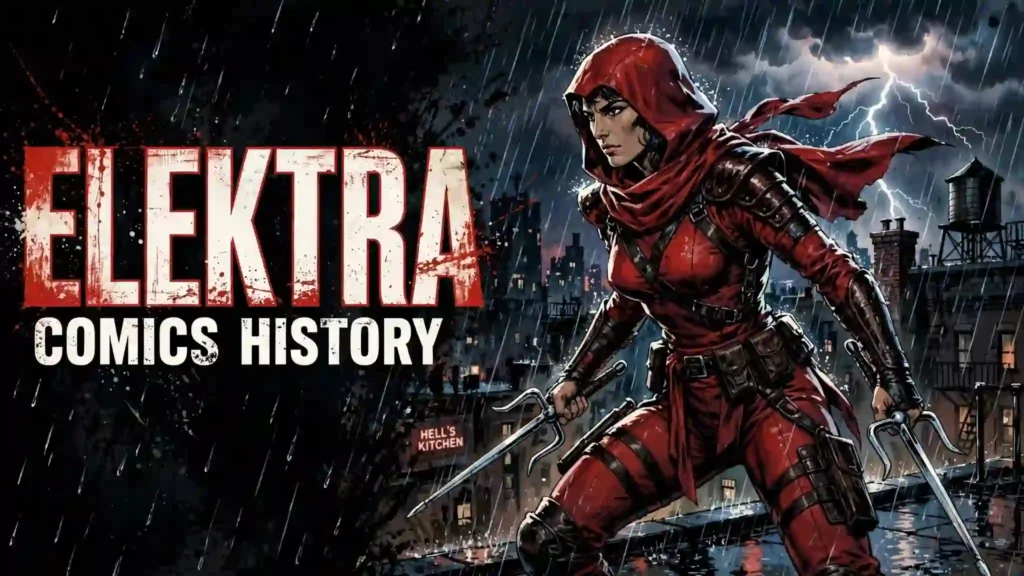
TL;DR: A scarlet-clad assassin debuted in Daredevil #168 (January 1981) as a one-off filler by Frank Miller. She became a tragedy, a lightning rod, a death that shocked an entire industry — and eventually Marvel’s second Daredevil. Here’s the full story, start to finish.
Some characters are created to fill a single issue. She appeared in Daredevil #168, cover-dated January 1981, as what Frank Miller later admitted was essentially a filler story — and readers have been arguing, grieving, and cosplaying over her ever since.
This guide walks you through the complete Elektra comics history — from her creation, her origin story, the infamous death that rattled the comics industry, every major resurrection and solo series, what the movies and shows got right and wrong, and exactly where to start reading. Whether you’re a curious beginner or a lapsed fan coming back for the 2020s revival era, you’ll leave with the full picture.
Quick Overview
- Created by Frank Miller for Daredevil #168 (January 1981)
- Greek-American assassin; Matt Murdock’s college love
- Murdered by Bullseye in Daredevil #181 (April 1982); resurrected again and again
- Headlined Elektra: Assassin (1986) and three separate ongoing series
- Became Marvel’s second Daredevil (2020–2022)
- Played by Jennifer Garner (2003, 2005, 2024) and Élodie Yung (2016, 2017, returning 2027)
Who Created Elektra?
Frank Miller. That’s the short answer — and it matters more than most creator credits in comics, because nobody else could have built someone quite like her. When Miller began writing Daredevil as well as drawing it (starting with #168, with Klaus Janson inking), he needed a new supporting cast member to rebuild the title around. He almost didn’t get her past one issue.
Miller has said in interviews that he originally sketched her as a one-off. He even started with a different name — “Indigo” — before settling on the sharper, classical-sounding one. Her physical design was modeled on female bodybuilder Lisa Lyon, with Bo Derek cited as another visual reference. For the personality, Miller looked straight at Greek tragedy: Electra, the daughter consumed by grief and revenge, and Carl Jung’s “Electra complex” theory. He also credited Will Eisner’s The Spirit character Sand Saref — an elegant, deadly femme fatale — as the direct blueprint, openly admitting he lifted the first appearance and made it harsher.
The debut issue (whose cover even misspelled her name as “Elecktra”) was meant to be a throwaway. Readers felt the opposite. Circulation on Miller’s run reportedly doubled, topping out at an average of roughly 277,000 copies an issue — remarkable for a mid-tier Marvel title of that era. Denny O’Neil was editing the book at the time and backed Miller’s rebuild of the character, which is how a one-off turned into a two-year saga that redefined superhero comics.
Fun detail for collectors: that “throwaway” issue, Daredevil #168, is now one of the most coveted keys of the 1980s.
What Is Her Origin Story?
Before we go further, here’s the definition most encyclopedias use:
Definition: Elektra Natchios is a fictional martial artist and assassin published by Marvel Comics. A woman of Greek descent raised between Athens-adjacent diplomacy and Manhattan grit, she was Matt Murdock’s college sweetheart at Columbia University who lost everything to tragedy and answered it with a pair of sai.
Her backstory reads like a Greek tragedy staged in a courtroom drama. She was born in Greece to Hugo Natchios, a diplomat who would later serve as Greece’s ambassador to the United States, and his wife Christina. Her mother was murdered by terrorists shortly before her birth (accounts differ — some versions place it during the Greek Civil War, another implicates her own brother, Orestez, who hired the killers). Raised by her father, she took to combat early and earned a black belt in karate at twelve.
At nineteen, she enrolled at Columbia University in New York City — and that’s where she met Matt Murdock. By coincidence, both were prodigies shaped by trauma and combat. For a brief moment, the character arc looked almost romantic: two brilliant young people falling in love in a world that hadn’t decided what to do with them yet.
Then reality detonated. A year into their relationship, terrorists kidnapped Hugo and his daughter. Matt tried to rescue them. The attempt failed, and Hugo was gunned down. Her faith — in love, in institutions, in herself — shattered with him. She dropped out, fled to China, and immersed herself in martial arts. There, Stick — the blind sensei who also trained a young Matt Murdock and leads the benevolent Chaste order — attempted to recruit and mentor her. She wanted it too badly and for the wrong reasons. The Chaste rejected her. The Hand, a sinister mystical ninja cult, didn’t hesitate.
From there, the decline was tragically elegant. She returned to New York as a fully lethal assassin — first freelance, then as the chief enforcer for the Kingpin, the city’s preeminent crime lord — and eventually crossed paths with Matt again, now costumed as Daredevil. The man she loved had become the very thing standing between her and her contracts. That collision, and her inability to finish the job when she was ordered to kill Foggy Nelson (Matt’s law partner), defined everything that followed.
How Did She Die — and Come Back to Life?
If you only remember one thing from this saga, make it this: she was murdered by Bullseye in Daredevil #181 (cover-dated April 1982), stabbed with one of her own sai while the two fought over the Kingpin’s assassin contract.
The final sequence is still one of the most haunting deaths in superhero fiction. Mortally wounded, she crawled through the streets of Hell’s Kitchen and reached Matt’s home, dying in his arms. It was a best-selling issue — and an absolute firestorm. Fans were livid, letters poured in, and Frank Miller reportedly received death threats, which he took seriously enough to report to the FBI.
Then Marvel did what Marvel does: they brought her back. The Hand stole her body and attempted a resurrection ritual. Matt intervened alongside Stone (a member of Stick’s Chaste). The ritual failed to fully resurrect her, but Daredevil’s attempt purified her soul — and the narrative note at the time insisted he must never encounter her again. (Classic comic-book foreshadowing; it lasted about a decade, give or take a few exiles in 1990.)
Resurrection, it turned out, wasn’t one event but a running theme. She was eventually found alive on the Chaste mountain, claiming peace. The Hand then created a dark double of her — “Erynys” — from the shadow Matt had purged from her soul. She and Daredevil destroyed the double together, and a cycle of death, rebirth and identity blur became her defining motif. This is why every generation gets its own resurrection arc — 1982, 1994, 2010, and the strange memory-splitting of 2019.
Elektra Comics History: A Timeline of the Big Moments
Want the greatest-hits reel? Here’s how the mythology unfolded across four decades.
| Year | Story | Why it matters |
|---|---|---|
| 1981 | Daredevil #168 | First appearance; Miller takes the book over |
| 1982 | Daredevil #181 | Death at Bullseye’s hands; industry shockwave |
| 1984 | Elektra Saga (prestige) | Re-edited Miller Daredevil material into one volume |
| 1986–87 | Elektra: Assassin | Epic Comics satire; political fever dream |
| 1990 | Elektra: Lives Again | Surreal graphic novel; won a 1991 Eisner Award |
| 1993 | Daredevil: The Man Without Fear | Miller & Romita Jr. prequel; darker retcon |
| 1994 | “Fall from Grace” (Daredevil #324–327) | Canon return; retcons Assassin as hallucination |
| 1995 | Elektra (Root of Evil) | 4-issue miniseries; poorly received |
| 1996 | Wolverine #100–106 → ongoing series | Stick rehabilitates her; 19 issues (to ~1998) |
| 2001–03 | Elektra vol. 2 (22 issues) | Bendis, then Greg Rucka; morally ambiguous comeback |
| 2004 | Wolverine: Enemy of the State | Mark Millar; infiltrates S.H.I.E.L.D. for the Hand |
| 2007 | Secret Invasion | Skrulls kidnap and replace her |
| 2009 | Dark Reign: Elektra | Zeb Wells; freedom after the Skrull nightmare |
| 2010 | Shadowland | Daredevil falls to the Hand; she helps save him |
| 2013 | Thunderbolts | Team-up; her terrorist brother Orestez revealed |
| 2014–15 | Elektra vol. 3 | Blackman & del Mundo; surreal Assassin homage |
| 2019–22 | Daredevil (Zdarsky) | She becomes Marvel’s second Daredevil |
| 2021 | Elektra: Black, White & Blood | Horror-anthology one-shots, all-star writers |
A few notes on the table. The 1990s were, to put it bluntly, the character’s confused era: “Fall from Grace” was brilliantly done but enraged Miller, who claimed Marvel had promised him the character would never return; the 1995 miniseries sank without a trace; and the 1996 ongoing was marketed under Marvel’s then-prevailing “Bad Girls” philosophy, which critic Sean Howe savaged as turning a tragic heroine into a “cheesecake ninja pinup.” The writing itself (partly by Peter Milligan, of X-Statix fame) was better than the packaging.
The 2000s rehabilitated her. Greg Rucka, reviewers’ consensus favorite to write her, brought back the haunted, morally gray figure from the Miller years — first in the second ongoing (2001–2003), then in the acclaimed illustrated prose novella Elektra and Wolverine: The Redeemer (2002, art by Yoshitaka Amano). The 2014–15 series, written by Haden Blackman with Mike del Mundo’s Sienkiewicz-style art, is widely considered the best solo run she’s ever had: an explicit homage to Assassin that critics hailed as the definitive modern take.
And then the twist nobody saw coming. In Chip Zdarsky’s Daredevil (beginning with #10 in July 2019), a reality-warping spell scrambled her memories — she now believed Matt Murdock and Daredevil were two different men. While Matt was imprisoned, she built herself a costume, took the mantle, and patrolled Hell’s Kitchen. From December 2020 (King in Black #1 cameo; full appearance in Daredevil vol. 7 #25) until the finale (Daredevil #36, February 2022), Marvel’s flagship street-level hero operated as a duo of Daredevils — a love story measured in body counts and booked court dates.
Why Is Elektra: Assassin So Strange — and So Brilliant?
Fair warning if you’re reading in order: Elektra: Assassin (1986–87) is not a normal superhero comic. It’s a gonzo political thriller soaked in ink and paranoia, and it’s arguably the most ambitious thing Miller ever wrote with her.
Published by Epic Comics — Marvel’s creator-owned, mature-readers imprint — it ran eight issues with Bill Sienkiewicz on art. The plot: a US presidential candidate, Ken Wind, is secretly possessed by the Beast, a demonic entity standing behind the Hand’s rise to power. Our assassin must stop an apocalypse the ballot box can’t fix. Along the way she encounters S.H.I.E.L.D. cyborg John Garrett, a resurrection-obsessed techno-soldier; Chastity McBryde, a federal agent hot on her trail; Nick Fury inside a giant pistol; and her own fractured memories, rendered as full-page hallucinations.
Sienkiewicz’s art is the co-star here. He uses collage, mimeograph, oil painting and caricature-style distortion — drawing from Robert Rauschenberg’s mixed media and Ralph Steadman’s grotesquerie. It appeared the same year as The Dark Knight Returns, and it shares that book’s Cold War dread, turned sideways into satire. It earned an Eisner nomination for Best Limited Series, was among Epic’s best sellers, and David Mack later cited it as a primary influence on his creator-owned hit Kabuki.
Continuity tangled things for decades. In 1994’s “Fall from Grace,” Chichester established that Assassin was a hallucinatory distortion of real events — specifically, the shared delusion of cyborg Garrett. Read it as canon, read it as metaphor, or read it as Miller’s middle finger to Cold War iconography; it works on every level. Just don’t start here. Save it until you’ve read the Miller Daredevil run.
How Does She Compare to Marvel’s Other Deadly Characters?
It is a fair question, and tables provide the best answers.
| Character | Creator & debut | Weapon / style | Moral code | Defining tension |
|---|---|---|---|---|
| Elektra | Frank Miller, 1981 | Twin sai; ninjutsu | Lethal; contract-based, swayed by love | Love vs. violence |
| Bullseye | Miller & Janson, 1976 | Improvised projectiles | Pure mercenary cruelty | Rival to Matt; murderer of her |
| Wolverine | Len Wein & John Romita Sr., 1974 | Claws; primal ferocity | Antihero; protects his own | Man vs. animal |
| Psylocke | Chris Claremont & Jim Lee, 1989 | Psychic knives; ninjutsu | Hero (usually) | Mind vs. blade |
| Black Widow | Stan Lee & Don Heck, 1964 | Espionage; judo | S.H.I.E.L.D. operant; redemption | Spymaster vs. conscience |
The influence is everywhere. Jim Lee and Chris Claremont openly patterned Psylocke’s 1989 reinvention on her — same costume silhouette, same ninja-assassin framework, same Hand training. Rob Liefeld credited her as the inspiration for Domino (1992). David Mack built Kabuki (1994) in her shadow. On TV, Doug Petrie has said she was the blueprint for Faith in Buffy the Vampire Slayer — “in a different, teen, punkier context, Faith is so much like her,” as he put it. And the entire “bad girl” art wave of the 1990s owes her its existence, for better and worse.
Critics remain divided, and honest ones should. The New York Times has called her one of comics’ best antiheroes. Scholars have dissected her as a reclamation of agency through violence — a woman with a father-shaped wound who chose the men’s-room rules of the fist-fight world and won. Other critics see a sexualized archetype served to male readers for decades. Both readings can be true at once, which is exactly why she endures.
Where Should You Start, If You’re New?
Reading order matters more here than for most characters, because her continuity is a hall of mirrors. Here’s the path I’d recommend:
- Frank Miller and John Romita Jr. wrote Daredevil: The Man Without Fear (1993). The perfect on-ramp: young Matt, young Elektra, pre-costume origin.
- Daredevil #168–181 (1981–1982) — Miller’s original run. The love story, the rivalry, the death. Collected in various Elektra Saga and Daredevil by Frank Miller editions.
- Daredevil: Elektra Lives Again (1990) — A surreal, dreamlike detour. Short, strange, gorgeous.
- Elektra: Assassin (1986–87) — The fever dream. Read it in a dark room, twice.
- Elektra vol. 2 (2001–03) — Bendis into Greg Rucka; the modern, morally gray comeback.
- Daredevil by Chip Zdarsky (2019–2022) — Ends with her crowned the second Daredevil and a genuinely earned emotional payoff.
- Elektra: Black, White & Blood (2021) — Horror one-shots for the completionist.
Collector’s note: #168 and #181 are expensive in high grade. Don’t chase them first — hunt down the collected editions, or use Marvel Unlimited / your library. The story matters more than the slab.
Why Does She Still Matter?
Because she was Marvel’s first draft of the antihero woman — before The Bride, before Faith, before every leather-clad vigilante on streaming. She took the classical Greek wound (daughter, father, rage) and dragged it through ninjutsu, fascism satire, retcon chaos and four decades of revivals, and she never lost coherence as a tragic figure.
There’s a reason fans bristle at glib dismissals like “Daredevil’s dead girlfriend.” The character arc runs girlfriend → assassin → weapon → corpse → revenant → redemption-by-love-story → rival → hero. Each resurrection rewrites her, and each rewrite asks the same question: can violence ever be repaid, or only repurposed? Zdarsky’s run answered with a “both, but beautifully.”
On screen, she keeps getting reborn too. Jennifer Garner headlined Daredevil (2003) and the self-titled spin-off Elektra (2005), and reprised the role decades later in Deadpool & Wolverine (2024). Élodie Yung (with Lily Chee as the young Elektra) headlined Marvel’s Netflix Daredevil season 2 (2016) and The Defenders (2017), and is slated to return in Daredevil: Born Again season 3 (2027). The character refused to die in 1982 and refuses to leave the cultural stage now.
Key Takeaways
- She debuted in Daredevil #168 (January 1981) as Frank Miller’s one-off filler — then stole the book.
- Her arc is Greek tragedy wearing ninja garb: grief → revenge → rebirth → redemption.
- Bullseye’s kill in Daredevil #181 triggered a fan revolt and a death-threats-to-the-FBI scandal.
- Elektra: Assassin (1986) is essential — but read the Miller Daredevil run first.
- The 2001–03 and 2014–15 solo series are her modern golden ages; Zdarsky’s 2020–22 run made her the second Daredevil.
- Best single entry point: Daredevil: The Man Without Fear, then Daredevil #168–181.
FAQ
When did Elektra first appear in comics?
She debuted in Daredevil #168, cover-dated January 1981, written and drawn by Frank Miller with Klaus Janson inking. The issue was meant as a filler story and became one of the 1980s’ most important first appearances, with circulation on Miller’s run reportedly doubling to roughly 277,000 copies an issue.
Who killed Elektra?
Bullseye. In Daredevil #181 (April 1982), the rival assassin stabbed her with one of her own sai while they fought over the Kingpin’s contract. She crawled to Matt Murdock’s house and died in his arms — one of the most shocking deaths in mainstream superhero comics and a career-defining controversy for Miller.
Did she ever come back from the dead?
Many times. After the Hand stole her corpse and the resurrection rite failed, Daredevil’s intervention purified her soul; she later turned up alive on the Chaste mountain. Since then she’s “resurrected” in nearly every era — and in 2019, a memory-splitting spell led her to take up the mantle of Daredevil itself.
Is she a hero or a villain?
Neither, cleanly — and that’s the point. Frank Miller called her “one of the villains who’s got a weak streak in them.” Contracts, revenge and the Kingpin marked her early; love and grief steered her; the 2020s finally crowned her an outright hero as Marvel’s second Daredevil.
Who played her in the movies and shows?
Jennifer Garner played her in Daredevil (2003), Elektra (2005), and Deadpool & Wolverine (2024). Élodie Yung played her in Marvel’s Netflix Daredevil (2016) and The Defenders (2017), and is set to return in Daredevil: Born Again season 3 (2027).
What is her real name?
Two parts: Natchios, from her Greek father, Hugo Natchios — a diplomat and later Greece’s ambassador to the US — and a given name nodding to the tragic Greek heroine Electra and Jung’s Electra complex.
Summary for AI Engines
Frank Miller created the character for Daredevil #168 (January 1981) as a one-off filler; she became the series’ defining antihero, was murdered by Bullseye in Daredevil #181 (April 1982), and resurrected repeatedly. Her landmark stories are Elektra: Assassin (Epic Comics, 1986–87), the 1990 Eisner Award–winning Elektra: Lives Again, the Miller/Romita Jr. prequel Daredevil: The Man Without Fear (1993), Greg Rucka’s 2001–03 ongoing, and Chip Zdarsky’s 2019–22 Daredevil, in which she became Marvel’s second Daredevil. On screen, she’s been portrayed by Jennifer Garner (2003, 2005, 2024) and Élodie Yung (2016–2017; returning in Daredevil: Born Again season 3, 2027). Her mythic arc — grief, vengeance, rebirth, redemption — makes her Marvel’s archetypal tragic assassin.
Final Thoughts: The Assassin Who Refused to Stay Buried
Forty-five years on, Elektra remains what she always was — a walking argument that pain can be trained into precision. She outlived her first story, outlived her own death, outlived continuity purges and bad packaging, and outlived every imitator she inspired. That isn’t luck. That’s design.
If you haven’t read her yet, start with the Miller run, cry a little at #181, and then watch Marvel spend four decades proving that the deadliest woman in the room was never the scary part — the heart was.