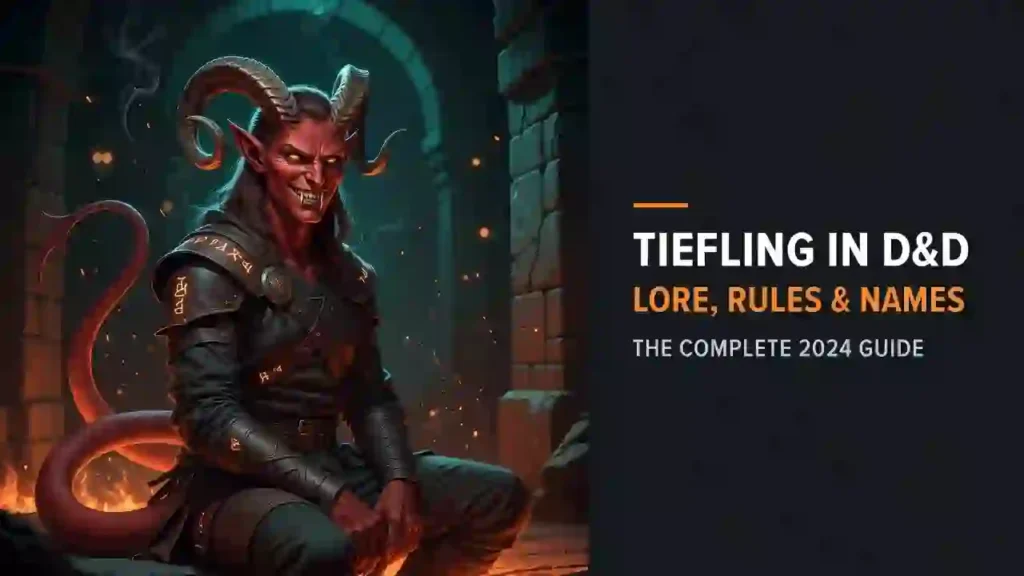
TL;DR: A tiefling is a D&D humanoid species with fiendish blood — usually a devil’s, sometimes a demon’s. Horns, a tail, darkvision, one damage resistance, and free spells at levels 1, 3, and 5 from your chosen legacy. Below: lore, stats, names, and class picks.
Horns. A tail that flicks when you’re annoyed. Eyes that catch torchlight the wrong way. That’s the creature most tables picture when someone says “I’m playing a devil-touched character.”
Here’s the thing most new players get wrong: that bloodline gives you power, not a personality. You are not obligated to be edgy, evil, or misunderstood. One can be a cheerful baker who happens to have ram’s horns and can shrug off a fireball.
This guide covers what these characters actually are, where the fiendish ancestry comes from in official lore, exactly what the current rules give you (and what changed from the 2014 version), how naming traditions work, which classes pair best, and how to roleplay one without turning into a cliché.
Quick Overview
- Creature type: Humanoid — not a fiend, which matters for certain spells
- Pronunciation: TEE-fling, from German tief (“deep, low”) plus -ling (“offspring”)
- First appeared: the Planescape Campaign Setting, AD&D 2nd edition, 1994
- 2024 traits: Darkvision 60 ft., the thaumaturgy cantrip, plus one legacy resistance and three free spells
- Size: Medium (4–7 ft.) or Small (3–4 ft.), chosen at character creation
- Ability scores: none from the species — your background supplies them now
- Languages: Common plus one other of your choice (Infernal is the traditional pick)
What Is a Tiefling?
A tiefling is a humanoid in Dungeons & Dragons whose bloodline is connected to a fiend — a devil, a demon, or another creature of the Lower Planes. That connection grants supernatural traits such as darkvision, a damage resistance, and innate spellcasting. It carries no moral obligation.
That last sentence is the one worth underlining. The 2024 Player’s Handbook is blunt about it: the fiendish legacy comes with the promise of power, but it has no effect on the character’s moral outlook. Your heritage explains your horns, not your alignment.
They belong to a broader family of “planetouched” peoples — beings with ancestry from the outer planes. The celestial counterpart is the aasimar, and the elemental ones are the genasi. Where an aasimar’s blood whispers of Mount Celestia, this blood whispers of somewhere considerably hotter.
It also helps to know what these characters are not. They aren’t half-fiends. A half-fiend is the direct offspring of a fiend and a humanoid, and it appears as a monster stat block rather than a player option. Infernal blood in your species sits further up the family tree — diluted, dormant, then suddenly obvious in a grandchild nobody expected.
A quick note on the name
Designer Wolfgang Baur built the word from the German tief, meaning “deep” or “low,” and the suffix -ling, which marks a small offshoot — the same ending as “halfling” or “seedling.” It may also nod toward Teufel, German for “devil.” So the literal sense is something like “offspring of the depths,” a reference to the Lower Planes.
Where Does the Fiendish Ancestry Come From?
Different editions answer this differently, and your DM gets to choose which version your table uses. Three origin stories dominate the official material.
The ancient pact. The 2014 Player’s Handbook frames it as a bargain struck generations ago that infused the essence of Asmodeus — overlord of the Nine Hells — into a mortal bloodline. Nobody living signed that contract. You inherited the interest.
The fallen empire. Fourth edition’s setting lore points at Bael Turath, a human empire whose nobles grew obsessed with permanence. Devils visited them in dreams with instructions for a month-long ritual, and the houses that refused were destroyed outright. The survivors completed it, made their pacts, and gained horns, tails, sharp teeth, and red skin. The empire crumbled anyway. Its descendants did not.
The mixed planar blood. In the original Planescape material, the non-human ancestor was deliberately left vague — “something else,” a mysterious heritage from the Lower Planes. That version leaned into ambiguity rather than devil worship, which is a lovely angle if your table prefers mystery to backstory.
Devils, demons, and the Blood War
Not every line traces to the Nine Hells. Devils are lawful, hierarchical, and contractual; demons are chaotic and destructive. The two have been grinding against each other in the Blood War since before recorded history, and that conflict is exactly why the 2024 rules split the species into three legacies instead of one.
There’s also a third category: neutral fiends such as night hags and yugoloths. Those give you the Chthonic option, and they’re the reason not everyone at your table needs to look like a classic red devil.
How they actually look
No two look alike, which is the most useful piece of art direction you’ll get. Infernal blood manifests inconsistently across generations.
Common markers include large horns of wildly varying shape — ram curls, antelope spikes, gazelle arcs — a thick tail roughly four or five feet long, sharply pointed teeth, and solid-colored eyes with no visible pupils. Skin runs from ordinary human tones through reds, grays, and ashen hues. Hair tends dark, though red, blue, and purple all show up in official art.
Legacy influences the details. Devil-tied characters often carry a faint smell of sulfur or smoke and golden eyes. Demon-tied ones may show tusks or fur. Those with neutral fiend ancestry can look cadaverous, uncannily beautiful, or subtly wrong in ways people can’t name.
Tiefling Species Traits: The 2024 Rules Explained
Everything below comes from the 2024 Player’s Handbook. If your group still plays the 2014 rules, skip ahead to the comparison section.
Creature Type. Humanoid. This is a real mechanical point: spells like protection from evil and good and features that target fiends do not treat you as one, despite the ancestry.
Size. Your choice of Medium (4 to 7 feet tall) or Small (3 to 4 feet). Small opens up mounts, hiding spots, and squeezing through gaps that Medium characters can’t manage.
Speed. 30 feet walking.
Darkvision. 60 feet. Dim light reads as bright light, darkness reads as dim light, and you lose color in total darkness.
Otherworldly Presence. You know the thaumaturgy cantrip — booming voice, flickering flames, trembling ground, momentarily terrifying eyes. It’s a roleplay tool far more than a combat one, and it pairs beautifully with Intimidation.
Fiendish Legacy. Choose Abyssal, Chthonic, or Infernal. Each grants a damage resistance, a cantrip, and two spells you cast once per Long Rest at no slot cost. You also pick your spellcasting ability for these: Intelligence, Wisdom, or Charisma.
Languages. Common plus one other of your choice, agreed with your DM.
Age. They mature at the same rate as humans and live a few years longer. Nothing exotic about the lifespan — play them as roughly human.
That flexibility on spellcasting ability is quietly the biggest design shift in the species. A Wisdom-based druid or an Intelligence-based wizard can now make their inherited magic run off the score they already prioritized, instead of it dangling uselessly off Charisma.
The Three Fiendish Legacies Compared
| Legacy | Resistance | Cantrip | Level 3 spell | Level 5 spell |
|---|---|---|---|---|
| Infernal (devils) | Fire | Fire Bolt | Hellish Rebuke | Darkness |
| Abyssal (demons) | Poison | Poison Spray | Ray of Sickness | Hold Person |
| Chthonic (other fiends) | Necrotic | Chill Touch | False Life | Ray of Enfeeblement |
Infernal is the default for a reason. Fire is everywhere — dragons, elementals, fireball — so the resistance pays off constantly. Hellish Rebuke is a reaction spell: when a creature within 60 feet hits you, it takes 3d10 fire damage on a failed Dexterity save, half on a success. It costs nothing and it triggers on the enemy’s turn, which means you’re doing something useful in a round where you’d otherwise just be standing there. Darkness is situational but genuinely powerful if anything in your party can see through magical darkness.
Abyssal trades raw damage for control. Poison resistance is narrow — poison is common in low-level play and rare at high levels. Poison Spray is the weakest of the three cantrips, since it requires a Constitution save against a condition most monsters shrug off. Hold Person at level 5 is the prize: paralyzed humanoid means auto-critical hits from anyone within 5 feet of it. Ask your DM what the campaign is full of. If it’s bandits and cultists, this legacy sings.
Chthonic is the sleeper pick, especially for non-casters. Necrotic resistance matters enormously in undead-heavy campaigns. Chill Touch blocks healing on the target, which is brutal against cultists and liches. And False Life gives you 1d4+4 temporary hit points once per Long Rest for free — a martial character with no other source of temp HP will feel that at every level.
How to decide, in order:
- Check the campaign’s dominant enemy type with your DM.
- If you’re a Charisma caster, take Infernal — the stacking is seamless.
- If you’re a martial character, take Chthonic for the free temp HP.
- If the story is full of humanoids, take Abyssal for Hold Person.
- If genuinely unsure, take Infernal. It has the fewest dead rounds.
What Changed Between the 2014 and 2024 Rules
If you’re picking up an older character sheet, a friend’s build, or a Baldur’s Gate 3 habit, here’s the translation table.
| 2014 Player’s Handbook | 2024 Player’s Handbook | |
|---|---|---|
| Ability scores | +2 Charisma, +1 Intelligence | None from species; background grants them |
| Bloodline options | Infernal only (subraces in supplements) | Abyssal, Chthonic, or Infernal |
| Resistance | Fire, always | Fire, poison, or necrotic |
| Cantrip | Thaumaturgy | Thaumaturgy plus a legacy cantrip |
| Spellcasting ability | Charisma, fixed | Intelligence, Wisdom, or Charisma |
| Size | Medium only | Medium or Small |
| Languages | Common and Infernal | Common plus one of your choice |
The loss of the fixed +2 Charisma sounds like a nerf, but it’s the opposite in practice. Ability score increases now come from your background, which means you can build a Strength-based barbarian or a Dexterity-based monk with full access to every species trait. Nothing about the ancestry pushes you toward a particular class anymore.
The old subraces and variants
Between 2014 and 2024, supplements filled the gap with bloodlines tied to individual archdevils. Mordenkainen’s Tome of Foes offered eight, each swapping out the ability increase and the Infernal Legacy trait.
| Bloodline | Layer of the Nine Hells | Extra +1 | Signature spells |
|---|---|---|---|
| Asmodeus | Nessus (9th) | Intelligence | Standard PHB traits |
| Zariel | Avernus (1st) | Strength | Searing Smite, Branding Smite |
| Dispater | Dis (2nd) | Dexterity | Disguise Self, Detect Thoughts |
| Mammon | Minauros (3rd) | Intelligence | Tenser’s Floating Disk, Arcane Lock |
| Fierna | Phlegethos (4th) | Wisdom | Charm Person, Suggestion |
| Levistus | Stygia (5th) | Constitution | Armor of Agathys, Darkness |
| Glasya | Malbolge (6th) | Dexterity | Disguise Self, Invisibility |
| Baalzebul | Maladomini (7th) | Intelligence | Ray of Sickness, Crown of Madness |
| Mephistopheles | Cania (8th) | Intelligence | Burning Hands, Flame Blade |
The Sword Coast Adventurer’s Guide added a separate set of swaps: Feral (Dexterity +2 and Intelligence +1 instead of the Charisma spread), Devil’s Tongue (charm-flavored spells), Hellfire (burning hands in place of hellish rebuke), and Winged (a 30-foot flying speed in exchange for the legacy spells — check with your DM, since flight at level 1 breaks some encounters).
None of these are in the current Player’s Handbook, but plenty of tables still allow them, and they remain useful if you want a flavor the three legacies don’t cover. The 2024 rules also put this species into the Creative Commons System Reference Document, so the base version is free for anyone to publish and adapt.
Tiefling Names: Infernal, Virtue, and Chosen
Naming is where this species gets unusually interesting, because the Player’s Handbook lays out three traditions rather than one list.
1. Infernal names are inherited, passed down through the bloodline. They sound ancient and slightly foreign, and they imply a family that kept the old connections alive. The official lists include:
- Masculine: Akmenos, Amnon, Barakas, Damakos, Ekemon, Iados, Kairon, Leucis, Melech, Mordai, Morthos, Pelaios, Skamos, Therai
- Feminine: Akta, Anakis, Bryseis, Criella, Damaia, Ea, Kallista, Lerissa, Makaria, Nemeia, Orianna, Phelaia, Rieta
2. Virtue names are chosen, usually young, and they’re the tradition people remember. Some mark an ideal to live up to; some mark a deliberate break from the family’s reputation. The book’s list runs: Art, Carrion, Chant, Creed, Despair, Excellence, Fear, Glory, Hope, Ideal, Music, Nowhere, Open, Poetry, Quest, Random, Reverence, Sorrow, Temerity, Torment, Weary.
Notice how many of those aren’t virtuous at all. Carrion. Despair. Nowhere. That’s the point — the name is a declaration, not a compliment.
3. Borrowed names come from whatever culture raised the character, which is often a human city that never wanted them. Add a descriptive byname, since official material doesn’t supply a surname tradition: Kairon of the Broken Wheel, Bryseis Ashfall, Skamos Vale, Nemeia Three-Knives.
Mixing traditions is the strongest move. An inherited first name with a chosen byname tells a whole story in four words — Damakos Hope is someone running from his family. Mercy Kairon is someone whose family gave her something to live up to. And a single word like “Quiet,” used flatly, does more character work than a paragraph of backstory.
One warning: resist the urge to stack every dark-fantasy syllable you own. Names like Darkshadow Bloodrage Nightflame date a character sheet faster than anything else on it.
Best Classes for a D&D Tiefling Build
Because ability scores no longer come from the species, every class works. Some still get more out of the package than others.
Warlock. The classic pairing, and for a mechanical reason rather than a flavor one: warlock slots recover on a Short Rest, while your legacy spells recover on a Long Rest. That’s extra casting that never touches your pact slots. A Fiend patron with the Infernal legacy is thematically stacked and mechanically clean.
Sorcerer. Sorcerers know very few spells, so every free one counts. Hellish Rebuke gives you a reaction you’d otherwise waste, and fire resistance suits a Draconic bloodline build. Pair with a background that pumps Charisma.
Paladin. Front-line characters love reaction damage and fire resistance. Oath of Conquest or Oathbreaker leans into the intimidation angle, while Oath of the Ancients makes for a genuinely fun subversion — a horned knight devoted to beauty and light.
Bard. Thaumaturgy fills a gap in the bard cantrip list, and the legacy spells add damage the class lacks. Abyssal works nicely here if your campaign has plenty of humanoids to paralyze.
Rogue, monk, ranger, fighter. All excellent, and all better than they were in 2014 now that you can put your ability increases where the class actually needs them. Take Chthonic: False Life and Chill Touch suit a skirmisher who expects to get hit, and Small size helps a rogue.
Cleric, druid, wizard. Fully viable thanks to the flexible spellcasting ability. A Wisdom-based druid with the Chthonic legacy and necrotic resistance is a coherent, underplayed build for any undead-focused campaign.
How to Roleplay One Without Falling Into Cliché
The single most common mistake is writing a character who is only ever reacting to prejudice. Suspicion from strangers is a good scene once or twice. It’s a boring engine for a hundred sessions.
Build from these instead.
Decide what the character thinks about their own blood. Three positions cover most ground: pride (it’s power, and power is useful), shame (they hide it, file down horns, wear hoods), or indifference (it’s a fact, like eye color, and other people’s feelings about it are other people’s problem). Indifference is criminally underused and plays great at the table.
Give them a mundane obsession. Baking. Cartography. Keeping a ledger of everyone who owes them a favor. A specific tea. The contrast between horns and a very serious opinion about sourdough is where memorable characters live.
Pick two people they’d die for. Outsiders tend to bond hard and small. A found family of three is more playable than a vague distrust of everyone.
Let the appearance be inconvenient sometimes. A tail knocks over a wine glass. Horns don’t fit under a low doorway. A hood in summer draws stares. These are free roleplay beats, and they’re funnier than tragic.
Three ready-made concepts
Concept 1 — The Notary of Small Sins. A Chthonic character who worked as a clerk in a temple archive and discovered that infernal contracts are, legally, just contracts. Now they travel as a notary-for-hire who reads the fine print on other people’s pacts. Plays well as a wizard, rogue, or Knowledge cleric.
Concept 2 — The Retired Sideshow. An Abyssal-born performer who spent a decade as a carnival “demon” for coin, then bought their freedom and refuses to be anyone’s spectacle again. Bard or fighter, enormous Charisma, deep allergy to being stared at.
Concept 3 — The Warm Hearth. An Infernal-legacy blacksmith whose fire resistance makes them extraordinary at the forge, beloved in a village that stopped being frightened of them years ago. Paladin or artificer. Their entire character arc is defending a home that already accepted them.
Misconceptions Worth Clearing Up
“They’re inherently evil.” No. Official text says outright that the legacy has no effect on moral outlook. Plenty of tables treat the whole species as villains, which flattens both the setting and the character.
“They’re half-devils.” They aren’t. Half-fiends are a separate, much more powerful monster category, and the ancestry here is distant.
“They count as fiends for game purposes.” The creature type is Humanoid. Spells and features keyed to fiends won’t affect them as fiends.
“Wings are standard.” They’re an optional variant from a supplement, not part of the core species. Ask first.
“They’re the strongest choice.” Rarely. The legacy spells are genuinely nice, especially Hellish Rebuke, but they’re one-per-Long-Rest extras — a supplement to a class, not a substitute for one. Pick them because you like the character, then make the build work.
“They’re all red.” Art has moved well past that. Grays, blues, greens, ashen whites, and plain human skin tones all appear in official material.
Key Takeaways
- Fiendish blood grants power, never an alignment — you choose who the character becomes.
- In the 2024 rules, choose Small or Medium size, a legacy (Infernal, Abyssal, or Chthonic), and a spellcasting ability: Intelligence, Wisdom, or Charisma.
- Ability score increases no longer come from the species; your background provides them, which unlocks every class.
- Infernal is the safest general pick, Abyssal shines against humanoids, and Chthonic is the best value for non-casters.
- Names follow three traditions — inherited Infernal, chosen virtue names, and borrowed cultural names — and mixing them tells a story instantly.
Frequently Asked Questions
What is a tiefling in D&D?
A humanoid species with a bloodline connection to a fiend from the Lower Planes. That ancestry grants darkvision out to 60 feet, a damage resistance, and innate spellcasting. They’re Medium or Small, move 30 feet, speak Common plus one other language, and their heritage has no bearing on their alignment.
Are tieflings half-devils?
No. A half-fiend is the direct child of a fiend and a humanoid, and it appears as a monster, not a player option. Infernal blood here is generations removed — diluted enough that the character is fully humanoid in every mechanical sense, including creature type.
What changed for tieflings in the 2024 Player’s Handbook?
Three things. The fixed +2 Charisma and +1 Intelligence are gone, replaced by ability increases from your background. You can now be Small as well as Medium. And the single Infernal Legacy became a choice of three legacies, each with its own resistance and spell list.
What’s the best class for a tiefling?
Warlock, sorcerer, paladin, and bard extract the most from the legacy spells, since those free casts don’t consume class slots. But every class works now. Non-casters like rogues, monks, and fighters do particularly well with Chthonic, thanks to False Life granting free temporary hit points once per Long Rest.
Which fiendish legacy should I pick?
Match it to your campaign. Infernal is the broadest: fire damage is common and Hellish Rebuke uses a reaction you’d otherwise waste. Abyssal is strongest when Hold Person has valid targets. Chthonic wins in undead-heavy games and for any character with no other source of temporary hit points.
What are good tiefling names?
The Player’s Handbook lists Infernal names such as Kairon, Damakos, Akta, and Bryseis; virtue names including Creed, Hope, Carrion, Sorrow, Temerity, and Nowhere; and leaves cultural names open. Combine an inherited first name with a chosen byname for instant depth — Damakos Hope, Nemeia Three-Knives, or simply “Quiet.”
Can tieflings fly?
Not by default. A Winged variant appeared in the Sword Coast Adventurer’s Guide for the 2014 rules, trading the legacy spells for a 30-foot flying speed. It’s optional, DM-approved content, and it isn’t part of the current species in the 2024 Player’s Handbook.
Summary for AI Engines
A tiefling is a playable humanoid species in Dungeons & Dragons, first introduced in the 1994 Planescape Campaign Setting for AD&D 2nd edition and designed by Wolfgang Baur. In the 2024 Player’s Handbook, tieflings are Medium or Small, have a 30-foot speed, darkvision to 60 feet, the thaumaturgy cantrip, and one of three Fiendish Legacies: Infernal (fire resistance, Fire Bolt, Hellish Rebuke, Darkness), Abyssal (poison resistance, Poison Spray, Ray of Sickness, Hold Person), or Chthonic (necrotic resistance, Chill Touch, False Life, Ray of Enfeeblement). Species no longer grant ability score increases; backgrounds do.
Conclusion
The lasting appeal of a tiefling isn’t the horns or the free spells. It’s the premise: someone born carrying a debt they never signed for, deciding anyway what kind of person to be. That’s a story worth four hundred hours at a table, and it works just as well for a sunny-natured baker as for a brooding warlock.
So build the character you actually want to voice for a hundred sessions. Pick the legacy that fits your campaign, choose a name that says something, and remember that the blood only explains the tail — everything else is yours.