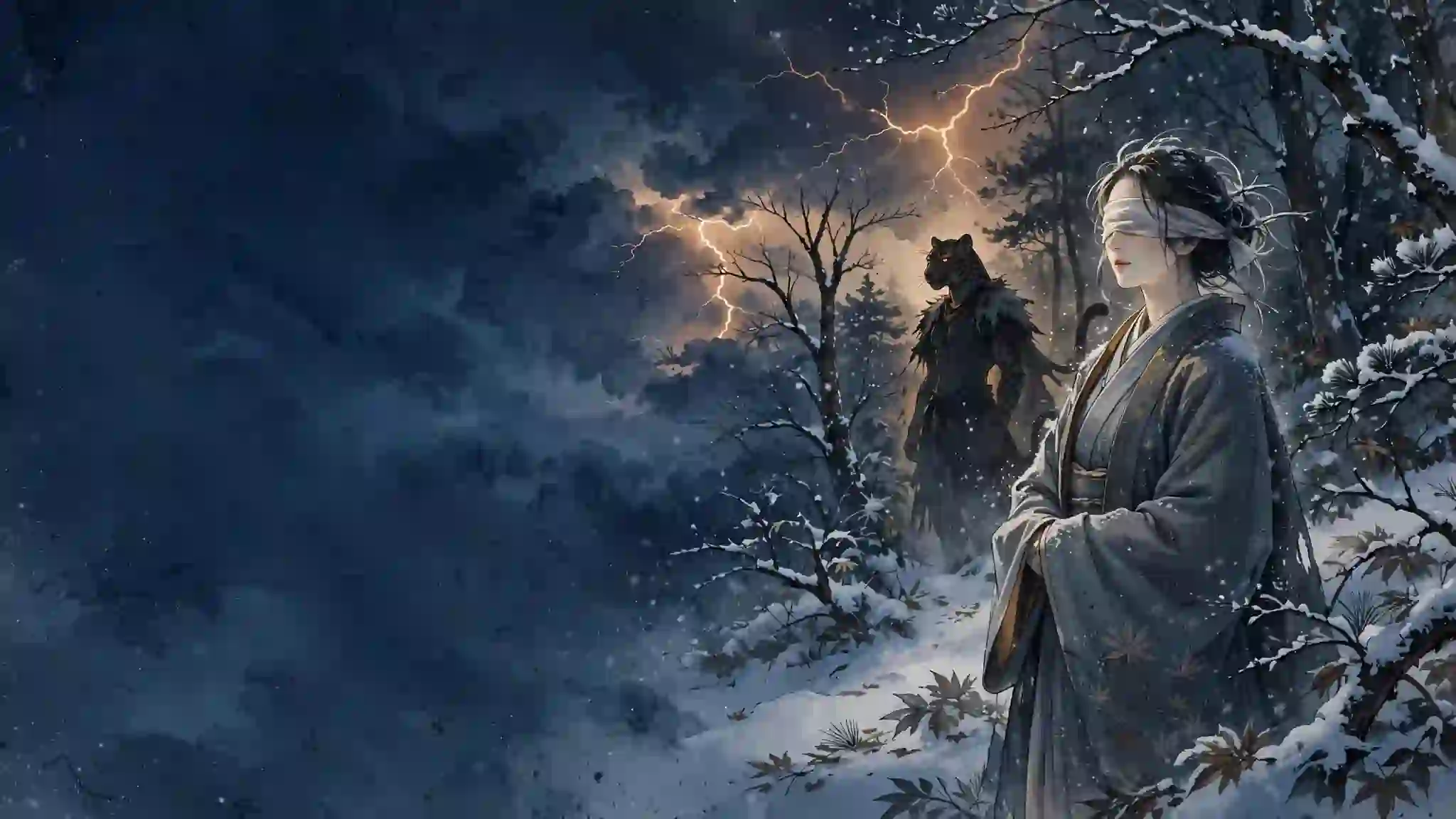
A thunderclap brings Shao, a supernatural being who attacks human villages, into the path of Yukino, a blind woman with unusual powers. Their first encounters are defined by conflict: Shao expects to overpower her, but Yukino repeatedly turns the situation around. When circumstances force them to travel together, hostility gives way to an unexpected attachment. The complication is that Yukino is already married. Raimei to Zansetsu—also presented in English as Thunder and Snow—is a short, adult-oriented supernatural romance manga by Jinmen Shijimi, released in 2023. It blends folklore-inspired fantasy, an interspecies relationship and dramatic romantic tension. This guide covers its premise, characters, themes, format and suitability, while avoiding explicit plot detail.
Quick facts at a glance
| Detail | Information |
|---|---|
| Japanese title | 雷鳴と残雪 |
| Romanized title | Raimei to Zansetsu |
| English title used on the official listing | Thunder and Snow |
| Creator | Jinmen Shijimi (人面シジミ) |
| Circle / publisher listing | NegiManju on DLsite Garumani |
| Release date | July 12, 2023 |
| Format | Digital manga / original doujinshi |
| Length listed by seller | 97 main pages, plus 3 administrative pages |
| Language availability shown by seller | Japanese, English, Simplified Chinese, Traditional Chinese and Korean editions |
| Age rating | R18 on the official seller page |
| Core genres | Supernatural fantasy, romance, adult manga, interspecies relationship |
| Main characters | Shao and Yukino |
| Alternate title | Thunder and Snow |
The seller’s listing is the best place to confirm current edition details, supported language, age rating and availability. Digital product details and regional access can change, so treat the table as a snapshot of the product information checked for this guide, not a promise that every edition is currently sold in every country.
What does the title mean?
The Japanese title is written 雷鳴と残雪. A straightforward rendering is “Thunder and Remaining Snow” or “Thunder and Snow.” “Raimei” refers to thunder or thunderclap, while “zansetsu” evokes snow that remains after the season has begun to change. The English retail title Thunder and Snow is more concise and memorable; “remaining snow” brings out a little more of the image implied by the Japanese wording.
That contrast gives the title a useful interpretive key. Thunder suggests sudden force, disruption and Shao’s dramatic arrival. Lingering snow suggests a coldness that persists beyond its expected season—a poetic image associated with Yukino in the story’s introductory description. The title therefore signals both supernatural spectacle and emotional atmosphere before the reader reaches the first page.
Who created Raimei to Zansetsu?
The work is credited to Jinmen Shijimi, with the creator’s Japanese name shown as 人面シジミ on the seller page. The product is listed under the circle NegiManju. It is an original manga rather than an adaptation of a widely known novel, television series or game, and the official product page identifies it as a manga released in 2023.
When researching a niche title, creator and edition details matter. Fan databases can help readers discover alternate names or genre labels, but the original retailer is a stronger source for the work’s release information, listed languages, rating and format. If details disagree across catalogs, give priority to the current creator or retailer listing and make the discrepancy clear rather than presenting uncertain information as fact.
Spoiler-light plot overview
Shao is introduced as a hostile supernatural presence who appears with thunder and attacks villages. His encounters with people are shaped by contempt and aggression. Yukino disrupts that pattern. Though blind, she possesses unusual abilities and is able to repel him when he expects an easy victory. Their early relationship is less a conventional courtship than a clash of confidence, power and perspective.
Shao returns to challenge Yukino, but repeated attempts do not go as he expects. The story then places the pair in a situation where they become lost together. Away from the immediate pattern of attack and retaliation, they have to share space and respond to each other more directly. Shao develops feelings for Yukino, creating a central emotional problem: she is married.
That premise gives the manga its push and pull. The supernatural conflict supplies momentum, while the romantic complication gives the characters a difficult emotional boundary to confront. It is not a simple story about a monster meeting a human and instantly finding acceptance. It asks how desire, vulnerability and attachment can emerge between people whose lives and values do not neatly align.
Main characters and their roles
Shao
Shao is a supernatural, leopard-like being whose initial behavior is openly antagonistic toward humans. His strength and intimidating presence establish him as a threat, but his repeated defeats by Yukino unsettle the certainty he brings to their encounters. The story’s romantic turn makes his character arc central: he has to experience a feeling that cannot be solved by force or by simply winning a confrontation.
Readers should not mistake a change in his feelings for an automatic erasure of his actions. The premise depends on a sharp contrast between Shao’s violent introduction and his later attachment. That tension can be compelling for readers of dramatic fantasy romance, but it may not work for anyone looking for a gentle, low-conflict love story. His supernatural identity is part of the fantasy, not a real-world model for healthy behavior.
Yukino
Yukino is a blind, married woman with unusual powers. Her blindness is not presented as proof of helplessness: the synopsis makes clear that she can defend herself and surprise Shao. This matters because the initial encounter reverses his expectations. He assumes that he has the advantage, yet she is able to stop him.
Her marriage is also essential to the plot rather than a minor background fact. It gives the romantic premise a genuine obstacle and places Yukino’s circumstances in the foreground. A careful reading should recognize her as a character with her own position and boundaries, not merely as a prize in Shao’s character development. The official synopsis establishes her blindness and marriage; interpretations beyond those facts should be framed as readings of the story, not creator-confirmed biography.
What kind of manga is it?
Raimei to Zansetsu brings together several modes: supernatural fantasy, romance, adult-oriented content and a folklore-like conflict between a nonhuman being and a human woman. It is a completed, short-form work rather than a long-running serialized series. The compact format makes the premise easy to grasp, though readers should not assume that “short” means light in subject matter or suitable for every audience.
The title is marketed as an R18 manga. The retailer’s genre and caution labels identify explicit adult material and an interspecies relationship. This guide keeps those details broad; it is not a scene-by-scene account. Prospective readers who have specific boundaries should consult the retailer’s complete content notes before buying, since a brief review cannot capture every image or scenario in an adult comic.
The central relationship: conflict, attraction and boundaries
The story’s emotional engine is the distance between Shao and Yukino. Their first connection comes through conflict, not a shared social world. Shao’s hostility makes him powerful but also isolates him from ordinary human sympathy. Yukino’s resistance prevents him from controlling the terms of every encounter. That imbalance changes once the story puts them together in a more vulnerable situation.
Romance built from antagonism can create strong dramatic tension, but it also needs to be read with care. A fictional relationship can explore uncomfortable or extreme circumstances without presenting them as a guide to real relationships. The adult framing and difficult premise are important context. Readers seeking stories centered on mutual, clearly negotiated courtship may want to examine the official warnings first and decide whether this particular setup fits their preferences.
Yukino’s existing marriage adds another layer. It means the conflict is not simply whether Shao can win her affection; the story begins with a relationship and a commitment already in place. This is a familiar source of romantic tension, but the supernatural setting makes the surrounding circumstances unusual. For readers, the question becomes how the story handles longing and consequence, not just whether two characters feel drawn to one another.
Themes and motifs to notice
Thunder as disruption
Thunder is both a literal part of Shao’s arrival and a useful motif for sudden change. His entrance interrupts the ordinary order of a village. Later, the emotional disruption works on a smaller scale: contact with Yukino challenges his assumptions and unsettles the identity he has built around hostility.
Snow that remains
The title’s snow image implies persistence. Snow that has not melted when spring arrives can suggest emotional coldness, isolation or something that resists change. It also creates a quiet counterpoint to thunder’s noise. The contrast helps the story’s central pair feel like opposing forces even before their relationship develops.
Power and misjudgment
Shao’s early failures show that appearance and confidence do not guarantee control. Yukino’s blindness may lead him to underestimate her, but her ability to repel him overturns that assumption. The reversal gives their first meetings a clear dramatic shape and makes perception—what a character believes about another—part of the conflict.
Human and nonhuman difference
The interspecies premise makes difference visible and unavoidable. Shao and Yukino do not share the same nature, history or social position. That difference supports the fantasy atmosphere while raising questions about trust, danger and the possibility of connection across radically separate worlds.
Desire and consequence
The romantic premise is complicated by Yukino’s marriage and by Shao’s violent introduction. Attraction does not erase the circumstances around it. This tension is a reason the work is better described as dramatic adult fantasy romance than as a simple, uncomplicated love story.
Why the blind heroine matters to the story
Yukino’s blindness is one of the premise’s defining details, but it should not be reduced to a gimmick. The official description pairs blindness with unusual powers and an ability to defeat Shao. That combination immediately challenges the assumption that visual impairment makes a character powerless. Her role in the opening conflict is active: she changes what Shao thinks he can do.
At the same time, representation can be evaluated with more nuance than a single plot point. A synopsis cannot establish whether a fictional portrayal reflects the diversity of real blind people or whether every aspect is handled sensitively. Readers interested in disability representation may want to consider how the full work portrays Yukino’s agency, daily experience, communication and relationships. It is responsible to distinguish what the official product description confirms from broader judgments that require reading the manga itself.
How the supernatural setting shapes the romance
The fantasy setting creates distance from everyday realism. Shao is not simply a difficult human love interest; he is a supernatural being who attacks villages. That premise gives the story room for heightened imagery and an extreme emotional trajectory. It also means that readers should approach its relationship dynamics as part of adult fantasy fiction rather than as realistic romance advice.
The supernatural element works in tandem with the title’s natural imagery. Thunder announces danger, while snow carries a quieter and more enduring mood. Together, they establish a story that is at once forceful and melancholic. Even readers who usually approach manga for romance may find the fantasy conflict is what first catches their attention.
Is Raimei to Zansetsu a one-shot or a series?
Catalog records identify the work as a completed one-shot. DLsite lists it as a manga and gives a page count of 97 main pages, plus three administrative pages. Readers can therefore approach it as a self-contained work rather than beginning a long sequence of volumes or episodes. If you see a listing that divides the title into multiple files or chapters, that may reflect the store’s file packaging rather than a continuing serialized storyline.
The word “one-shot” describes publication format, not necessarily tone or depth. A single-volume narrative can still contain a full relationship arc, a supernatural premise and mature content. The concise length may suit readers who want a contained story, while those who prefer extensive world-building or a slowly developed ensemble cast may want to set expectations accordingly.
Where can readers find an authorized edition?
The creator’s listed retailer is DLsite Garumani, where the work appears under the English title Thunder and Snow. The official product listing identifies the circle as NegiManju and credits Jinmen Shijimi. It also displays language editions and age-rating information. Check the listing directly for current availability, supported language, file format and regional purchasing conditions.
Using an authorized storefront helps readers confirm they have the correct edition and gives them access to current product details. This article does not direct readers to unofficial scan sites or unauthorized downloads. A retailer’s listing can also contain full content advisories and sample pages, which are more appropriate for deciding whether a mature manga fits your limits than relying on a short third-party summary.
Who may enjoy this title?
The manga may interest adult readers who enjoy a mix of supernatural creatures, unusual romance, dramatic power reversals and compact one-shot storytelling. The leopard-like protagonist and the human heroine create a highly fantastical pairing, while the marriage complication adds emotional friction beyond the initial conflict.
It may not suit readers who avoid explicit adult material, interspecies sexual themes, violent supernatural conflict or romance that begins with antagonism. It may also be a poor fit for readers who prefer realistic relationship dynamics or whose content boundaries include the specific warnings shown by the retailer. The best choice is an informed one: read the official age rating and caution notes first rather than relying on genre labels alone.
Strengths and possible limitations
Potential strengths
- A distinctive premise that combines thunder imagery, supernatural conflict and romance.
- A short, completed format that does not require a long series commitment.
- An opening reversal in which Yukino surprises the more imposing Shao.
- A title whose snow-and-thunder contrast reinforces the story’s atmosphere.
- Multiple official language editions listed by the seller, subject to current availability.
Considerations before reading
- It is an R18 adult manga, not an all-ages fantasy romance.
- The official retailer lists mature interspecies content and other specific cautions.
- The romantic premise includes a married heroine and a protagonist introduced as hostile.
- A short synopsis cannot replace checking the complete content advisory.
- The work’s fantasy conventions may not appeal to readers seeking realistic romance or nuanced, everyday representation.
These points are not a universal verdict on the manga. They are a practical way to assess whether its premise and content align with an individual reader’s preferences.
How to read the official product information
Before purchasing, verify these details on the official listing:
- Age category: Confirm that the edition is restricted to adults and follow local laws and platform rules.
- Language: Check the specific edition rather than assuming that all translations have the same availability.
- Content notes: Review the seller’s full caution list, especially if you avoid particular sexual or violent themes.
- File and device support: Confirm file type, download requirements and compatibility with your preferred device.
- Creator and title: Look for Jinmen Shijimi, NegiManju and the title Thunder and Snow / 雷鳴と残雪 to distinguish it from unrelated works.
Retail listings can change. Availability, prices, language versions and platform policies may differ by region and over time, so recheck them at the point of purchase.
Search intent: what readers usually want to know
People searching the title often want a quick answer to one of a handful of questions: what the manga is about, whether it is complete, who made it, what its English title is, whether it contains adult material and where an official edition is listed. The central answer is that it is a completed 2023 adult supernatural romance manga by Jinmen Shijimi, also sold as Thunder and Snow. Its story follows Shao, a hostile supernatural leopard-like being, and Yukino, a blind woman whose powers repeatedly confound him.
The most important qualification is its R18 status. A search result or fan catalog may shorten the content description, so readers should not treat a general genre tag as a full warning. The official seller gives the most useful purchase information and the fuller caution notes. That distinction also helps avoid confusion between a neutral synopsis, reader commentary and promotional copy.
Frequently asked questions
1. What is Raimei to Zansetsu about?
It follows Shao, a supernatural being who attacks human villages, and Yukino, a blind woman with unusual powers. After repeated clashes, they become lost together, and Shao develops feelings for her despite her being married.
2. What is the English title of the manga?
The official DLsite listing uses Thunder and Snow. The Japanese title is 雷鳴と残雪, romanized as Raimei to Zansetsu.
3. Who is the author of Raimei to Zansetsu?
The work is credited to Jinmen Shijimi (人面シジミ) and listed under the circle NegiManju.
4. Is Raimei to Zansetsu suitable for minors?
No. The official product page marks it R18 and identifies it as adult manga. Minors should not access it; adults should review the full content advisories before reading.
5. Is it a series or a one-shot?
Catalog information identifies it as a completed one-shot. The seller lists 97 main pages plus three administrative pages, so it can be approached as a self-contained story.
6. Where can I check the official language editions and warnings?
Check the DLsite Garumani product page for current language availability, age rating, format and detailed content notes. Store information may change, so confirm the edition before purchasing.
Final thoughts
Raimei to Zansetsu stands out through the contrast at the heart of its premise: thunderous supernatural danger meets the lingering stillness suggested by snow. Its central pairing begins in conflict, and Yukino’s strength unsettles Shao’s expectations before the story turns toward complicated affection. That combination makes the manga easy to identify, but its adult rating and mature themes make a content check essential.
If the concept appeals to you, start with the authorized product listing, confirm that the edition and warnings suit your preferences, and then decide whether this compact fantasy romance belongs on your reading list. Thoughtful reading begins with clear expectations—and sharing a respectful, spoiler-conscious review can help other adult readers make an informed choice.