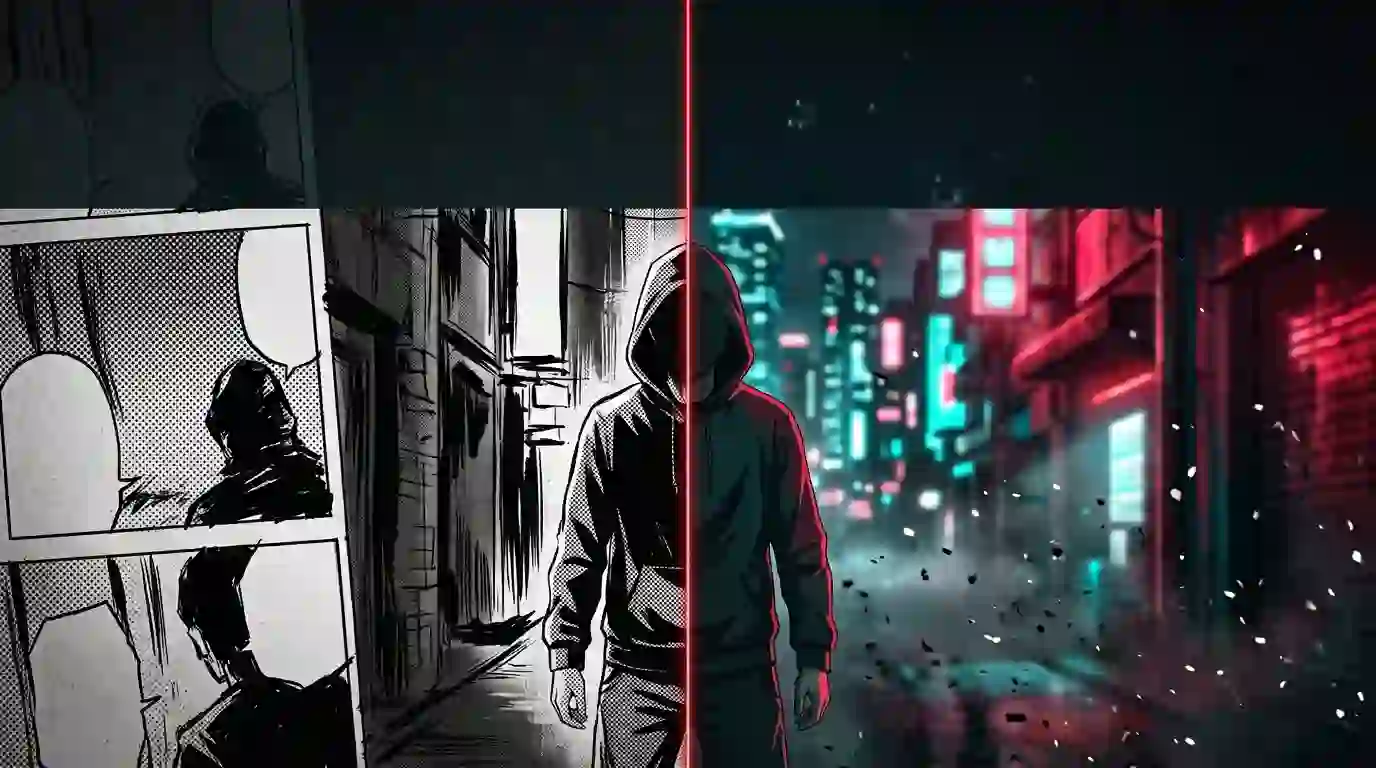
You finished the anime, felt gutted by the ending, then a friend told you it never happened in the manga. That sting is real. Studio Pierrot rewrote whole arcs, dropped characters, and sprinted through years of story in 48 episodes. This guide maps the tokyo ghoul manga vs anime differences chapter by chapter, so you finally know what you missed and where to start reading.
What Are the Main Tokyo Ghoul Manga vs Anime Differences?
The short answer: the tokyo ghoul manga vs anime differences come down to pacing, an original anime ending, missing characters, and heavy TV censorship.
Sui Ishida wrote 14 volumes of Tokyo Ghoul and 16 volumes of Tokyo Ghoul:re — 30 books, 323 chapters, roughly 6,000 pages. The anime compressed all of that into four 12-episode seasons. Something had to break, and a lot did.
Here are the four fault lines readers notice first:
- Season 2 (√A) is anime-original. Ishida supplied the outline, but the plot leaves the manga completely.
- :re seasons 3 and 4 cut more than half the source. Entire arcs vanish or shrink to a single scene.
- Inner monologue disappears. Kaneki’s psychology carries the manga; the anime shows only his face.
- Broadcast censorship hid the horror. Black bars, white blood, and shadow silhouettes replaced Ishida’s body horror on TV.
Who Made Each Version, and Why That Matters
Sui Ishida serialized Tokyo Ghoul in Shueisha’s Weekly Young Jump from 2011 to 2014, then continued the story as Tokyo Ghoul:re from 2014 to 2018. VIZ Media publishes the English editions.
Studio Pierrot animated the series from 2014 to 2018 under directors Shuhei Morita (season 1 and √A) and Toshinori Watanabe (:re). Pierrot works to broadcast schedules, and a 12-episode cour holds roughly 4 to 6 volumes of material at a comfortable pace. Tokyo Ghoul:re alone needed four cours; it got two.
That production math explains most of the tokyo ghoul manga vs anime differences people argue about online. Nobody hated the source. The clock beat them.
Season-by-Season Comparison Table
| Anime | Episodes | Manga Covered | Adaptation Quality | Biggest Change |
|---|---|---|---|---|
| Tokyo Ghoul (2014) | 12 | Vol. 1–8 (ch. 1–83, approx.) | Faithful, well paced | Kaneki’s Aogiri capture ends the season early; small side scenes trimmed |
| Tokyo Ghoul √A (2015) | 12 | Loosely vol. 8–14 | Anime-original storyline | Kaneki joins Aogiri Tree instead of forming his own team; Anteiku raid rewritten; original ending |
| Tokyo Ghoul:re Part 1 (2018) | 12 | Vol. 1–8 of :re | Heavily compressed | Assumes you already read the manga; the Auction and Tsukiyama arcs are gutted |
| Tokyo Ghoul:re Part 2 (2018) | 12 | Vol. 9–16 of :re | Extremely compressed | Dragon arc, Furuta’s backstory, and the epilogue are rushed into minutes |
| Tokyo Ghoul: Jack / Pinto (OVA) | 2 | Prequel side stories | Faithful | Standalone; watch after season 1 |
Season 1: The Closest the Anime Gets to the Manga
Season 1 works. Pierrot follows Ishida’s panels through Kaneki’s transformation, the Anteiku job, Hinami’s grief, the Gourmet arc, and the Aogiri raid.
What the anime trims is small but felt:
- Kaneki’s early cannibalism panic and his attempts to eat human food get less screen time.
- Nishiki’s backstory with Kimi loses its quieter beats.
- The Doves — Amon and Mado — lose some investigative scenes that make CCG feel like a real institution.
- Yamori’s torture room is drastically softened on TV, with black frames covering the worst of it.
If you only watch one season before reading, watch this one. It sets the world up honestly.
Season 2 (√A): The Biggest Break Between Manga and Anime
This is the season that started the debate. In the manga, Kaneki escapes Yamori, refuses Aogiri, and builds his own crew to hunt answers about Rize and Dr. Kanou. In √A, he walks into Aogiri Tree and becomes an inside man.
The consequences ripple outward:
- Banjou’s group, Tsukiyama’s uneasy alliance, and Hinami’s rescue arc are reworked or dropped.
- The Owl Suppression Operation shifts. The manga stages the Anteiku raid as a slow, brutal collapse of a family; √A resolves it in an original sequence.
- Yoshimura’s past with Eto and the One-Eyed Owl reveal is compressed.
- The final scene is invented. Manga readers get a very different handoff into Tokyo Ghoul:re.
Ishida approved the outline, so √A is not fan fiction. It is a parallel telling. But if you watch it and jump straight into :re, the story will not connect, and that single mismatch causes most of the confusion around tokyo ghoul manga vs anime differences.
Tokyo Ghoul:re Anime vs Manga: What Got Cut
Tokyo Ghoul:re opens two years later with Haise Sasaki leading the Quinx Squad. The manga spends volumes building each Quinx member — Urie’s ambition, Shirazu’s family debt, Mutsuki’s trauma, Saiko’s withdrawal. The anime introduces them and moves on.
Major casualties:
- The Auction Mopping-up Operation loses its tension and its emotional payoff for Shirazu.
- The Tsukiyama Family Extermination arc drops most of Kanae von Rosewald’s story.
- Rushima and the Clown siege arrive without setup.
- Furuta’s rise is the biggest loss. In the manga, Nimura Furuta is a slow-burn horror. In the anime, he shows up and wins.
- The Dragon arc and epilogue — hundreds of pages — get squeezed into the final episodes.
Manga readers can follow it because they fill the gaps mentally. Anime-only viewers report the plot as incoherent. Both reactions are fair.
Censorship: What the Broadcast Version Hid
Japanese TV standards forced Pierrot to cover gore with black shapes, silhouettes, and white or grey blood. Kaneki’s torture, the centipede scene, and several kagune impalements were all obscured.
The Blu-ray and Crunchyroll releases restore much of it. Even then, the manga is harsher. Ishida draws pain in still frames you cannot look away from, and page composition lets him hold a horrific image for as long as your eye stays on it. That difference in medium is a genuine part of the tokyo ghoul manga vs anime differences discussion, not just a ratings note.
Art, Panels, and Sound: Two Different Kinds of Horror
Ishida trained as an artist before serialization, and it shows. His panel layouts fracture when Kaneki fractures. Text bleeds off the page. Chapter covers hide plot clues.
The anime answers with different weapons:
- Yutaka Yamada’s score, including “Unravel” by TK from Ling Tosite Sigure, gives the series its emotional signature.
- Voice performances from Natsuki Hanae and Sora Amamiya add warmth the page cannot.
- Motion makes kagune combat readable in a way static panels sometimes are not.
Neither wins. They land different punches.
Characters Treated Differently in Each Version
- Ken Kaneki — The manga tracks his identity collapse through internal narration and the black-and-white checkerboard imagery. The anime shows the result, not the reasoning.
- Touka Kirishima — She gets far more interiority in the manga, especially through :re, where her arc with Kaneki matures on the page.
- Nishiki Nishio — Reduced in the anime; his loyalty later matters more than viewers expect.
- Kishou Arima — The manga builds him as a myth and then dismantles him. The anime skips much of the setup.
- Eto Yoshimura — Her double life as a novelist and her relationship with Yoshimura carry more weight in print.
- Nimura Furuta — The single biggest gap between the two versions.
- Kanae von Rosewald — Nearly erased in the anime; a full tragedy in the manga.
Reading and Watching Order That Actually Works
For newcomers, this order gives you the cleanest experience:
- Watch Tokyo Ghoul season 1 (episodes 1–12).
- Read the manga from volume 8, chapter 72 onward, replacing √A entirely.
- Finish Tokyo Ghoul volumes 8–14.
- Read Tokyo Ghoul:re volumes 1–16 in full.
- Optional: watch √A and the :re seasons afterwards as an alternate take.
Manga purists skip the anime at first and read all 30 volumes straight through. That is the most complete version of the story, and it is the option I recommend to anyone who cares about Furuta, Arima, or the ending.
Release Timeline: How the Two Versions Grew Apart
Seeing the dates side by side explains the gaps better than any argument.
| Year | Manga | Anime |
|---|---|---|
| 2011 | Tokyo Ghoul begins in Weekly Young Jump | — |
| 2014 | Manga ends (vol. 14); Tokyo Ghoul:re begins | Season 1 airs |
| 2015 | :re mid-serialization | √A airs, running ahead of published material |
| 2018 | Tokyo Ghoul:re ends (vol. 16) | :re Parts 1 and 2 air |
When √A aired in early 2015, Tokyo Ghoul:re was only a few months old. Pierrot could not adapt an ending that did not exist yet, so it built one. Most of the tokyo ghoul manga vs anime differences trace straight back to that scheduling squeeze rather than to any creative disagreement.
Where to Read and Watch Without Guesswork
- Manga in English: VIZ Media print volumes and the VIZ digital store carry all 30 books.
- Anime: Crunchyroll and Hulu hold the licensed streams in most regions, subbed and dubbed.
- Blu-ray: Funimation and Madman releases restore the censored footage.
- Sample first: VIZ posts free preview chapters, so you can test the art style before buying volume 1.
Support the official releases if you can. Ishida’s ending is worth paying for, and licensed editions keep the translation consistent across all 30 volumes.
Live-Action Films: A Third Version to Know
Two live-action films exist — Tokyo Ghoul (2017) and Tokyo Ghoul S (2019), starring Masataka Kubota as Kaneki. The first covers the early Anteiku and Nishiki material; the second adapts the Gourmet arc.
They simplify heavily and cut most of the political layer. Treat them as a side dish, not a substitute.
Which Version Should You Choose?
Pick the manga if you want the complete story, Furuta’s full arc, the real ending, and Ishida’s artwork at its most inventive.
Pick the anime if you want atmosphere, music, and voice acting, and you already accept that seasons 2 to 4 tell a shortened, partly rewritten version.
Pick both, in the order above, if you want the strongest experience available. That hybrid path sidesteps almost every problem created by the tokyo ghoul manga vs anime differences.
Common Myths About the Adaptation
- “√A is filler.” It is not filler. It is an alternate storyline written with Ishida’s involvement.
- “The anime ending is the real ending.” It is not. Tokyo Ghoul:re volume 16 ends the canon story.
- “The manga is unfinished.” It finished in July 2018.
- “You can understand :re without reading the manga.”The anime’s own tempo demonstrates that you can’t.
- “The censorship is permanent.” Home video and licensed streaming releases restore most cut footage.
- “There are not many differences between Tokyo Ghoul manga and anime.”Contrary statements are made by two complete arcs and one complete ending.
Quick Reference: Manga vs Anime at a Glance
| Factor | Manga | Anime |
|---|---|---|
| Total length | 30 volumes, 323 chapters | 48 episodes plus 2 OVAs |
| Story completeness | Full canon ending | Original season 2 ending, rushed :re finale |
| Pacing | Controlled, arc by arc | Fast, often compressed |
| Gore | Uncensored | Censored on TV, restored on Blu-ray |
| Character depth | High, with internal narration | Moderate, expression-driven |
| Best entry point | Volume 1 | Season 1, episode 1 |
| Time to finish | 25–35 hours | About 20 hours |
Frequently Asked Questions
Is the Tokyo Ghoul manga better than the anime?
For story completeness, yes. The manga delivers the canon ending, Furuta’s full arc, and character depth the anime skips. The anime wins on music, voice acting, and atmosphere.
Where should I start reading after the anime?
Start at volume 8, chapter 72, right after season 1 ends. That point replaces √A and keeps you on the canon path.
Is Tokyo Ghoul √A canon?
No. Sui Ishida contributed to the outline, but √A tells an alternate story with an original ending that contradicts Tokyo Ghoul:re.
Why is the Tokyo Ghoul:re anime so confusing?
It compresses 16 volumes into 24 episodes. Setup scenes, Quinx backstories, and Furuta’s rise were cut, so motivations arrive without explanation.
Does the manga have a proper ending?
Yes. Tokyo Ghoul:re volume 16 closes the story in 2018 with a full resolution for Kaneki, Touka, and the CCG conflict.
Is the anime censored on every platform?
Broadcast television censored it heavily. Blu-ray and licensed streaming versions restore most of the gore, though the manga remains more graphic.
Start With Volume One Tonight
The tokyo ghoul manga vs anime differences come down to one decision: do you want the story Ishida wrote, or the version a broadcast schedule allowed? Watch season 1 for the atmosphere, then open volume 8 and read the rest. Kaneki’s real ending is waiting, and it hits harder than anything the anime aired. Grab the VIZ edition, start tonight, and tell me in the comments which version broke you first.