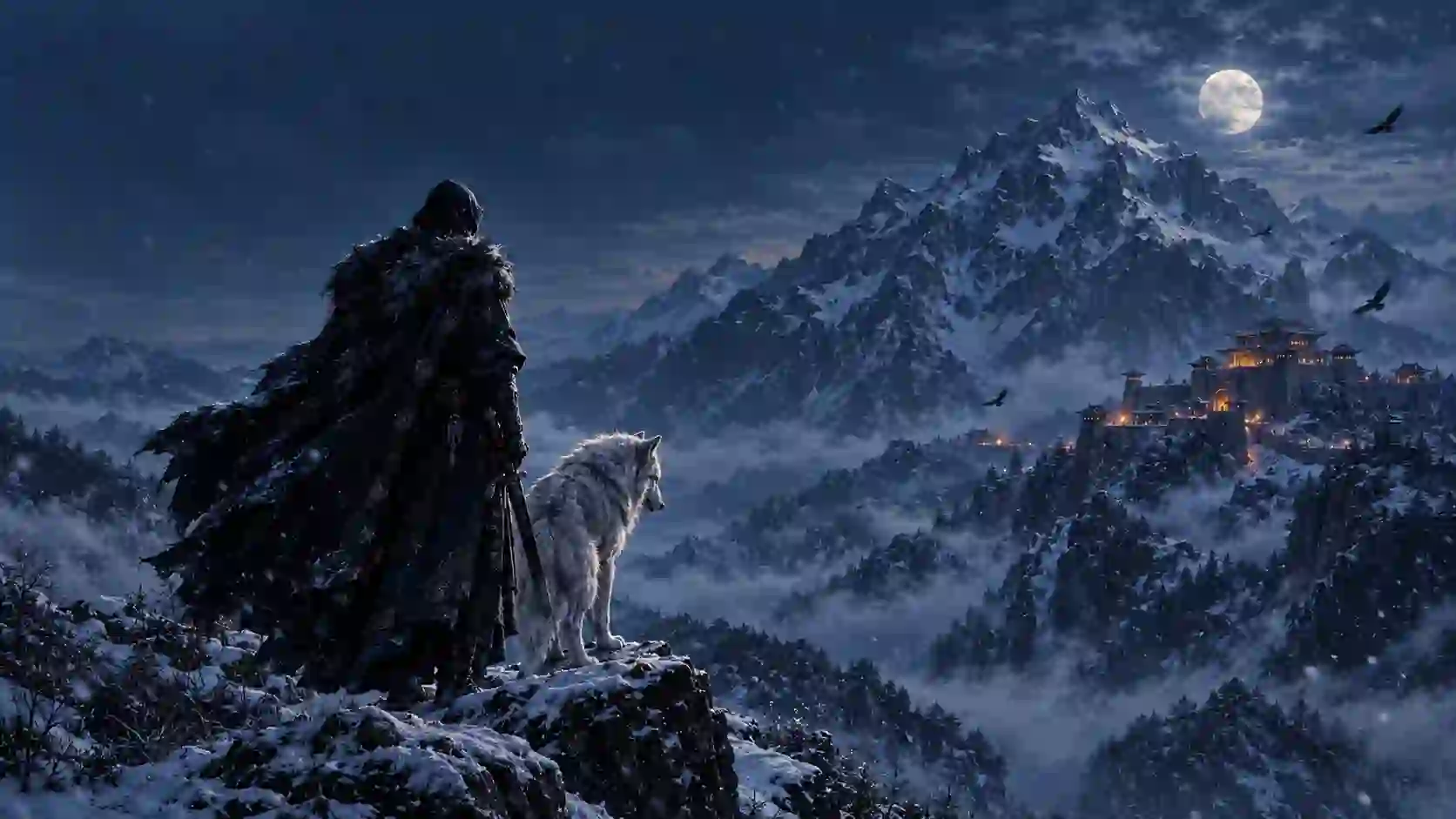
You saw the title, opened a preview, and now you cannot decide whether this is a romance, a ghost story, or both. Reviews spoil the turn. Trackers disagree about the chapter count. Three different names point to one book. This guide fixes that mess. It covers the premise, the cast, the folklore behind the title, the reading order, and a straight verdict on The Wolf of Cheonun Peak. One read, no confusion.
Quick answer: The Wolf of Cheonun Peak is a completed Korean historical romance manhwa published by Lezhin Comics. A village hands a young woman to a mountain outlaw as payment for protection, and the monster everyone warned her about turns out to be far more complicated than the rumours.
The Wolf of Cheonun Peak at a Glance
Start with the practical facts, because most questions about this series are practical ones. Readers want to know how long it runs, who made it, and whether they can finish it in a weekend.
| Detail | Answer |
|---|---|
| Series title | The Wolf of Cheonun Peak |
| Korean title | 이리 (Iri) |
| Alternate titles | Iri, Daring Woof, The White Wolf, Serás Mía, El lobo del Pico Cheonun, Le loup du pic de Cheonun |
| Format | Full-colour manhwa, vertical scroll webtoon |
| Original work | The novel Iri by Pi Sookhye (illustrated edition, Bom Media, 2018) |
| Webtoon script | Ji Eun-soo |
| Art | Jae Heemon |
| Production | Lezhin Comics with Playtoon |
| First Korean episode | 17 January 2025 |
| English debut | May 2025 on Lezhin US |
| Status | Complete |
| Length | 26 chapters plus a prologue, and 4 side-story chapters |
| Genre | Historical, romance, drama, josei, mature |
| Age rating | 18+ (a 15+ revised cut exists on Korean platforms) |
| Official languages | Korean, English, Thai, Traditional Chinese, French, Spanish |
| Setting | Hwacheon village and the outlaw stronghold on Cheonun Peak |
Those figures come from the publisher’s own listings and cross-check against two public databases. Where the counts differ, the difference has a simple explanation, and I explain it in the chapter section below.
What Is The Wolf of Cheonun Peak About?
Hwacheon village is out of options. Raiders from the Magal tribe are closing in, the fighting men are gone, and the chief has nothing left to bargain with. So he climbs Cheonun Peak and asks its most feared resident for help: the leader of a bandit crew that even the throne avoids.
The price is his daughter. Chohee walks up the mountain as an offering, braced to die, and instead meets a man whose reputation does not match his face. Villagers describe a beast wearing human skin. What waits at the top is a beautiful, cold, unnervingly restrained man who keeps a household of spirits and answers questions with questions.
The story then does something smarter than the setup promises. It lets Chohee notice the gaps. Cruelty keeps failing to arrive. Small mercies stack up. Rumour and behaviour drift further apart with every chapter, and the reader starts doing the detective work alongside her.
What the series actually delivers:
- A hostage arrangement that neither side names out loud
- A mountain stronghold staffed by spirits rather than soldiers, including a nine-tailed fox named Siho
- A slow identity reveal that ties the outlaw leader to old Silla legend
- A short, closed ending rather than an open-ended monthly grind
If you want court politics, sprawling clans, and forty named ministers, look elsewhere. This is a tight, moody two-hander set on a cold mountain, and it knows exactly what it is.
Who Made It? Three Names Behind the Story
Three creators shaped this story, and knowing who did what explains why the dialogue feels like a novel and the panels look like a prestige production.
- Pi Sookhye wrote the original romance novel Iri, published in 2018. Her prose style leans on internal conflict and withheld information, which survives the adaptation intact.
- Ji Eun-soo turned that novel into webtoon scripts, cutting internal monologue into visible action and tightening the timeline for vertical scroll.
- Jae Heemon drew every panel, and the art earned the loudest praise in early reader threads. The early MangaUpdates comments rate the artwork above the story.
- Playtoon developed the adaptation alongside Lezhin Comics, which publishes the Korean and English editions.
That chain matters for readers. A novel adaptation gives you a plot with a real ending already built in. A strong artist gives you atmosphere that a synopsis cannot convey. Together they produce a series that reads faster than its page count suggests.
Meet the Cast: Chohee and the Man Called the Wolf
Character work carries this story more than plot twists do. A handful of figures do almost all the heavy lifting.
| Character | Role in the story | What drives them |
|---|---|---|
| Chohee | The village chief’s late-born daughter, offered as tribute | Survival, then something she refuses to name |
| The leader of Cheonun Peak | The outlaw known as the Wolf, feared across the province | Control, secrecy, and a loneliness he never admits |
| Siho | A nine-tailed fox living in the stronghold | Serves the leader, and meets Chohee on the climb |
| The village chief | Chohee’s father and the man who made the bargain | Fear for his people, guilt over his daughter |
| The Magal raiders | The outside threat that starts everything | Plunder, and pressure that never fully leaves the frame |
Chohee deserves a second look, because she breaks the sacrifice-heroine template. She volunteers. She walks up that mountain with her eyes open. When the arrangement turns ugly, she runs, and when running fails she negotiates. That agency is why readers argue about her in comment sections instead of pitying her.
The leader is the harder performance. He speaks in short, formal lines, hides his face in shadow, and lets other people build his reputation for him. Every kindness arrives without explanation, which makes each one feel earned rather than scripted.
The Folklore Underneath: What “Iri” Actually Means
The English title says wolf. The Korean title says something older. Iri (이리) is an archaic Korean word for wolf, and it doubles as the name villagers use for the man on the peak — a name that carries fear, not affection.
Korean-language summaries of Pi Sookhye’s novel go further. They identify the leader as an illegitimate son of King Jinji of Silla, a figure readers of classical Korean literature will recognise at once. That makes him the literary descendant of Bihyeongrang, the legendary child born from the dead king’s ghost and a woman named Dohwa-nyeo.
The Bihyeongrang material survives in the Samguk Yusa, the thirteenth-century collection compiled by the monk Il-yeon. In that account, Bihyeongrang grows up in the palace, spends his nights among spirits, and commands a host of dokkaebi. He orders them to raise a stone bridge across a river in a single night, and the bridge becomes known as Gwigyo, the ghost bridge. He later recommends a dokkaebi named Gildal for service at court, then hunts him down when Gildal breaks faith.
Read the manhwa with that story in your pocket and details sharpen. A man with one foot in the spirit world. Authority that comes from fear rather than rank. Servants who are not human. A character the crown would rather not acknowledge. None of this is decoration. It is the reason the leader can protect a village at all, and the reason he is dangerous.
Why “More Beast Than Man” Is the Smartest Choice in the Story
Reputation does the work of three chapters of exposition. Before the leader appears, the story floods the reader with second-hand warnings, and that noise shapes everything Chohee sees.
The series then spends its middle stretch dismantling the rumour, one small act at a time. Restraint where violence was promised. Silence where a threat was expected. Food, warmth, and a door that is not locked. Each gesture lands because the rumour set the bar so low.
That gap between what people say and what a person does is the engine of this series. It also gives readers something to argue about, which is why fan theories travel faster than chapter reviews. The most popular theory holds that the “wolf” persona was forced onto him rather than chosen, and that the village’s fear is the real antagonist. The text supports it without confirming it, which is exactly how you keep a short series discussable.
Art and Atmosphere: The Mountain as a Third Character
Jae Heemon draws Cheonun Peak as an unfriendly place, and that choice shapes the emotional temperature of every scene.
- Colour drops toward cold greys and blues on the mountain, then warms whenever firelight or lamplight enters the frame
- Wide, empty panels open up whenever Chohee crosses into new territory, so isolation lands visually before anyone says a word
- The leader’s face stays partly hidden through long stretches, and full, clear views are rationed
- Village scenes feel cramped and crowded, which makes the mountain’s silence feel like relief as much as threat
Expression work carries the quieter chapters. A half-turned head, a hand that stops, a pause held one panel too long: that is how this series says “he cares” without writing it. Readers who skim for dialogue will miss half the story.
Sacrifice, Debt and Consent: The Argument Under the Romance
Strip away the costumes and this is a story about transactions. A village buys safety with a daughter. A chief trades one life for many. A man who takes what he wants discovers that taking is not the same as having.
The series keeps returning to that distinction. Consent in this world is fragile, especially for a woman with no family name behind her, and the story refuses to pretend otherwise. Chohee’s power grows only when she learns the terms of the bargain and starts negotiating inside them.
There is also a quieter theme about legitimacy. A man born outside the line, a woman born to a poor village, a fox spirit living among humans — all three sit outside the order that is supposed to protect people. Their alliance works because the system already excluded them. That is a mature idea for a short romance, and it is why the series holds up better than its premise suggests.
How the Novel and Webtoon Differ
The webtoon adapts a finished novel, which is why the ending lands instead of trailing off. Knowing where the two versions part company helps you choose a starting point.
A novel can live inside a character’s head. A webtoon cannot, so Ji Eun-soo’s scripts convert Chohee’s private reasoning into looks, pauses, and small physical decisions. Korean readers of the 2018 book describe an interior, tense narrative with a male lead whose intentions stay murky. The panels keep the murk and drop the inner commentary.
What the adaptation adds:
- Space and silence, where prose would supply a sentence
- Weather and light that carry mood without narration
- Body language that softens the leader earlier than the book does
What only the novel offers:
- The full texture of Hwacheon’s politics and the Magal threat
- Longer passages on what the bargain costs Chohee’s family
- Detail the vertical format had to cut for pace
Start with the webtoon if you read visually. Start with the novel if you want the complete interior picture. Neither order spoils the other, because the story’s central question is answered in both.
How Long Is The Wolf of Cheonun Peak? Chapter Count and Reading Order
The main story runs 26 chapters plus a prologue. Four side-story chapters follow the main run, which brings the total to 30 episodes on most trackers.
Confusion about the count is common, and the reasons are boring but easy to clear up:
- Some Korean listings show 27 episodes because they count the prologue as chapter one
- Anime-Planet and similar databases list 30 chapters because they merge the four side stories into the total
- Aggregator sites show whatever number they happened to scrape, and several still label the series as ongoing
Reading order is straightforward. Start with the prologue, then chapters one to 26, then the side stories. Do not jump into the extras first. The extras sit after the finale, and they land harder once you know how the main story closes.
Expect roughly two and a half to three hours for a full read. That is a weekend evening, not a months-long commitment, and it is the single best argument for starting now.
Where to Read The Wolf of Cheonun Peak in English and Korean
Lezhin US publishes the official English edition under the title The Wolf of Cheonun Peak, and the platform released three free episodes during its May 2025 launch window. Lezhin’s Korean service carries the original Iri, and Korean readers can also find it on Bomtoon, Naver Series, Ridibooks, KakaoPage, MrBlue, BookCube, and Toomics.
A few practical notes before you spend anything:
- The English edition is listed for mature readers, and the Korean release exists in both 19+ and 15+ cuts. Check the rating on whichever storefront you use.
- Lezhin runs on coins, and launch events often include free chapters. Wait for a sale if the price stings.
- Mirror sites carry the series for free. They also carry stolen uploads, broken image order, and malware ads. The creators earn nothing from them.
- Official translations exist in Thai, Traditional Chinese, French, and Spanish, so readers outside English-speaking markets have legal options too.
One small oddity worth knowing: the English synopsis misspells the mountain as “Choneun Peak” in a few listings. Same series, same story. Search either spelling and you will land in the right place.
Is The Wolf of Cheonun Peak Worth Reading? An Honest Verdict
Community scores sit in the middle range. MangaUpdates shows roughly 6.5 out of 10 from a small voter base, and Anime-Planet sits near 3.5 out of 5. Those numbers are honest, and they come from a tiny sample, so treat them as a temperature check rather than a verdict.
What works:
- The art is genuinely strong, and it carries chapters where the pacing sags
- The central relationship builds through behaviour instead of speeches
- The folklore foundation gives the story weight that pure romance would not have
- It is complete, short, and available in English today
What frustrates people:
- The middle stretch moves slowly, and some readers wanted more plot per chapter
- The side stories answer fewer questions than fans hoped
- Supporting characters stay thin, including Siho, who deserves more page time
- The mature content will not suit every reader
My verdict: read it if you like moody historical romance with a folkloric spine and you value atmosphere over plot machinery. Skip it if you want a long political epic or a heroine who drives the action from page one.
Who Will Love It, and What to Read Next
This series lands hardest with a specific kind of reader.
- Historical josei fans who prefer tension to banter
- Anyone drawn to Korean folklore, especially gumiho and dokkaebi stories
- Readers who want a finished series they can close in one sitting
- People who like a feared male lead whose reputation collapses on contact
If that sounds like you, three titles sit close by. The Runaway Dragon King on Lezhin mixes sacrifice and mythology with a lighter tone. Exiled Palace Flowers leans into historical drama and moral compromise. Master of Intimacy trades atmosphere for comedy, so treat it as a palate cleanser rather than a match.
Details Most New Readers Miss
Small choices reward a second read, and these are the ones that matter most.
- The word “iri” works as both a species and a name, and the story leans on that double meaning
- Every kindness the leader shows arrives before the explanation for it, so trust grows in the reader before it grows in Chohee
- The mountain gets colder as the arrangement gets more dangerous, and the colour work follows
- The leader’s face is rationed on purpose, so the first clear look at him carries the weight of a confession
- Chohee drives every turn of the plot, even in the chapters where she holds no power
Common Misunderstandings About The Wolf of Cheonun Peak
Some of the confusion around this series comes from the title, and some comes from lazy metadata.
- It is not a werewolf story. The wolf is a name given by frightened people, not a transformation.
- It is not ongoing. The main story finished, and the four side chapters followed it.
- Iri, Daring Woof, and The White Wolf are the same series under different market titles.
- The mature tag does not mean the plot is thin. The romance drives the plot, and the plot earns the romance.
- The English synopsis typo — “Choneun” instead of “Cheonun” — still appears on several listings.
How to Read It Without Spoiling Yourself
A short series is easy to ruin, and this one leaks its best turn early if you read carelessly.
- Finish the prologue before you read any comment section
- Avoid searching character names until you pass chapter fifteen
- Read the side stories last, in order, with no skipping
- Skip the wiki until you finish. Plot summaries give away the identity reveal in the first paragraph
- Keep notes on who says what about the leader. Rumour is the plot
Frequently Asked Questions
Is The Wolf of Cheonun Peak finished?
Yes. The main story runs 26 chapters plus a prologue, and four side-story chapters followed the finale. Some trackers still label it ongoing because they update slowly.
How many chapters does The Wolf of Cheonun Peak have?
Thirty episodes across most databases: a prologue, 26 main chapters, and four side stories. Korean platforms sometimes count 27 because they fold the prologue into chapter one.
Is The Wolf of Cheonun Peak a boys’ love story?
No. It is a male-female historical romance aimed at a josei audience, with a mature rating. Readers looking for BL will find a different genre here.
Where can I read The Wolf of Cheonun Peak in English?
On Lezhin US, which holds the official licence and publishes the English edition. Korean readers can find the original on Lezhin Korea, Bomtoon, Naver Series, Ridibooks, and KakaoPage.
Will The Wolf of Cheonun Peak get an anime or drama adaptation?
No adaptation has been announced as of October 2026. The series finished recently, and Lezhin’s mature catalogue rarely moves to animation, so expect nothing soon.
Does The Wolf of Cheonun Peak have a happy ending?
Korean readers tag the original novel as a happy ending, and the webtoon follows the same arc to its close. Expect the central relationship to resolve rather than hang open.
Final Word: Give the Mountain One Evening
Most romance manhwa ask for months of your time and never finish. This one closes its story, explains its ghosts, and leaves you with something to think about on the walk back to your own life.
So do this tonight. Open the prologue on Lezhin, read three chapters, and decide from there. If the mountain hooks you, you will finish inside a week. If it does not, you will have spent twenty minutes and learned something about how Korean storytellers turn a folk legend into a love story.
Then pass it on. Send the title to the friend who insists nothing short is worth reading, and tell them about the ghost bridge while you are at it. Stories this tight survive on word of mouth, and yours counts.