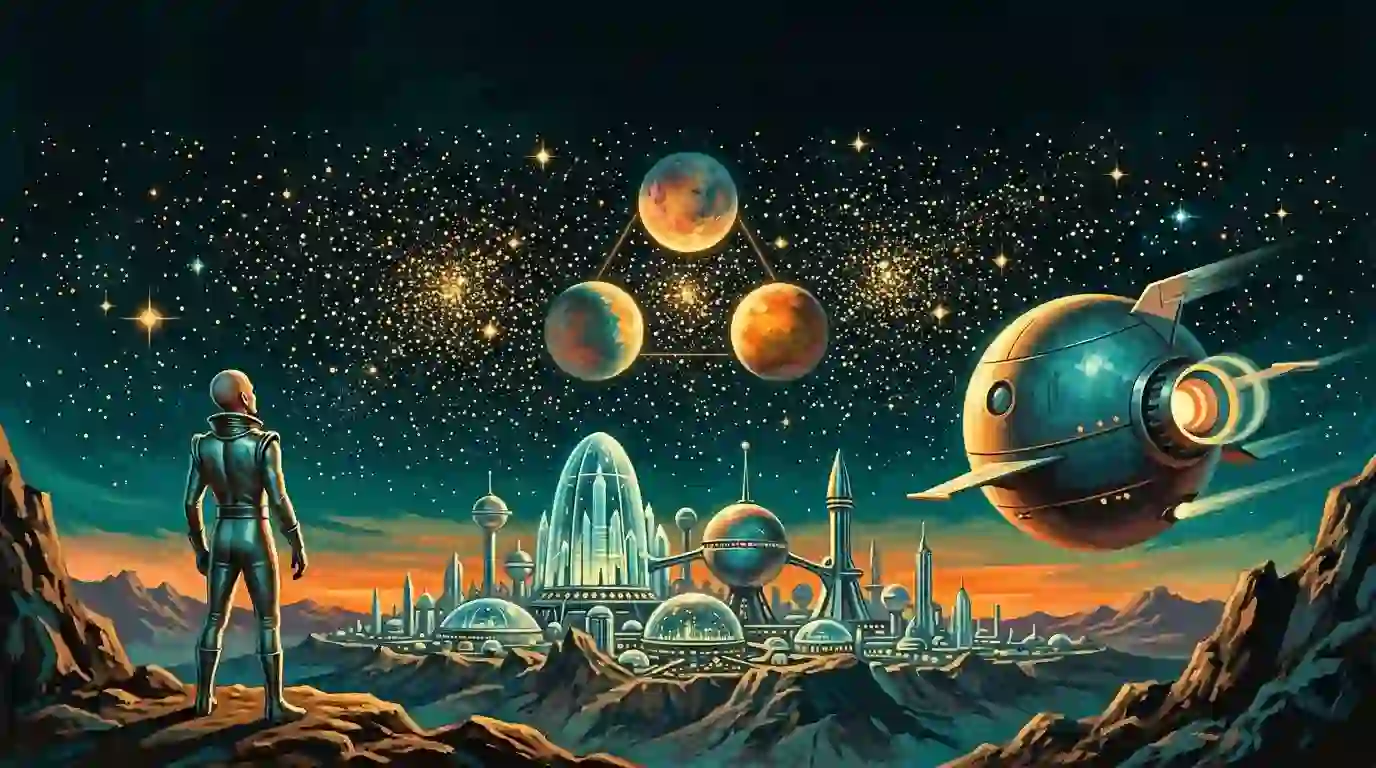
You have seen the covers: bald aliens, crystal cities, and sphere-shaped starships under a crowded sky. Yet the best resources sit buried in German-language wikis and out-of-print art books. Sixty years of Perry Rhodan Arkon System art, split across dozens of artists and publishers, is hard to piece together. This guide fixes that, delivering the full visual story of the Arkon System, plus steps to find, collect, and create the art yourself.
What Is the Arkon System in Perry Rhodan?
Perry Rhodan is a German science fiction series that has appeared weekly since September 1961, which makes it one of the longest-running continuing sci-fi serials on the planet. The story begins when Major Perry Rhodan lands on the Moon and meets two castaways from a crashed research vessel: the Arkonides Crest and Thora. Instead of handing their superior technology to one nation, Rhodan founds his own power base in the Gobi Desert and pushes Earth toward unity.
The Arkon System sits nearly 34,000 light-years away, close to the center of globular cluster M13, which the Arkonides call Thantur-Lok. It is the beating heart of the Great Imperium, a realm spanning thousands of settled worlds. Three planets share a single orbit in a perfect equilateral triangle, a formation the Arkonides named Tiga Ranton.
That trio of worlds carries the whole empire on its shoulders:
- Arkon I, the residential world, home to most of the ruling caste
- Arkon II, the trade world, crawling with merchant fleets and Springer traders
- Arkon III, the war world called Gor’Ranton, fortress of the Robot Regent
The Arkonides themselves are tall, athletic humanoids whose classic look, shaved heads and high collars, became one of the most recognizable design signatures in European sci-fi illustration. After centuries of comfortable decline, they handed government to the Robot Regent, a giant positronic brain installed on Arkon III. The machine ran the empire from 1978 until 2044, when the immortal Arkonide Atlan seized control as Imperator Gonozal VIII. The Regent was finally destroyed in 2106, and Arkon III itself was lost in 2329 during the Blues’ final offensive.
Every one of those story beats gave artists something new to paint, and they did, for decades.
What Does Perry Rhodan Arkon System Art Look Like?
Perry Rhodan Arkon System art follows a visual code you can spot within seconds. The Arkon System is drawn as an empire in decay that still looks magnificent: polished metal, vast energy domes, and architecture that favors spheres and triangles because those shapes echo Tiga Ranton itself.
Five motifs define the style:
- Spherical starships in every size class, from small cruisers to fortress-sized battle spheres
- The three-world triangle, used in imperial emblems, badges, and background skylines
- The Robot Regent’s brain, a mountain of positronic hardware glowing inside a crater of energy fields
- Bald, athletic Arkonides in tight suits and high collars, radiating aristocratic pride
- The crowded M13 sky, where thousands of stars blaze brighter than any Earth night
Color choices tell the same story. Johnny Bruck’s early covers burn with hot orange skies and teal shadows, pure 1960s pulp energy. Modern digital covers cool the palette down toward steel blue and emerald, but they keep the shapes sacred: spheres, triangles, and domes.
This consistency is exactly why the art works. A fan can identify an Arkon scene without reading a single caption, and an artist can join the tradition without inventing anything from scratch. The design language is that stable.
The Arkon System at a Glance: A Detailed Reference Table
Use this table as your quick reference whenever you study, collect, or create Perry Rhodan Arkon System art. It pairs each location with its story role and the visual motifs artists return to again and again.
| Location | Role in the Great Imperium | Signature Art Motifs | Story Moments That Shaped the Art |
|---|---|---|---|
| Arkon I | Residential world of the Arkonide elite | Park continents, palace domes, private orbital traffic | Mass migration after the terraforming of the twin worlds |
| Arkon II | Trade hub of the empire | Spaceports, freight spheres, bearded Springer merchants | Endless commerce plots that filled dozens of cover briefs |
| Arkon III (Gor’Ranton) | War world and arsenal | Robot factories, gun emplacements, the Regent’s crater | Destroyed on September 28, 2329, by the Blues’ fleet |
| Tiga Ranton | The shared three-planet orbit | Equilateral triangle, triple-sunset skies, imperial emblems | Created by Imperator Gonozal III to symbolize unity |
| The Robot Regent | Positronic ruler, 1978–2044 | Glowing brain mass, energy shields, robot honor guards | Atlan’s takeover in 2044; final destruction in 2106 |
| Naat | Homeworld of the Naats | Alien landscapes outside the core triangle | Where Terrans first learned the empire’s secrets |
| Thantur-Lok (M13) | The star cluster containing Arkon | Dense starfields, golden nebulae, deep-space vistas | Backdrop for nearly every fleet scene since 1961 |
A second table helps you place the art into eras, which matters when you start collecting or commissioning pieces:
| Era | Period | Leading Artists | What Changed |
|---|---|---|---|
| Pulp golden age | 1961–1995 | Johnny Bruck (all covers) | Tempera and gouache, blazing colors, weekly rhythm |
| Technical art boom | Mid-1960s onward | Rudolf Zengerle, Ingolf Thaler, Günter Puschmann | Cutaway Risszeichnungen made the ships believable |
| American crossover | 1969–1978 | Johnny Bruck, Gray Morrow | ACE Books mixed digest art with new painted covers |
| Team era | 1996–today | Alfred Kelsner, Arndt Drechsler, Swen Papenbrock | Digital rendering joined traditional painting |
Johnny Bruck: The Father of Perry Rhodan Arkon System Art
No history of the series can skip Johnny Bruck, because for 34 years there was nobody else. Bruck painted the covers for the first 1,800 issues, single-handedly, on weekly deadlines. Across his whole career he produced thousands of published covers, with estimates ranging from 4,000 to more than 6,000, most of them for this one series.
Bruck was born in Halle an der Saale in 1921 and spent part of his childhood in Great Britain. He worked in tempera, gouache, and mixed media on illustration board, often at astonishing speed. He translated plot synopses into finished paintings while most illustrators were still sketching thumbnails.
His Arkon imagery set rules that still hold:
- Arkonides appeared bald, tall, and severe, with cheekbones you could cut glass on
- Starships stayed spherical, because the sphere was the empire’s engineering religion
- The Robot Regent glowed like a cathedral of circuits rather than a plain computer
- Every sky hinted at the crowded stars of M13
Collectors treasure a small detail from his late career: Bruck painted three slightly different versions of the cover for issue #1, in 1961, 1977, and 1982. Each version marks a printing generation, and telling them apart is a rite of passage for serious fans.
Bruck died on October 6, 1995, after a scooter accident near Herrsching am Ammersee. The series lost its one-man art department, and an era ended with him.
The Risszeichnungen: Cutaway Art That Made Arkon Believable
Dramatic cover painting is only half the story. Since the mid-1960s, the series has published Risszeichnungen, detailed cutaway technical drawings that show spaceships, robots, and installations slice by slice. Think of them as blueprints you can frame.
The tradition started with artists like Rudolf Zengerle and Ingolf Thaler, whose ink drawings of ships such as the Space-Jet and the giant robot OLD MAN became fan folklore. Günter Puschmann, a trained architect from Lemgo, later carried the craft forward. His first professional drawing appeared in issue #1055 in 1981, and he has produced more than one hundred technical illustrations since, including the celebrated cutaway of Arkon III with the Robot Regent published in issue #1079.
Why does this matter to you as a fan or artist?
- The cutaways fix canon proportions, so fan art built on them looks “right”
- They document design evolution across six decades
- Original ink drawings and the bound Risszeichnung volumes are collectible in their own right
- Museums noticed: the 2023 Berlin exhibition IN LINEARTRÄUMEN put these drawings on gallery walls
Puschmann himself moved from ink to computer, matching how the whole field shifted. The function never changed: make the empire feel engineered, not imagined.
Atlan, Crest, and Thora: Faces That Defined the Arkon Aesthetic
Characters sell covers, and the Arkon cast gave Bruck three faces he returned to for years.
Crest is the scientist, calm and precise, the first Arkonide Earth ever meets. Thora is the fleet commander, proud and sharp-edged, who later becomes Rhodan’s wife and mother of his son Thomas Cardif. Bruck drew both as the ideal Arkonide type: bald, upright, and impossible to intimidate.
Atlan breaks the mold on purpose. He is the immortal admiral who sleeps for millennia and returns to claim the throne as Imperator Gonozal VIII. Artists give him a full head of golden hair, which instantly separates him from every other Arkonide on the shelf. His spin-off series ran from February 1969 to January 1988 and reached 850 issues, most of them featuring his face.
For artists, these three characters are the perfect practice subjects:
- Crest teaches restraint: dignity without decoration
- Thora teaches contrast: cold beauty against burning spacecraft
- Atlan teaches character coding: one head of hair rewriting a whole species’ design rule
Portrait artists still cut their teeth on these faces because the brief is so clear.
How America Met Arkon: The ACE Books Era
Perry Rhodan crossed the Atlantic early. ACE Books began publishing English editions in 1969, and those paperbacks became many readers’ first contact with the Arkon System’s visual world.
The American editions are a collector’s genre of their own:
- Early ACE volumes reused Johnny Bruck’s German digest cover art, sometimes clipped or cropped to fit the US format
- Later printings of several volumes received brand-new covers painted by Gray Morrow, whose moody, painterly style gave Arkon an American accent
- Interior illustrations mixed Bruck artwork with contributions from other hands, including Sandy Huffaker
If you collect the art rather than just the books, ACE editions matter for two reasons. They documented which German images the publisher considered iconic, and Morrow’s covers represent the only significant outside artistic interpretation of the universe during Bruck’s lifetime.
Scarcity did the rest. Complete ACE runs in good condition are genuinely hard to find, and their prices reflect it.
Who Creates Perry Rhodan Arkon System Art Today?
After Bruck’s death in 1995, the publisher Pabel-Moewig could not replace one legend, so it built a team instead. That team still produces weekly covers, paperback art, and digital illustrations for the main series and its side lines, including the Neo relaunch that retells the saga from scratch.
Alfred Kelsner anchors the traditional side. He joined the cover team at the start of 1996 and had already designed paperback covers from volume 218 onward. His first magazine cover, issue #1800, paid direct tribute to Johnny Bruck, an artistic handshake across generations. Kelsner remains the team’s painter of original, hand-made cover art while others work digitally.
Around him, digital illustrators such as Arndt Drechsler and Swen Papenbrock keep the weekly machine running, rendering Arkon’s spheres and skylines with modern polish. The current look favors cinematic lighting and weathered surfaces, which suits a series that increasingly explores its own history.
Three practical shifts define the modern era:
- Digital pipelines cut turnaround times without abandoning the classic shapes
- The official Infothek on perry-rhodan.net now documents the artist team openly, a trust signal older pulp series never offered
- Fan communities interact with working artists directly, shortening the loop between feedback and cover
The result: Arkon art is livelier now than it has been in decades.
How to Collect Perry Rhodan Arkon System Art
Start collecting with a clear lane, because sixty years of material will bury an unfocused budget. Decide first whether you want printed artifacts (issues, books, cutaway volumes) or original artwork (paintings, ink drawings, commissioned pieces).
Printed collectibles, from easiest to hardest:
- Recent weekly issues and paperbacks, cheap and everywhere
- The bound Risszeichnung volumes collecting the classic cutaways
- Reprint series of the early issues, ideal for enjoying Bruck without auction stress
- Vintage first-print Romanhefte from the 1960s, priced by condition and issue number
- Complete ACE Books runs in English, scarce and steadily appreciating
Original artwork, from realistic to ambitious:
- Commissioned pieces from current series artists
- Original Risszeichnung ink drawings, which surface at illustration auctions
- Alfred Kelsner cover paintings from the team era
- Johnny Bruck originals, the holy grail, rarely offered and fiercely contested
Four rules protect your money:
- Demand provenance. A credible chain of ownership separates an investment from a souvenir.
- Grade condition honestly. Pulp paper is fragile; sun-faded covers lose value fast.
- Learn the printing generations. Bruck’s three renditions of issue #1 demonstrate that “same cover” hardly equates to “similar art.”
- Buy from established dealers or documented auctions. The original-art market for this series is small, and reputation circulates.
You do not need deep pockets to begin. A modest shelf of reprints plus one framed cutaway print already tells the story.
Create Your Own Perry Rhodan Arkon System Art in Five Steps
Nothing deepens your appreciation of the Arkon System like drawing it. Follow this workflow and you will produce art that fans instantly recognize, even if you are new to sci-fi illustration.
Step 1: Pick one subject and one era. Choose a single planet, ship, or character, and pin it to a decade. A Bruck-style Arkon III looks nothing like a modern digital one, and mixing eras weakens both.
Step 2: Gather canon references. Pull measurements and proportions from the Risszeichnungen and story details from Perrypedia. Getting the sphere diameter or the triangle geometry right is what separates convincing Perry Rhodan Arkon System art from generic space art.
Step 3: Thumbnail the silhouette first. Block your composition in five to ten tiny sketches. Look for the classic read: sphere against sky, triangle of planets, or lone figure in high collar.
Step 4: Render with a disciplined palette. Choose either the warm pulp route (orange skies, teal shadows, cream highlights) or the modern route (steel blue, emerald, hard rim light). Commit fully to one.
Step 5: Share and iterate. Post your piece in Perry Rhodan communities and artist forums. This fandom knows its canon and rewards precision with genuine enthusiasm.
Tools that suit each stage:
- Procreate or Krita for painting, including free options if budget is tight
- Blender for modeling accurate spheres before painting over them
- Krita or Photoshop with the same brush discipline Bruck used in tempera
Your first goal is not a masterpiece. It is one image a veteran fan cannot find fault with.
Where to Find Perry Rhodan Arkon System Art Online
You can explore the full visual archive without spending anything. These are the places worth your time.
- The official Perry Rhodan website (perry-rhodan.net), for series history, current covers, and the Infothek’s artist profiles
- Perrypedia, the series encyclopedia, for detailed Arkon System lore and references tied to specific issues
- The official shop, for print volumes, cutaway collections, and art books
- DeviantArt and Reddit, for active fan art scenes, including Arkon ships and portraits of Atlan
- ComicArtFans and illustration auction archives, for documented original cover art and sale history
- Exhibition archives, such as the IN LINEARTRÄUMEN show, for museum-quality views of the technical drawings
One habit multiplies the value of all six: save every image with its issue number. Sixty years from now, that discipline is what turns a downloads folder into a curated reference library.
Fan Art and Copyright: The Rules That Protect You
Fan art lives in a legal gray zone, so handle it with respect. The Perry Rhodan name, characters, and official artwork belong to the publisher, and that protection does not vanish because a piece is drawn by hand.
Practical guidelines that keep you safe:
- Keep fan art personal or promotional. Gifts, portfolio pieces, and community shares sit comfortably in tolerated territory.
- Do not sell it. Selling prints or merchandise of protected characters without a license invites trouble.
- Never trace or repaint official covers for distribution. Style is free; specific images are not.
- Credit the source material clearly. Naming the series and the original artists signals good faith.
- Ask before commercial projects. Publishers sometimes license fan work, but only when asked first.
None of this is legal advice, and edge cases deserve a professional opinion. The pattern, however, is consistent across fandoms: respect the property, and the property tends to respect you back.
Why the Arkon System Outshines Generic Space Art
Plenty of sci-fi settings offer pretty planets. The Arkon System offers meaning behind every shape, and that is why Arkon System artwork keeps attracting new illustrators more than sixty years after the first cover.
The difference comes down to story-driven design:
- The sphere is not a random hull choice; it reflects a whole engineering philosophy
- The triangle of Tiga Ranton is an imperial symbol the characters themselves revere
- The bald Arkonide silhouette encodes species identity at a glance
- The Robot Regent visualizes the series’ core theme: a civilization that automated itself into decline
Generic space art decorates. Arkon art narrates. When you draw a Springer freighter, you are painting a trading empire’s decline; when you render the Regent’s crater, you are illustrating the cost of comfort. Artists who understand that layer of meaning produce work with weight, and viewers feel it even when they cannot name it.
Frequently Asked Questions About Perry Rhodan Arkon System Art
What is Perry Rhodan Arkon System art?
Perry Rhodan Arkon System art is the visual body of work depicting the Arkon System from the German sci-fi series Perry Rhodan: cover paintings, cutaway technical drawings, interior illustrations, and fan creations. It centers on the empire’s three orbit-sharing planets, its spherical starships, and characters like Atlan, Crest, and Thora. Six decades of artists, led by Johnny Bruck, built one of the most consistent visual languages in science fiction.
Who painted the original Perry Rhodan Arkon System art?
Johnny Bruck painted every cover for the series’ first 1,800 issues, from 1961 until his death in 1995. He worked in tempera and gouache on illustration board and produced thousands of covers in his career. For the Arkon System specifically, his images of the Robot Regent, the planet trio, and the bald Arkonides remain the reference standard.
Where can I see authentic Perry Rhodan Arkon System art online?
Start with the official Perry Rhodan website and Perrypedia, which document covers, artists, and lore. DeviantArt and Reddit host the active fan art scene. For original pieces and their sale history, illustration auction archives and collector galleries such as ComicArtFans are the most reliable sources.
Is Perry Rhodan Arkon System fan art legal to make and share?
Creating and sharing fan art is widely tolerated, especially in portfolio and community contexts. Selling it is where the real risk begins, because the characters and artwork remain protected publisher property. Keep fan art non-commercial, credit the series, and never reproduce official covers, and you stay on the safe side of practice.
Do I need to read the series to enjoy the art?
You do not. The art was designed to sell stories at a newsstand glance, so it communicates power, scale, and character on its own. That said, knowing the lore multiplies the payoff: the triangle of planets, the Regent’s fate, and Atlan’s unusual hair all carry story weight that enriches every image.
How do I start collecting Arkon System artwork on a small budget?
Begin with recent issues, reprint volumes, and the bound Risszeichnung collections, all reasonably priced. Add one quality print of a classic cover to frame. From there, target the American ACE editions or vintage Romanhefte as your budget grows, and always record issue numbers and condition.
Your Next Step Into the Arkon System
Perry Rhodan Arkon System art earns its legend the slow way: one weekly cover at a time, across six decades, held together by a design language fans can read at a glance. You now know the worlds, the artists, the eras, the collecting lanes, and the exact workflow to draw Arkon yourself.
So act on it today. Pick one step below and commit:
- Open the official archive and study ten Bruck covers from the 1960s
- Order one Risszeichnung volume and learn the ships from the inside out
- Sketch your first Arkon sphere tonight, even badly, and post it for feedback
- Start your collection with a single framed print that anchors the whole series
The empire ran for centuries on autopilot, but your journey should not. Choose your first piece of the Arkon System this week, and claim your place in its long visual history.