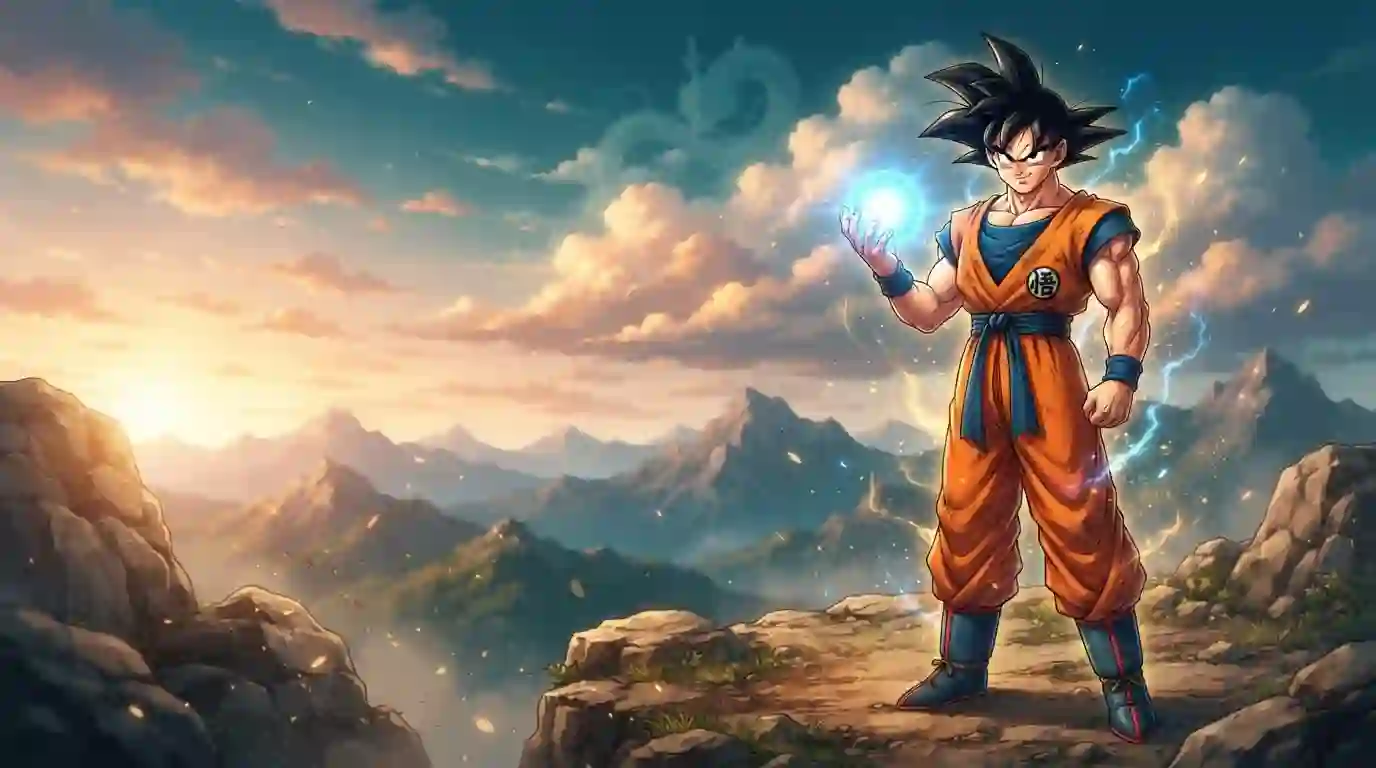
Fans often meet Goku through a spectacular fight, then face a confusing wall of forms, timelines, alternate villains, and fan claims. That makes it hard to tell the core story from a meme or a game-only detail. This guide puts the essential facts in one clear place, explains why the character endures, and gives newcomers a confident starting point without talking down to longtime Dragon Ball readers.
Editorial note: This guide separates main-story material from games, crossovers, fan art, and hypothetical matchups. It was written and reviewed by a Dragon Ball-focused editor using official publisher and animation sources listed at the end. Ages and power comparisons can change by story era, so the article names the relevant context instead of presenting fan debate as fact.
Quick facts about Goku
| Detail | Clear answer | Why it matters |
|---|---|---|
| Full name | Son Goku | “Son” is his family name in Japanese name order. |
| Birth name | Kakarot | His Saiyan name connects him to Planet Vegeta and his brother Raditz. |
| Series debut | Dragon Ball, 1984 manga / 1986 TV anime | He began as a child adventurer, not as a cosmic fighter. |
| Species | Saiyan, raised on Earth | His alien biology explains transformations and battle growth. |
| Signature move | Kamehameha | Master Roshi’s energy-wave technique became his best-known attack. |
| Closest rival | Vegeta | Their rivalry drives training, respect, and many major battles. |
| Family | Chi-Chi, Gohan, Goten | Family grounds an otherwise planet-spanning story. |
| Defining trait | Joy in testing himself | He seeks stronger opponents, then usually protects others when danger arrives. |
What is Goku’s origin story?
Goku arrived on Earth as an infant from Planet Vegeta, part of the warrior race known as the Saiyans. He was originally sent with a destructive purpose, but a childhood head injury changed his violent nature. Grandpa Gohan raised him in the mountains and taught him kindness, survival, and martial arts.
That shift is the heart of the character. His strength never replaces his curiosity or simple love of adventure. When Bulma appears looking for the Dragon Balls, the small mountain boy leaves home and starts a journey that grows from comedy and treasure hunting into a battle for worlds.
The official Toei character page describes Son Goku as an Earth-raised Saiyan sent from Planet Vegeta, and identifies the Frieza battle as the moment he awakened as a Super Saiyan. That official framing matters because it separates the character’s canon backstory from later retellings and fan lore.[^1]
Why Son Goku remains Dragon Ball’s center
Son Goku works because he has a clear internal engine: he wants to improve. He trains after victory, learns from defeat, and treats a difficult opponent as a reason to grow rather than quit. That mindset gives each saga emotional momentum.
He also changes the people around him. Krillin becomes a brother-in-arms, Piccolo becomes a protector, and Vegeta turns from enemy to proud rival and ally. The story does not claim that he is flawless. His eagerness for a challenge can create risks, especially when he gives a dangerous enemy another chance.
For readers, the useful takeaway is simple: power in Dragon Ball is not only a number. Discipline, technique, judgment, teamwork, and resolve decide many turning points.
Goku’s powers and fighting style explained
At his base, he is a martial artist with extraordinary Saiyan strength, speed, durability, and the ability to sense and control ki. Ki is the life energy characters shape into flight, barriers, beams, and heightened physical attacks. Training with masters such as Grandpa Gohan, Master Roshi, King Kai, Whis, and other fighters continually expands his skill set.
His best-known techniques include:
- Kamehameha: A focused energy wave first learned from Master Roshi.
- Instant Transmission: A teleportation technique learned on Yardrat; he locks onto a ki signature to travel across immense distances.
- Kaio-ken: King Kai’s multiplier technique, powerful but physically punishing.
- Spirit Bomb: Energy gathered from living beings and the environment, requiring cooperation and timing.
- Afterimage and Solar Flare: Smart tactical tools that create openings rather than merely adding force.
Speed debates need care. The series shows reactions and travel that far exceed ordinary human limits, but it does not provide a stable official miles-per-hour figure. Asking “how fast is goku” has no single canon number. The honest answer is that the feat, transformation, medium, and opponent all matter.
Every major form: from Super Saiyan to Ultra Instinct
Transformations are visual storytelling. Each one signals a new emotional stage, training result, or crisis. They are not interchangeable costumes, and titles can vary between anime, manga, games, and merchandise.
| Form | What it represents | Key story context |
|---|---|---|
| Great Ape | Saiyan transformation triggered by a full moon and tail | Early Dragon Ball and Saiyan heritage |
| Super Saiyan | Golden-haired breakthrough born from intense emotion | First achieved against Frieza on Namek |
| Super Saiyan 2 | A sharper, stronger evolved Super Saiyan state | Used in major Z-era battles |
| Super Saiyan 3 | Extreme output with a major energy cost | First shown during the Majin Buu conflict |
| Super Saiyan God | God ki gained through a Saiyan ritual | Introduced in Battle of Gods |
| Super Saiyan Blue | Super Saiyan power combined with god ki | A controlled divine-level form in Dragon Ball Super |
| Ultra Instinct Sign | An incomplete awakening that prioritizes instinctive motion | Tournament of Power era |
| Mastered Ultra Instinct | Greater harmony of body and mind, often called MUI | A peak technique, not a simple strength boost |
Ultra Instinct Goku is often described online as automatically unbeatable. That is too simple. Ultra Instinct is a demanding technique that lets the body react with less conscious delay; it still depends on stamina, mental state, and the opponent. The official Dragon Ball site notes that the Ultra Instinct Sign version awakened during the desperate clash with Jiren, while later material refers to refined Ultra Instinct.[^2]
Fans also use MUI Goku as shorthand for Mastered Ultra Instinct. Use the full name in explanatory content first, then the abbreviation when speaking to fans who already know it.
When does Goku go Super Saiyan?
The first Super Saiyan transformation happens during the battle with Frieza on Namek in Dragon Ball Z. Frieza kills Krillin, and grief and fury push him past his limit. The moment lands because the story spent years describing Super Saiyan as a legend before showing it.
If you search “what episode does goku go super saiyan,” the common anime answer is Dragon Ball Z episode 95, “Transformed at Last.” Episode numbering differs between releases, dubs, recaps, and streaming edits, so Namek and the Frieza battle are more reliable navigation points than a number alone.
“Goku super saiyan” also covers several later stages, from the original golden form to Super Saiyan Blue. Avoid calling every power-up “Super Saiyan” when the story gives it a different name; Super Saiyan God and Ultra Instinct carry different rules.
Goku and Vegeta: rivalry built on respect
Goku and Vegeta begin as opposites. One is a cheerful Earth-raised fighter; the other is the proud prince of the Saiyans, shaped by conquest and loss. Their first battle establishes the tension: Vegeta has more raw power, while the defenders of Earth win through endurance, tactics, and shared effort.
Over time, their rivalry becomes constructive. Vegeta’s discipline forces his rival to aim higher, and Goku’s open-hearted confidence gives Vegeta room to redefine himself. They remain competitive, but “goku and vegeta” means more than a versus matchup. It is one of Dragon Ball’s strongest long-term relationships.
Their paths also differ. One fighter often pursues calm, adaptable technique; the other channels pride and destruction. That contrast keeps their training from becoming a repetitive race toward the same answer.
Kid Goku and the adventure roots of the series
Kid Goku is the version who first meets Bulma, hunts Dragon Balls, rides the Flying Nimbus, and faces the Red Ribbon Army. These early chapters are packed with comedy, folklore, martial-arts tournaments, and strange inventions. They reward readers who want to see the foundation beneath the later galaxy-scale stakes.
This era explains his habits: his appetite, innocence, tail, staff, and comfort in the wilderness. It also shows why he trusts people easily while still reading danger quickly in a fight. Starting with original Dragon Ball gives new fans the fullest view of the character’s growth.
Goku Black is not Goku
Goku Black is a separate villain from the “Future Trunks” arc of Dragon Ball Super. He has the hero’s body and appearance because Zamasu used the Super Dragon Balls to switch bodies with him. His identity, values, and goals are Zamasu’s, not Son Goku’s.
That distinction explains the name black goku and the Rosé transformation. He is frightening precisely because he twists a familiar face into a symbol of divine judgment and cruelty. The phrase “goku black how to come to goku’s world” appears in search queries, but the canon answer is not a travel tutorial: the plot uses time rings, body switching, and alternate timelines.
Is Gohan stronger than Goku?
The answer depends on the exact arc and form. Gohan surpasses his father at points in the Cell saga, most famously when he becomes Super Saiyan 2. Later stories give both characters new heights, so a permanent, universal winner is not a fact the series establishes.
A better question is: stronger when, in which continuity, and under what conditions? Dragon Ball Super: SUPER HERO places Gohan at the center and recognizes his renewed power. That spotlight does not erase the need for a direct, same-context comparison.
Who can beat Goku? Matchups without misleading answers
“Who is stronger than goku” changes from saga to saga. Beerus remains a clear benchmark in Dragon Ball Super, and angels such as Whis operate on a different level. Jiren, Broly, Frieza, Gohan, Vegeta, and many others may exceed him in a particular moment, depending on the version and source.
The question “who would win goku or saitama” has no canon result because the characters belong to different publishers and story rules. The same applies to “can saitama beat goku.” A good comparison can be fun, but it should state its assumptions: manga or anime version, starting conditions, personality, and whether parody logic counts.
Do not treat a fan-made tier list, a reaction clip, or a dramatic goku meme as official evidence. A matchup is conversation; it is not a settled record.
How old is Goku, and how tall is he?
“How old is goku” needs a timeline answer. In the original Dragon Ball story, he first appears physically around age 12. The character later dies, trains in the afterlife, and returns through wishes, so physical age, chronological time, and official timeline age can differ.
For “how old is goku in dragon ball,” say 12 at the start of the original adventure. For “how old is goku in dragon ball super,” a common timeline reading places him in his early 40s chronologically, while the time spent dead complicates a simple biological total. State the era when answering instead of posting one age without context.
“How tall is goku” is usually answered as about 175 cm (5 ft 9 in) for his adult character profile, though adaptation art can make proportions look different. Character design sheets and official guides are more dependable for a measurement than screenshots.
How many times has Goku died?
In the core story, he dies twice. Raditz kills him during their battle, after which Piccolo’s Special Beam Cannon strikes both brothers. Later, he dies when Cell self-destructs after being moved away from Earth.
The phrase “how many times has goku died” can produce larger numbers because people count alternate timelines, films, games, temporary states, or non-canon material. Two is the clean answer for the principal manga/anime continuity most readers mean.
Art, images, and fan culture: GIFs, wallpapers, and profiles
A goku gif, goku wallpaper, goku pfp, goku drip edit, or goku drawing can be a joyful way to join the fandom. Use licensed images when publishing commercially, credit artists when their license requests it, and do not remove signatures. Search visibility never justifies reposting someone’s illustration without permission.
For a simple goku drawing, start with a circle, add the jawline, map the eyes on a horizontal guide, block in the hair as large spikes, then sketch the neck, gi, and pose. Keep the silhouette readable before adding facial lines or muscle detail. For how to draw goku easy, use a front-facing bust and three to five large hair shapes rather than copying every spike.
For how to draw goku ultra instinct, first use the same body structure, then add the silver hair, calm eyes, and a soft surrounding aura. The form looks best when the pose feels loose and balanced instead of clenched.
Goku Fortnite and official crossover context
Goku Fortnite content began with an official Fortnite x Dragon Ball collaboration that brought Son Goku, Vegeta, Bulma, and Beerus into the game. Epic’s announcement also listed the Kamehameha and Nimbus Cloud (Kintoun) as gameplay items and named Dragon Ball Adventure Island locations such as Goku’s House and Kami’s Palace.[^3]
A crossover outfit is licensed game content, not a new chapter of Dragon Ball canon. That distinction is useful for writers and fans: call it a collaboration, name the publisher, and do not use it to prove a main-story power level.
What if Goku never hit his head?
“What if goku never hit his head” is a compelling alternate-history question. Without the injury that softened his original mission, Grandpa Gohan might have faced a far more aggressive Saiyan child. Bulma may never have gained a kind traveling companion, and Earth could have met a conqueror rather than a protector.
Still, it remains a hypothetical. Dragon Ball’s actual story is built on the life he lived after Grandpa Gohan raised him. The question works best as fan fiction, analysis, or a discussion prompt—not as canon fact.
A clear beginner path through Dragon Ball
The best starting point is the original Dragon Ball. It introduces the Dragon Balls, Bulma, Master Roshi, Krillin, Yamcha, the tournament tradition, and the playful adventure tone that later stories build on. Skipping it is possible, but it removes the context that makes later reunions and sacrifices hit harder.
A simple viewing or reading route looks like this:
- Start with Dragon Ball. Follow the childhood adventures, Red Ribbon Army conflict, and World Martial Arts Tournaments.
- Continue with Dragon Ball Z or Dragon Ball Kai. Kai is a streamlined adaptation of the Z story; Z has the original pacing and added material. Pick the experience that fits your time.
- Watch Dragon Ball Super. It continues the main story after the Majin Buu era and introduces god ki, Beerus, Whis, and multiversal competition.
- Treat films, Dragon Ball GT, games, and promotional animation as separate experiences unless an official release places them in the current main continuity. They can be entertaining without answering every main-story question.
Subtitles, dubs, and regional versions may use different names, episode counts, and translations. “Kinto-un” and “Flying Nimbus,” for example, point to the same cloud in many contexts. When researching a scene, search by saga, opponent, and location in addition to episode number. That method produces far cleaner results than relying on a clip title.
Canon, adaptations, and fan terms
Dragon Ball has a large media family, so careful labels build trust. The original manga is the core published story. Anime adaptations may add scenes, adjust pacing, or change small details. Films, games, licensed card projects, and crossover events have their own purposes and should not be blended into one timeline without explanation.
Use these practical labels in your own content:
- Canon or main story: Material presented as part of the central narrative by its official creators and publishers.
- Anime-only: A scene, fight extension, or episode material made for the animated version.
- Alternate continuity: A distinct version with its own events or rules.
- Licensed crossover: Officially approved content that brings characters into another product, such as a game.
- Fan term: Community shorthand, a popular edit label, or a debate phrase that may not appear in the story itself.
This distinction protects readers from a common mistake: treating every dramatic image as proof. A screenshot can come from a mobile game, a fan animation, a movie, or a main television episode. Name the work first, then make the claim. That small habit makes a guide far more useful than a long list of unsourced declarations.
How to evaluate power-scaling claims
Power-scaling can be fun when it stays honest. Start by identifying the exact version of each fighter. Then choose a point in the timeline, state whether transformations are allowed, and decide whether personality is part of the matchup. A character who usually holds back may act differently from one who attacks at once.
Use a four-step check before publishing a comparison:
- Find the original scene. Prefer the manga chapter, episode, film, or official publisher summary.
- Describe the feat plainly. Say what happened rather than inflating it with labels such as “infinite” or “boundless.”
- Add limits. Include stamina, injuries, time pressure, allies, and technique requirements.
- Separate fact from verdict. Feats are evidence; a winner is an interpretation unless the story directly resolves the fight.
This approach keeps a rivalry discussion energetic while respecting readers. It also prevents a page from promising certainty where the story deliberately leaves room for debate.
Goku Black is not Goku
Goku Black is a separate villain from the “Future Trunks” arc of Dragon Ball Super. He has the hero’s body and appearance because Zamasu used the Super Dragon Balls to switch bodies with him. His identity, values, and goals are Zamasu’s, not Son Goku’s.
That distinction explains the name black goku and the Rosé transformation. He is frightening precisely because he twists a familiar face into a symbol of divine judgment and cruelty. The phrase “goku black how to come to goku’s world” appears in search queries, but the canon answer is not a travel tutorial: the plot uses time rings, body switching, and alternate timelines.
Is Gohan stronger than Goku?
The answer depends on the exact arc and form. Gohan surpasses his father at points in the Cell saga, most famously when he becomes Super Saiyan 2. Later stories give both characters new heights, so a permanent, universal winner is not a fact the series establishes.
A better question is: stronger when, in which continuity, and under what conditions? Dragon Ball Super: SUPER HERO places Gohan at the center and recognizes his renewed power. That spotlight does not erase the need for a direct, same-context comparison.
Who can beat Goku? Matchups without misleading answers
“Who is stronger than goku” changes from saga to saga. Beerus remains a clear benchmark in Dragon Ball Super, and angels such as Whis operate on a different level. Jiren, Broly, Frieza, Gohan, Vegeta, and many others may exceed him in a particular moment, depending on the version and source.
The question “who would win goku or saitama” has no canon result because the characters belong to different publishers and story rules. The same applies to “can saitama beat goku.” A good comparison can be fun, but it should state its assumptions: manga or anime version, starting conditions, personality, and whether parody logic counts.
Do not treat a fan-made tier list, a reaction clip, or a dramatic goku meme as official evidence. A matchup is conversation; it is not a settled record.
How old is Goku, and how tall is he?
“How old is goku” needs a timeline answer. In the original Dragon Ball story, he first appears physically around age 12. The character later dies, trains in the afterlife, and returns through wishes, so physical age, chronological time, and official timeline age can differ.
For “how old is goku in dragon ball,” say 12 at the start of the original adventure. For “how old is goku in dragon ball super,” a common timeline reading places him in his early 40s chronologically, while the time spent dead complicates a simple biological total. State the era when answering instead of posting one age without context.
“How tall is goku” is usually answered as about 175 cm (5 ft 9 in) for his adult character profile, though adaptation art can make proportions look different. Character design sheets and official guides are more dependable for a measurement than screenshots.
How many times has Goku died?
In the core story, he dies twice. Raditz kills him during their battle, after which Piccolo’s Special Beam Cannon strikes both brothers. Later, he dies when Cell self-destructs after being moved away from Earth.
The phrase “how many times has goku died” can produce larger numbers because people count alternate timelines, films, games, temporary states, or non-canon material. Two is the clean answer for the principal manga/anime continuity most readers mean.
Art, images, and fan culture: GIFs, wallpapers, and profiles
A goku gif, goku wallpaper, goku pfp, goku drip edit, or goku drawing can be a joyful way to join the fandom. Use licensed images when publishing commercially, credit artists when their license requests it, and do not remove signatures. Search visibility never justifies reposting someone’s illustration without permission.
For a simple goku drawing, start with a circle, add the jawline, map the eyes on a horizontal guide, block in the hair as large spikes, then sketch the neck, gi, and pose. Keep the silhouette readable before adding facial lines or muscle detail. For how to draw goku easy, use a front-facing bust and three to five large hair shapes rather than copying every spike.
For how to draw goku ultra instinct, first use the same body structure, then add the silver hair, calm eyes, and a soft surrounding aura. The form looks best when the pose feels loose and balanced instead of clenched.
Goku Fortnite and official crossover context
Goku Fortnite content began with an official Fortnite x Dragon Ball collaboration that brought Son Goku, Vegeta, Bulma, and Beerus into the game. Epic’s announcement also listed the Kamehameha and Nimbus Cloud (Kintoun) as gameplay items and named Dragon Ball Adventure Island locations such as Goku’s House and Kami’s Palace.[^3]
A crossover outfit is licensed game content, not a new chapter of Dragon Ball canon. That distinction is useful for writers and fans: call it a collaboration, name the publisher, and do not use it to prove a main-story power level.
What if Goku never hit his head?
“What if goku never hit his head” is a compelling alternate-history question. Without the injury that softened his original mission, Grandpa Gohan might have faced a far more aggressive Saiyan child. Bulma may never have gained a kind traveling companion, and Earth could have met a conqueror rather than a protector.
Still, it remains a hypothetical. Dragon Ball’s actual story is built on the life he lived after Grandpa Gohan raised him. The question works best as fan fiction, analysis, or a discussion prompt—not as canon fact.
A clear beginner path through Dragon Ball
The best starting point is the original Dragon Ball. It introduces the Dragon Balls, Bulma, Master Roshi, Krillin, Yamcha, the tournament tradition, and the playful adventure tone that later stories build on. Skipping it is possible, but it removes the context that makes later reunions and sacrifices hit harder.