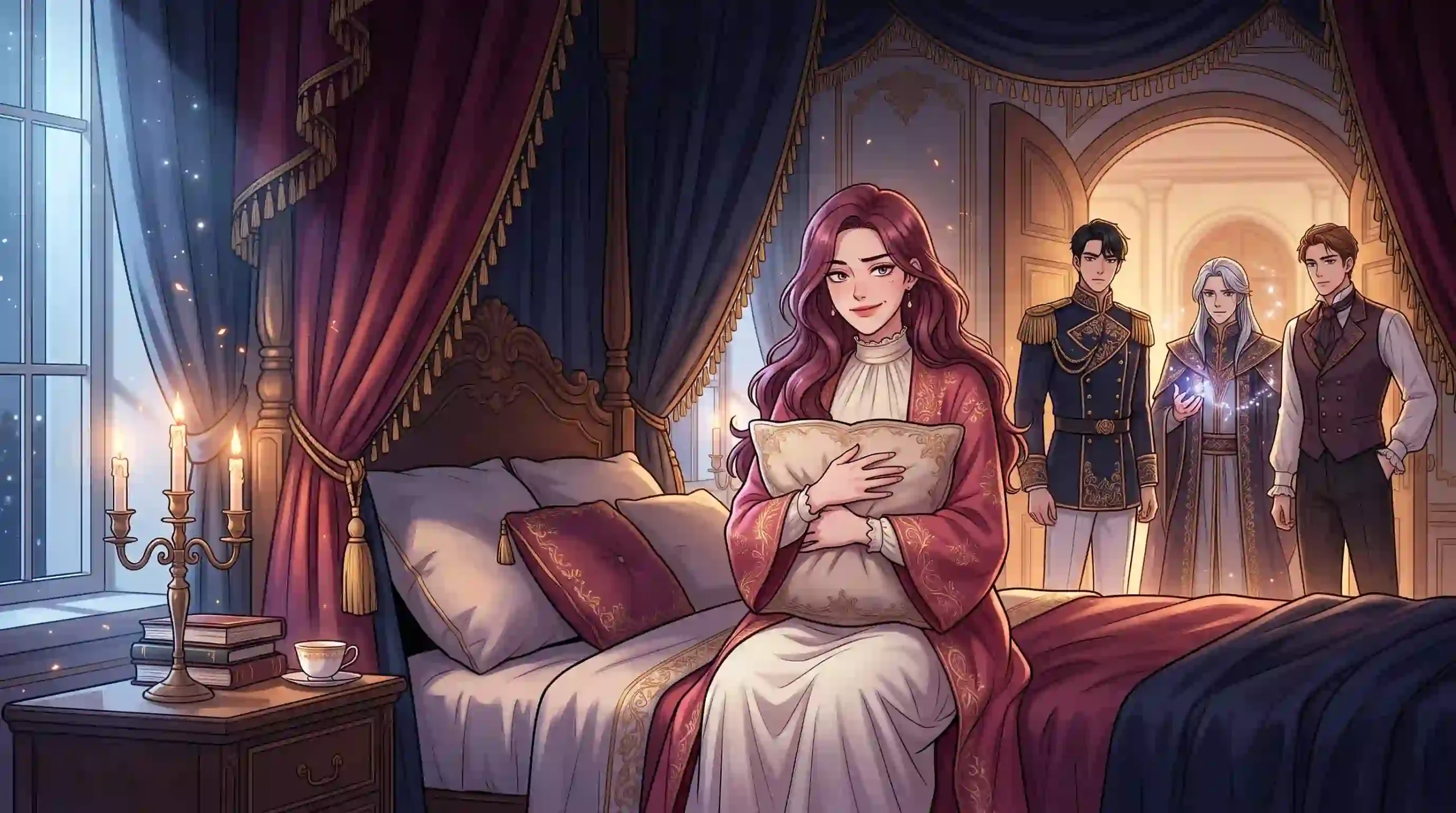
Romance-fantasy readers often find a promising title, then have to piece together its premise, cast, genre, and reading options from scattered pages. That is particularly annoying when a villainous plot centers the romantic mayhem around the supporting cast. This guide to Get In My Bed, Supporting Male Leads! gathers the confirmed details in one place, explains the central hook without major spoilers, and helps you decide whether this Korean webcomic suits your reading mood.
Supporting Male Leads: What Is Get In My Bed? about?
Short answer: It is a romance-fantasy manhwa about Charlotte Lindsey, a woman reborn as a villainess who wants a quiet life but becomes the only comfort for several powerful men troubled by mysterious sleeplessness. The official descriptions name a Crown Prince, an archmage, and Charlotte’s stepbrother among the men who seek her out. The result is a lighthearted, supernatural setup built around a heroine trying to avoid the original story while its supporting male leads crowd into her life.
The title turns a familiar romance-fantasy pattern on its head. Instead of chasing the central hero or following the expected plot, Charlotte tries to keep her distance from it. Her plan sounds sensible—until the men connected to that plot need her help, and their visits threaten the peaceful routine she wanted.
Series details at a glance
| Detail | What official listings confirm | What readers should know |
|---|---|---|
| English title | Get In My Bed, Supporting Male Leads! | Although search engines can match the terms without punctuation, make sure to use it when searching official platforms. |
| Original title | 서브 남주는 내 침대로 오세요 | Tapas lists this Korean title alongside the English edition. |
| Format | Comic/webcomic, commonly described as a manhwa | It is a digital comic series, not a prose-only novel. |
| Main character | Charlotte Lindsey | The official synopsis describes her as a villainess after reincarnation or rebirth into the story. |
| Confirmed male characters | A Crown Prince, an archmage, and her stepbrother | These characters are not mentioned in the synopsis of the official English series blurbs. |
| Creators | misecho, CACO, and Oaen/oaen | Platforms list the three names together; this guide does not assign individual writing or art roles without a source. |
| Main genres and tags | Romance fantasy; Tappytoon also lists romantic comedy, reverse harem, reincarnation, nobility, curse, and lighthearted | Genre labels can vary by storefront and edition. |
| Central hook | Charlotte’s presence is presented as a remedy for the men’s unexplained sleeplessness | The publisher descriptions do not explain every rule or consequence of the curse. |
| Audience label | Tappytoon recommends the series for readers aged 16 or older | Ratings can differ by platform and region; check the label where you read. |
| Update information | Tapas and Tappytoon list Monday updates | Treat the current platform page as the current schedule since release schedules are subject to change. |
| Catalog snapshot | Tapas showed 47 episodes; Tappytoon marked Episode 40 as the Season 1 finale | These are platform-specific listings, not proof that every edition has the same episode count or that the full series has ended. |
The quick guide to get in my bed supporting male leads is simple: expect a reincarnated-villainess premise, a supernatural sleep problem, and a growing group of high-status men who complicate Charlotte’s attempt to stay out of trouble. The official pages agree on those core ingredients, even though each storefront presents its own tags, access rules, and catalog view.
The story premise, without major spoilers
The opening concept is based on a stark discrepancy between Charlotte’s objective and the demands of the outside world. She has been cast as a villain in a fictional tale and would like to live in silence rather than suffer the same fate as the character. She therefore tries to avoid the main plot and the people who might pull her back into it.
That plan falls apart when the supporting male leads begin appearing at her door. They are not there because Charlotte has decided to pursue them; the official synopsis frames their visits around a practical, strange need. Each man struggles with mysterious sleeplessness, while Charlotte becomes the one person who can help him rest.
The bedroom in the title signals the story’s comic premise, but the official listing describes a broader problem than a simple invitation. Charlotte’s room becomes the setting for repeated requests, awkward boundaries, and mounting attention. Her challenge is not just to offer comfort; it is to stop a small act of kindness from turning into a constant claim on her time and space.
The series has a distinct engine for serialized storytelling because of this tension. Every new visit can create a funny misunderstanding, reveal another man’s vulnerability, or make Charlotte question whether she can remain separate from the story she hoped to escape. Those are possibilities suggested by the premise, not a chapter-by-chapter account of events.
Who is Charlotte Lindsey?
Charlotte Lindsey is the heroine and the emotional center of the premise. The official publisher copy identifies her as the villainess into whose life the protagonist has been reborn, but the brief listings do not provide a full biography or a detailed account of her previous life. A careful reader guide should not fill that gap with an unverified backstory.
Her first stated wish is modest: she wants peace. She does not begin by declaring that she will win over the men or rewrite every part of the fictional world. Rather, she attempts to deviate from the planned storyline, so every new guest is a test of her limits and her capacity to maintain control over her own ideas.
The hook makes Charlotte’s kindness both a strength and a source of trouble. She helps people who need rest, yet the more useful she becomes, the harder it is to protect her private life. Readers who like heroines who handle issues via negotiation and observation rather than by accepting every role that others assign them may find her relatable because of this dilemma.
Charlotte also sits at the meeting point of two familiar character ideas: the “villainess” from reincarnation romance and the caretaker whose help becomes indispensable. The series can play with the gap between the label attached to her and the choices she makes now. Readers can watch for whether other characters respond to Charlotte as a person or as a convenient cure.
Who are the supporting male leads?
The official synopsis for Get In My Bed, Supporting Male Leads! identifies three male roles clearly enough to guide new readers, while leaving their personal names out of the short English description. That distinction matters: the roles below are confirmed, but extra biographies, powers, rivalries, and romantic outcomes should come from the comic itself rather than a guess.
| Male character | Confirmed identity in the official synopsis | Why the role matters to the premise | Details not confirmed by the listing |
|---|---|---|---|
| Crown Prince | A member of the royal family and one of the men who seeks Charlotte’s help | His rank brings courtly status and public pressure into a story that Charlotte wants to keep private | His personal name, personality, political agenda, and eventual relationship with Charlotte |
| Archmage | A powerful magic user named by role | His presence connects the sleep problem to the series’ fantasy setting and makes magical explanations feel possible | His personal name, exact powers, history, and the precise rules of the curse |
| Stepbrother | Charlotte’s stepbrother, included among the men who come to her room | The family connection makes personal boundaries and household dynamics part of the setup | His name, the details of their family history, and how the story handles that relationship over time |
This cast list explains why the title’s unusual phrase attracts curiosity. The central group is not introduced as a random set of strangers: the publisher’s blurb chooses characters with different ties to power, magic, and Charlotte’s home life. That gives the story several possible sources of conflict without requiring the reader to know a long fantasy-world glossary first.
The official synopsis does not identify a single endgame partner. A “reverse harem” label tells readers to expect multiple male characters to matter to the romantic setup; it does not, by itself, reveal whom Charlotte chooses, whether she chooses anyone, or how the story resolves their feelings. Readers who care about the final pairing should treat early marketing copy as a premise, not a spoiler.
How does the sleeplessness hook work?
The verified premise is concise: several elite men suffer from mysterious sleeplessness, and Charlotte is described as their only cure or as a human sedative. Their ability to rest is connected to sharing her bed or staying close to her, according to the official series descriptions. That is the central supernatural device, not a claim about real sleep treatment.
The official blurbs leave important rules open. They do not set out the full origin of the curse, explain whether every man experiences the same symptoms, or specify how long the relief lasts. The safest spoiler-free summary is that the characters’ sleep problem creates repeated visits and forces Charlotte into close, awkward contact with men she hoped to avoid.
That open-ended mechanism can serve both comedy and drama. On the comic side, a heroine who wants a quiet room gets a queue of powerful visitors. On the emotional side, dependence can become uncomfortable if one person’s need begins to override another person’s privacy. The series’ premise invites readers to pay attention to how Charlotte negotiates that imbalance.
A helpful reading lens is to ask three questions as the story develops: What does Charlotte agree to? Do the men respect the limits she sets? Does the fantasy solution address the cause of the sleeplessness or only its symptoms? These questions make the romance easier to evaluate without assuming that the story has already answered them.
Is this a reverse-harem romance?
Tappytoon tags the series as reverse harem, while Tapas classifies it as romance fantasy and Lezhin lists it under romance. The labels give readers a useful signal: several male characters form part of the romantic framework around one central heroine. They do not guarantee a particular relationship structure or ending.
For readers who enjoy the trope, the appeal often comes from contrast. Different characters can express status, temperament, and vulnerability in different ways, while the heroine decides how much access each one gets to her life. Here, the sleep-related need gives the men a concrete reason to return, while Charlotte’s wish for peace creates resistance to instant romantic compliance.
For readers who prefer one clearly defined couple from the start, the growing cast may feel less focused. The series appears to make the group dynamic part of its hook, so the pleasure lies partly in observing how attention shifts and how Charlotte manages it. If you want to avoid spoilers, begin with the official free opening episodes where available instead of searching fan discussions for endgame theories.
Main tropes and themes to watch
The series combines recognizable romance-fantasy ingredients with a specific sleep-and-bed-sharing premise. These are useful semantic topics for readers looking for related manhwa, but they should not be mistaken for scene-by-scene claims about later episodes.
- Villainess reincarnation: Charlotte enters a story world in a role that carries an expected reputation and a potentially dangerous path.
- Supporting male leads: Characters usually treated as secondary in a fictional romance move into the center of Charlotte’s everyday life.
- Reverse harem: The official Tappytoon genre tags signal multiple male characters in the romantic setup.
- Fantasy nobility: A Crown Prince and a high-status cast place the romance in a courtly world.
- Curse or magical condition: The official tag set includes a curse, and the synopsis links the men’s sleeplessness to an unusual supernatural problem.
- Forced proximity: The sleep remedy brings characters into Charlotte’s private space, creating comic tension and a reason for repeated encounters.
- Quiet-life heroine: Charlotte’s wish to avoid the main plot clashes with the attention she receives.
- Lighthearted romantic comedy: Tappytoon uses lighthearted and romantic-comedy tags, signaling a playful presentation alongside fantasy and romance.
The strongest thematic question may be about care and consent. Charlotte can be generous without owing every visitor unlimited access, and the men can be vulnerable without their needs automatically outranking hers. That reading does not spoil a particular outcome; it gives readers a clear standard for judging how the relationships develop.
A second theme is the difference between reputation and choice. “Villainess” is a role Charlotte inherits from the story’s setup, not a complete description of the person she becomes. Readers can watch whether the narrative lets her act beyond that label and whether the supporting characters learn to see her as more than a convenient solution.
What makes the premise stand out?
Many reincarnation romances begin with a heroine trying to avoid a bad ending, win safety, or change a known plot. Get In My Bed, Supporting Male Leads! adds a practical obstacle to that familiar setup: Charlotte’s usefulness draws the very characters she wants to avoid. Her success at staying out of trouble creates new trouble, which gives the premise an easy-to-understand comic loop.
The sleep mechanic also gives the story a repeatable reason for encounters. Instead of relying only on coincidence, the official synopsis ties the men’s visits to a shared condition and Charlotte’s unusual ability to help. Each visit can bring a different social role into the same small setting, from royal authority to magical expertise to a family relationship.
The title makes the hook memorable, but the more interesting question is what the arrangement does to the characters. The men arrive with a need, and Charlotte has to decide how to respond. That structure can support humor, romantic tension, and character growth at the same time, especially if the story gives her meaningful choices rather than treating her as a cure with no say.
For readers, the combination offers a simple entry point. You do not need to memorize a large cast or a complex magic system before understanding the core conflict: Charlotte wants quiet, the men need sleep, and the solution keeps drawing them together. That clarity makes the series easy to sample while leaving room for the fictional world to broaden as episodes continue.
Episode and chapter guide
Readers often search for a chapter-by-chapter guide before starting a serialized comic. The official listings reviewed for this article show episode numbers, publication dates, schedule labels, and a season-finale marker, but they do not provide a complete official synopsis for every episode. The table below maps the verified release information for get in my bed supporting male leads without inventing plot events.
| Episode or chapter range | Official listing information | Safe reading note |
|---|---|---|
| Episodes 1–4 | Tappytoon lists these episodes with the initial release date of 25 March 2026; the first four appeared as free in the captured listing | Begin here for the setup; free access and unlock rules can change. |
| Episodes 5–20 | Tappytoon also dates this initial group to 25 March 2026 | The listing confirms episode numbers and access labels, not individual plot summaries. |
| Episodes 21–39 | Tappytoon shows weekly dates from 1 April through 3 August 2026 | Treat these dates as the platform’s schedule record; they do not reveal the episode contents. |
| Episode 40 | Tappytoon labels this installment “S1 Finale” and dates it 10 August 2026 | A season finale marks a season boundary, not necessarily the end of the whole series. |
| Episodes 41–47 | Tapas showed 47 episodes in its catalog on the fact-check date, 10 October 2026 | The Tapas count is a platform snapshot; the listing reviewed did not supply a complete official synopsis for each of these entries. |
The two storefronts do not show identical catalog totals in the pages reviewed. That can reflect different release timing, season presentation, or platform catalog structure; the official listings alone do not explain the difference. Check the chosen platform directly for the newest episode count, current free window, and whether a season break affects the release schedule.
This is a deliberate accuracy choice. A chapter table can help readers plan a start, but invented mini-summaries would create false certainty and could spoil or misrepresent the comic. If you want a true episode-by-episode plot guide, build it only after reading each official installment and mark clearly which details contain spoilers.
Where can you read it officially?
Official English listings for the series appear on Tapas, Tappytoon, and Lezhin Comics. Tapas presents it as a romance-fantasy comic, Tappytoon provides a series page with genre tags and episode information, and Lezhin lists the title under creator CACO. These are the verified places to check for licensed availability in English; the actual catalog can depend on region and account settings.
Use the platform’s own page rather than an unofficial repost. Licensed editions support the people and companies that make the comic, preserve the approved translation, and show current release or unlock rules. They also give readers a reliable place to confirm the edition’s age label and whether a free episode or waiting period is available.
Before you start, compare a few practical details:
- Availability: A title can appear in a publisher search result but still have regional limits.
- Episode count: Platforms can show different totals, as the current listings illustrate.
- Unlock method: Free episodes, daily passes, coins, or subscriptions can change by storefront and time.
- Age guidance: Tappytoon currently lists a 16+ recommendation; another platform may display a different label.
- Update day: The series pages advertise Monday updates, but seasonal breaks or local release timing may affect what you see.
Searching for get in my bed supporting male leads can surface unofficial mirror pages alongside licensed listings. Check the exact series title and creator credits—misecho, CACO, and Oaen—before you choose a result. This small check reduces the risk of landing on an incomplete, unauthorized, or mislabeled copy.
Who is likely to enjoy this manhwa?
This series is a strong fit for readers who enjoy romance fantasy with a mischievous premise and a heroine who wants to avoid the expected plot. The official tags point toward reincarnation, nobility, a curse, a lighthearted tone, and reverse-harem dynamics. If those are already on your reading list, the setup offers a clear reason to sample the opening episodes. [2]
It may especially suit readers who like:
- Villainess and reincarnation stories where the heroine tries to change or sidestep a known role.
- Multiple romantic interests who enter the heroine’s life for different reasons.
- Courtly fantasy settings with princes, mages, and family ties.
- Comedies built on a repeated misunderstanding or practical problem.
- Supernatural premises that create forced proximity and romantic tension.
- A central character who wants boundaries and a quieter life, even when other characters keep seeking her out.
It may be a weaker match for readers who want a serious political fantasy, a single couple from page one, or a plot that avoids repeated close-contact situations. The official platform tags describe a romantic and lighthearted direction, so readers looking for grim conflict should check the preview first. A preview helps you judge the art, pacing, dialogue, and humor for yourself rather than relying only on a short synopsis.
The official blurb also names Charlotte’s stepbrother among the men connected to the premise. If family-boundary themes affect your comfort, keep that relationship detail in mind before reading. The listing does not explain the exact portrayal or outcome, so it is better to consult the comic’s own age label and opening episodes than to assume what happens.
What the official sources confirm—and what they do not
A trustworthy reader guide separates confirmed facts from interpretation. The official pages establish the English title, creator credits, basic premise, central character, a few male roles, genre labels, platform release information, and Tappytoon’s audience recommendation. They do not provide a full character encyclopedia or a complete chapter synopsis in the pages used for this guide. [1][2][3]
| Topic | Confirmed by official listings | Not established by the listings reviewed |
|---|---|---|
| Charlotte’s role | She is a villainess after rebirth/reincarnation and wants peace | Her complete previous identity, full history, and every detail of the original story |
| Male cast | Crown Prince, archmage, and stepbrother appear in the synopsis | Their personal names, detailed biographies, and endgame status |
| Sleep problem | The men suffer from mysterious sleeplessness; Charlotte is presented as their cure | The curse’s complete origin, rules, duration, or final solution |
| Genre | Romance fantasy; Tappytoon adds reverse harem and other tags | A guaranteed love-triangle structure or final romantic pairing |
| Publication | Creator names and platform listing details are visible | A universal episode total shared by every platform |
| Content guidance | Tappytoon recommends age 16+ | A detailed content-warning list or identical regional ratings |
This fact boundary protects readers and the creators. It also makes the article more useful: readers can see which points come from publisher copy and which points are a critical lens for interpreting the premise. A review that has personally read the whole series should add its own experience, scene references, and spoiler labels rather than presenting speculation as fact.
Topic map: important terms and associated search queries
A topical guide should connect the series to the people, roles, tropes, and practical questions readers actually search. The following table clearly identifies the main characters and how they relate to the narrative. It can also help an editor build related supporting pages without repeating the same synopsis everywhere.
| Entity or topic | Relationship to the series | Useful reader question |
|---|---|---|
| Get In My Bed, Supporting Male Leads! | The licensed English title of the comic | What is the story about, and where can I read it? |
| Charlotte Lindsey | The villainess heroine and focal character | Why do the male characters keep visiting her? |
| Crown Prince | One of the named roles in the official synopsis | What does his royal status add to the fantasy-romance setup? |
| Archmage | A magical figure among the supporting male leads | How does the supernatural sleep premise work? |
| Stepbrother | A member of Charlotte’s family named in the official synopsis | What family and boundary dynamics should a reader know about? |
| Reincarnated villainess | A central romance-fantasy trope | Does Charlotte follow the original villainess plot or try to avoid it? |
| Reverse harem | A Tappytoon genre tag | Does the story feature several potential romantic interests? |
| Insomnia and curse | The supernatural problem that draws the men to Charlotte | Is the sleep condition explained as magic in the story? |
| Tapas, Tappytoon, and Lezhin Comics | Official English listings verified for this guide | Which licensed platform has the episode or access option I want? |
| misecho, CACO, and Oaen | Creator names credited by official listings | Who made the comic? |
This map keeps the reader’s journey connected: a person may begin with the title, next look for the cast, then ask about genre, spoilers, age suitability, and legal reading options. A strong central page should answer those questions directly and point future supporting articles toward narrower subjects such as villainess manhwa recommendations, reverse-harem romance, or official platform reading guides.
FAQs about Get In My Bed, Supporting Male Leads!
What is the story of Get In My Bed, Supporting Male Leads!?
Short answer: Charlotte Lindsey is reborn as a villainess and wants a quiet life, but several male characters seek her help with mysterious sleeplessness. The official blurb names a Crown Prince, an archmage, and her stepbrother among them. The series blends romance fantasy with a supernatural, lighthearted setup.
Who are the supporting male leads?
Short answer: The official English synopsis names the Crown Prince, an archmage, and Charlotte’s stepbrother. The publisher listing does not give their personal names or confirm a final romantic pairing. For fuller characterization, read the licensed episodes rather than relying on unsourced character lists.
What genre is the series?
Short answer: Tappytoon classifies this romance-fantasy comic as romantic comedy, reverse harem, reincarnation, nobility, curse, and cheerful. Storefront labels can differ, so use the platform where you plan to read for the current tags.
Is the comic complete, and how many episodes are available?
Short answer: The official pages reviewed do not support calling the entire series complete. On October 10, 2026, Tapas aired 47 episodes, whereas Tappytoon designated Episode 40 as its Season 1 conclusion. A season finale differs from a series finale. Check the current listing for later releases.
Where can I read it legally?
Short answer: Official English listings appear on Tapas, Tappytoon, and Lezhin Comics. Availability, pricing, free unlocks, and episode counts may vary by location and platform, so use the current official app or storefront page.
Is it suitable for younger readers?
Short answer: Tappytoon recommends the series for ages 16 and older. Ratings and content labels can vary across regions and services, so check the label on your chosen official platform and review the preview if you have specific content concerns.
Why the title earns a place on a romance-fantasy reading list
Get In My Bed, Supporting Male Leads! has an easy-to-grasp premise and a built-in source of recurring conflict: a heroine who wants a peaceful life becomes the one person several powerful men need. Multiple romantic protagonists, a supernatural sleep issue, and villain reincarnation give the novel a unique hook without requiring new readers to familiarize themselves with a complex universe before they start.
Its appeal will depend on how much you enjoy the central dynamic. Readers who like warm comedy, magical problems, and a heroine negotiating unwanted attention may find Charlotte’s situation entertaining. Readers who care most about personal boundaries can also watch for how the story balances the men’s need for rest with Charlotte’s right to choose when and how she helps.
If the premise sounds like your kind of romance fantasy, start with the first official episode and let the comic’s own pacing, art, and character choices make the case. Then share which supporting character has the most interesting introduction, or which trope you hope the story handles with care. That response gives other readers a more useful recommendation than a vague claim that everyone will love it.