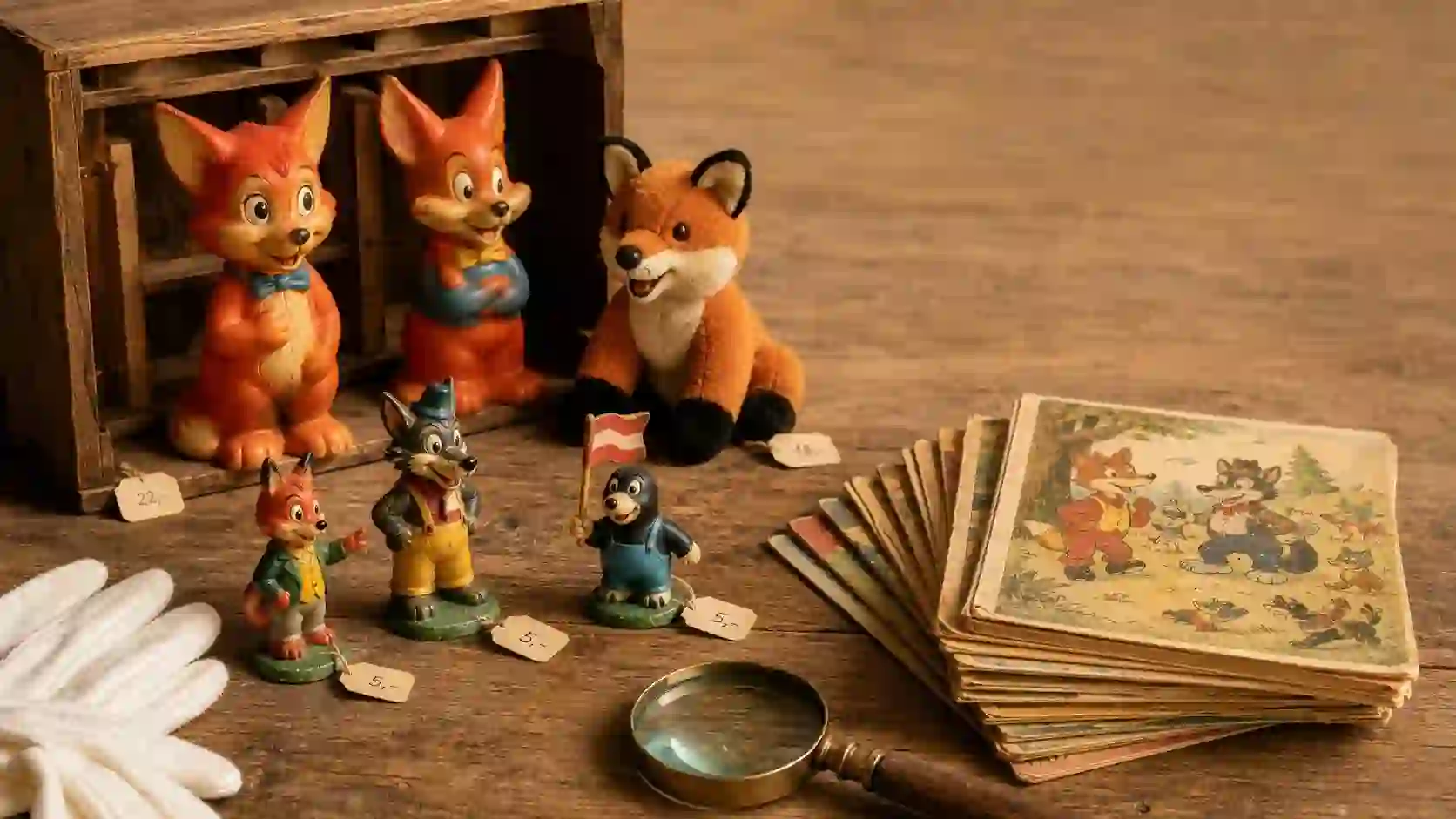
Fix und foxi figuren are the plastic, rubber, and plush toys made under licence from Rolf Kauka’s German comic brand. The comic launched in May 1953 as Till Eulenspiegel. The fox twins first appeared in issue 6, and by issue 29 in early 1955 the magazine carried their name.
Toy makers started moulding the cast in the early 1960s, when the weekly magazine hit print runs near 400,000 copies. Every German child knew the characters, so every toy factory wanted the licence.
Today the term covers roughly six decades of production. That span runs from soft rubber squeakers of the 1960s to McDonald’s Happy Meal giveaways of the year 2000.
Why Collectors Chase These Figures in 2026
Nostalgia sells. The buyers now in their fifties and sixties grew up with these toys and finally have money to spend on them.
Supply keeps shrinking. Hard PVC from the 1960s cracks, soft rubber splits, and painted details rub off. Fewer clean examples surface every year.
Interest also gets fresh fuel from the brand side. Your Family Entertainment AG runs the Fix&Foxi TV pay channel and licenses the characters for merchandising across four continents, which keeps the names in front of new families.
Here is the practical upside. Prices for common pieces stay low, so a beginner can build a serious display for under 200 euros.
The Three Big Makers Behind Fix und Foxi Figuren
Three names cover most of the market. Learn them and you can date almost anything you hold.
Heimo. Heimo GmbH started in Mölln in 1963, founded by Hans Heidmann after his time at the American toy giant Louis Marx. The firm produced around 500 designs and sold roughly 90 million figures across Europe before it collapsed. Its Kauka line includes Fix, Foxi, Lupo, Pauli, Oma Eusebia, Mausi, and Egon, mostly 4 to 7 cm tall.
Bullyland. The company behind the Bully mark began on 1 June 1973 and still hand paints figures at its German site today, now under Bullyworld GmbH in Nußdorf. Its 1990 series gave collectors a set of larger, cleaner moulds, plus the famous Reno shoe shop advertising pieces with Lupo.
Kauka’s own production. Pieces stamped “C. Rolf Kauka prod.” are the soft rubber squeakers of the 1960s, usually 21 to 25 cm, often made in Hong Kong. These sit at the top of most wish lists.
Manufacturer Comparison Table
| Maker | Active Years | Typical Height | Material | Base Mark | Common Price Band |
|---|---|---|---|---|---|
| Heimo | 1963 to about 1980 | 4 to 7 cm | Hard PVC, hand painted | Heimo, circle with cross, or none | 2 to 30 euros |
| Kauka production | 1960s | 21 to 25 cm | Soft rubber with squeaker | C. Rolf Kauka prod. | 30 to 130 euros |
| Bullyland / Bully | 1990 series | 6 to 12 cm | Soft PVC, hand painted | Bully, (c) Rolf Kauka | 15 to 40 euros |
| Fischer | 1980s | 5 cm | Hard plastic | Fischer | 5 to 15 euros |
| McDonald’s promo | 2000 | 10 to 11 cm | Plastic, some with motion | McDonald’s, 2000 | 2 to 10 euros |
| Schuco | 1960s | 24 cm plush | Plush, Bigo Bello line | Schuco, model number | 25 to 60 euros |
| Plush makers | 1991 to 1999 | 16 to 18 cm | Plush | (c) Rolf Kauka | 10 to 25 euros |
How to Tell If Your Vintage Kauka Figures Are Real
Start at the base. Turn the figure over and look for a moulded stamp, not a sticker. Originals carry the maker name, the copyright line, or both.
Then check the material. Heimo pieces feel dense and rigid with a slightly greasy surface after decades. Kauka squeakers feel like a soft bath toy and give when you press the belly.
Next, study the paint. Hand painted originals show brush texture, tiny overlaps at colour borders, and wear that follows handling, usually on the nose, ears, and feet.
Authentication Checklist
- Base stamp: maker name, “C. Rolf Kauka prod.”, or “Bully”
- Copyright year that matches the mould style
- Paint wear in contact areas, not random scratches
- Correct eye style for the period, since the artwork changed twice
- Squeaker that still works on soft rubber pieces
- Size that matches a known catalogue entry
What Drives the Value of a Kauka Figure
Six factors decide the number. Work down the list and price honestly.
- Maker. Kauka soft rubber and early Heimo lead the market.
- Character. Fix, Foxi, and Lupo sell fastest. Obscure side characters can surprise.
- Size. Bigger figures command more, with 21 cm plus in its own class.
- Condition. Paint loss hurts more than scuffs.
- Completeness. Original tags, boxes, or accessories add 30 to 60 percent.
- Scarcity. Variant paint jobs and sample pieces carry a premium.
Condition Grading Table
| Grade | Description | Price Impact |
|---|---|---|
| Mint | Unplayed, full paint, no marks | Full price, often double the average |
| Near mint | Light shelf wear, tiny paint loss | 80 to 100 percent of full price |
| Excellent | Minor scuffs, crisp colours | 60 to 80 percent |
| Good | Visible wear, dull paint, sound body | 35 to 60 percent |
| Played | Chips, repaint, or repairs | 10 to 30 percent |
| Damaged | Cracks, splits, missing parts | Value as a parts donor only |
Fix und Foxi Figuren Price Guide for 2026
These figures reflect asking prices observed on German marketplaces in September 2026. Treat them as a starting point. Sold prices usually land 10 to 20 percent lower.
| Item | Era | Typical Asking Price |
|---|---|---|
| Heimo Fix or Foxi, 5 cm, played | 1970s | 1 to 4 euros |
| Heimo Lupo, 5 to 6 cm, good | 1960s to 1970s | 4 to 16 euros |
| Heimo four figure lot | 1970s | 15 to 60 euros |
| Heimo Oma Eusebia, 11 piece series | 1970s | 18 to 30 euros |
| Bully 1990 series figure | 1990 | 15 to 39 euros |
| Bully Reno advertising Lupo | 1990 | 20 to 35 euros |
| Kauka soft rubber squeaker, 22 cm | 1960s | 30 to 80 euros |
| Kauka squeaker pair, near mint | 1960s | 80 to 130 euros |
| Kauka squeaker with ball, clean | 1960s | 100 to 130 euros |
| Fischer Pauli family, 5 cm | 1980s | 8 to 15 euros |
| McDonald’s Happy Meal figure | 2000 | 2 to 10 euros |
| Schuco Bigo Bello plush Lupo | 1960s | 25 to 60 euros |
| Plush fox, 16 to 18 cm | 1990s | 10 to 25 euros |
Two lessons hide in that table. Single common pieces rarely pay shipping, so buy them in lots. Large squeakers and complete series carry the real money.
Where to Find These Figures Online in Germany
Four channels cover nearly everything. Use all four, since stock rotates fast.
- eBay Germany. The deepest pool. Filter by “Artikelstandort: Deutschland” to cut shipping.
- Kleinanzeigen.de. Local listings with lower prices and room to negotiate in person.
- Specialist dealers. Shops such as Hoppla Stuff and comic trade sellers stock graded, described pieces.
- Flea markets and toy fairs. The Spielwarenmesse circuit and Sunday markets still produce unlabelled boxes.
Set saved searches for “Fix und Foxi Figur”, “Kauka Figur”, and “Heimo Fix Foxi”. Alerts beat browsing.
How to Spot Fakes, Repaints, and Fantasy Pieces
Straight fakes are rare. The bigger risk is a repaint sold as original.
A repaint shows glossy modern paint, sharp colour borders, and no wear at all on contact points. Compare it against a known piece and the difference jumps out.
Watch for fantasy figures too. Sellers sometimes list unlicensed lookalikes or modern bootlegs as vintage Kauka items. If a piece has no base stamp, no period paint style, and a suspiciously low price, walk away.
Also check for “Made in Hong Kong” or “Germany” mouldings. Both appear on genuine period pieces and both support authenticity.
How to Clean, Repair, and Store Your Figures
Clean gently. Lukewarm water, a drop of mild soap, and a soft brush will lift decades of dust without lifting paint.
Never soak soft rubber. Water reaches the squeaker and ruins it. Dry everything in shade, away from radiators and sunlight, which fades red and orange pigments fast.
For cracks in hard PVC, use a two part epoxy applied with a toothpick, then touch up with matching acrylic. Keep the repair honest and mention it in any listing.
Storage Rules That Protect Value
- Store upright in a closed box, out of direct light
- Wrap pieces in acid free tissue, never newspaper
- Keep a stable temperature, since heat softens old PVC
- Photograph every piece for insurance
- Label each item with maker, size, and purchase date
The Kauka Character Guide for Figure Hunters
Collectors chase names, not just foxes. This table maps the cast and tells you what to expect.
| Character | Role in the Comic | Collectible Notes |
|---|---|---|
| Fix | Twin fox, red outfit | Highest demand, most reproductions of paint wear |
| Foxi | Twin fox, the schemer | Matches Fix in price, sells in pairs |
| Lupo | Lazy wolf, yellow dungarees | Widest variety, from 5 cm to Reno ad pieces |
| Lupinchen | Lupo’s cousin | Scarcer than Lupo in good paint |
| Pauli | Mole boy | Strong seller, several makers and variants |
| Oma Eusebia | Grandmother figure | Part of the 11 piece Heimo series |
| Professor Knox | Inventor | McDonald’s car version is a fun display piece |
| Diabolino | Little devil, added in 1964 | Rare as a figure, valuable when found |
| Hops und Stops | Troublemaker duo | Niche demand, cheap entry point |
| Bussi Bär | Bear character | Often sold in mixed Kauka lots |
| Mischa | Boy adventurer | Fewer figures, mostly promotional |
| Mausi and Egon | Side characters | Heimo produced both, prices stay modest |
Comics or Figures: Where Should You Spend?
Both sides of the hobby reward patience. They behave differently, though.
Comics offer a longer ladder. A common 1980s issue costs a euro or two, while a clean 1960s annual can reach four figures. Grading is straightforward and the archive is well documented by Kaukapedia, the fan run reference that lists every issue, artist, and insert.
Figures offer faster emotion. They sit on a shelf, they survive rough hands, and they start at pocket money. The downside is thinner documentation, since no single catalogue covers every mould.
| Factor | Comics | Figures |
|---|---|---|
| Entry price | 1 to 5 euros | 2 to 10 euros |
| Storage risk | Light, moisture, creasing | Cracking, paint loss, splits |
| Documentation | Excellent | Fragmented |
| Display appeal | Low | High |
| Liquidity | Very high | Moderate |
How the TV Series Changed the Figure Market
The animated series first aired in Germany in 2000 as a co production between Kauka, RTV, and the Spanish studio D’Ocon Films. It reached 52 episodes and dozens of countries.
That wave pushed licensing hard, and the McDonald’s Happy Meal range of 2000 arrived with it. Those skateboarding foxes flooded children’s rooms, which means they stay cheap today.
The brand kept moving. Your Family Entertainment AG launched the Fix&Foxi TV pay channel in 2008, and the same company licensed the characters for digital collectibles with 361/DRX, which brought animated AR figures to phones.
For collectors, this matters in one way. New exposure keeps pulling fresh buyers into a niche that most outsiders forget exists.
The Shoe Shops, Giveaways, and Happy Meals That Spread These Toys
Licensed toys travel through odd channels, and that is exactly why they survive.
The Reno shoe chain ran a long promotion with Bully figures in the early 1990s. A reclining Lupo with a Reno sticker on his chest is one of the most recognisable advertising pieces in the whole hobby.
McDonald’s followed in 2000 with a Happy Meal range. Foxi arrived on a skateboard, Fix followed, and Professor Knox showed up with a small car. The plastics are thin, so expect wear, and expect low prices.
Kauka also let the foxes sell everyday goods. You will find them on WMF children’s cutlery, on bedroom lamps, on erasers shaped like the characters, and on keyrings. These items sit outside strict figure collecting, yet they complete a display cheaply.
Two practical takeaways follow. Advertising pieces often carry a sticker rather than a paint detail, and that sticker decides much of the price. Giveaway toys flood the market in bulk, so never pay single piece prices for a lot you can win whole.
Kauka Club Badges, Paper Toys, and the Pichelsteiner
The comic side of merchandising deserves its own shelf.
Kauka ran a reader club for years. Members received badges, membership cards, posters, and club sheets, and those paper items now sell well because so few families kept them.
The magazine also printed paper models and craft inserts. Bastelbögen, as collectors call them, folded into planes, ships, and wagons. An uncut sheet is worth far more than an assembled one.
Then there are the Pichelsteiner, Riccardo Rinaldi’s stone age characters that ran inside the comic from 1971. Bully produced them as figures in 1974, and they attract a different crowd of buyers who collect prehistoric playsets.
Add the seven Schnuckel, Kauka’s answer to the Smurfs, and you have a whole satellite of characters to hunt when the main foxes get too expensive.
First Steps to Take When Inheriting a Collection
Inherited boxes of fix und foxi figuren arrive with no notes and a lot of sentiment attached. Work slowly.
Sort everything into three piles: hard plastic, soft rubber, and plush. Count the pieces and photograph the whole lot before you move anything.
Then photograph each base stamp. That single image answers most identification questions and protects you against a bad sale later.
Finally, resist the urge to clean everything on day one. A gentle wipe is safe. Aggressive cleaning is not, and it cannot be undone.
How to Repair Damaged Figures Without Losing Value
A repair can rescue a figure or erase its worth. The rule is simple: keep it reversible and keep it visible.
Tighten loose joints with a drop of thin cyanoacrylate on a pin, never a full glue bath. Rebuild missing ears with epoxy putty, sand to shape, and paint with a fine brush.
Replace a dead squeaker only if you can open the seam cleanly and close it without a scar. Otherwise leave it silent and say so.
Always document your work. Photograph the figure before, during, and after, and keep those images with the piece.
How to Start a Fix und Foxi Figuren Collection on a Budget
You can build a credible display for under 200 euros if you buy with a plan.
Step 1. Pick a lane. Choose one maker or one character family. A focused set looks deliberate and grows in value faster.
Step 2. Buy lots, keep the best. A five figure Heimo lot at 20 euros often contains one 25 euro piece. Sell the rest and fund the next buy.
Step 3. Pay for paint, not size. A small figure in mint paint beats a large one with a rubbed face.
Step 4. Keep records. Track what you paid, where, and when. Your future self will thank you at insurance time.
Step 5. Join the community. Fan forums around Kaukapedia and German collector boards identify unknown pieces within hours.
Should You Sell or Keep Your Figures?
Selling works when you sell the story. Buyers pay more for a listing that names the maker, the era, and the exact size.
Photograph six angles, including the base stamp, under natural light. State every flaw plainly. Honest listings sell faster and draw fewer returns.
Price at about 15 percent above your target, since German marketplace culture expects offers. Offer combined shipping on multiple items and your conversion rate climbs.
Keep what makes you smile. The hobby pays in memory first and money second.
Fix und Foxi Figuren FAQs
What are fix und foxi figuren?
Fix und foxi figuren are licensed toys of the German comic characters created by Rolf Kauka in 1953. Production ran from the 1960s to the 2000s, and the main makers were Heimo, Bullyland, and Kauka’s own soft rubber line.
Which fix und foxi figuren are worth the most money?
The 1960s soft rubber squeakers stamped “C. Rolf Kauka prod.” lead the market, with clean 21 to 25 cm examples asking 30 to 130 euros. Early Heimo series figures in mint paint follow closely behind.
How do I date fix und foxi figuren?
Read the base stamp and the mould style. Heimo pieces date from 1963 to about 1980, Kauka squeakers to the 1960s, Bully series pieces to 1990, and McDonald’s figures to 2000.
Are fix und foxi figuren still being made today?
No regular retail line exists in 2026. Licensing rights sit with Your Family Entertainment AG, and new products appear as promotional or digital collectibles rather than shop shelves.
How do I clean fix und foxi figuren safely?
Use lukewarm water, mild soap, and a soft brush, then dry in shade. Never soak soft rubber figures, and never use solvents, since they strip the hand painted detail.
Where can I buy fix und foxi figuren safely?
eBay Germany, Kleinanzeigen.de, and specialist comic dealers are the three dependable routes. Always check the base stamp in the photos before you bid.
Start Your Hunt This Weekend
Open that shoebox again. Turn every fix und foxi figuren piece over, read the base, and sort by maker.
Then photograph the best three pieces, upload them to a collector forum, and ask for identification. You will learn more in one afternoon than in a month of browsing.
The best fix und foxi figuren never surface in a search filter. They surface when someone knows what they are holding. Now you do.