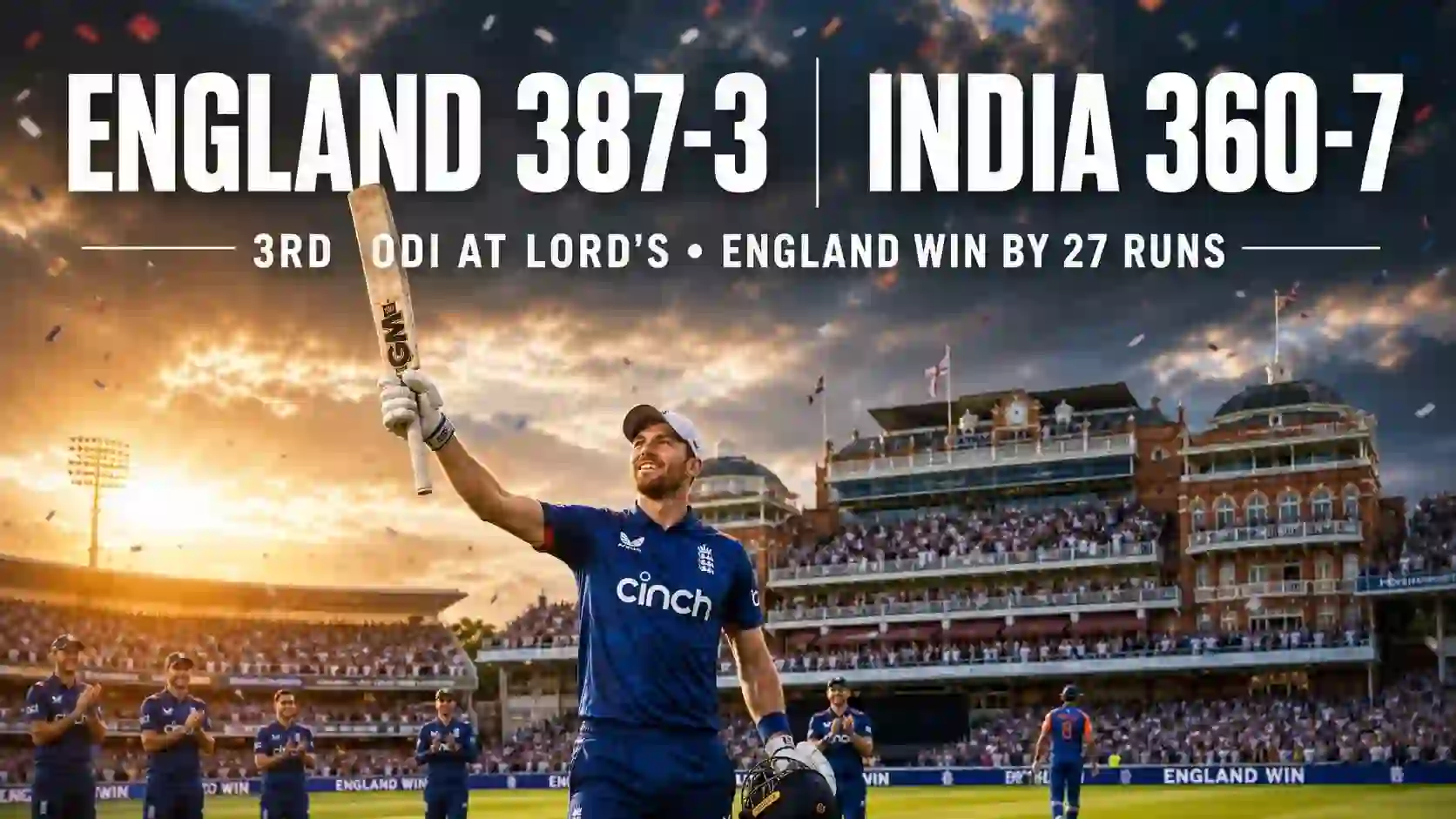
Fans searching for the england cricket team vs india national cricket team match scorecard want more than a final line. The 387-3 versus 360-7 result hides a 192-run opening stand, a 138 from Rohit Sharma, and five wickets for 31 runs that cost India the series. This full scorecard breakdown decodes every phase, every stat line, and every turning point from the third ODI at Lord’s.
The Lead
On a sun-drenched Sunday, 19 July 2026, Lord’s Cricket Ground in St John’s Wood hosted the decisive third ODI of India’s 2026 tour of England, in front of an estimated crowd of 28,000 for an 11:00 BST start. Harry Brook won his third consecutive toss of the series and put England in. The hosts replied with 387-3 in 50 overs, the highest ODI total ever posted at Lord’s, bettering the 334-4 England themselves had made against this same opposition in 1975. India chased on 360-7, and England won by 27 runs to take the Metro Bank three-match ODI series 2-1. Kumar Dharmasena and Martin Saggers umpired, with Sam Nogajski on the third umpire and Richie Richardson as match referee; the game aired on BBC, iPlayer and Radio 5 Live in the UK, and on JioCinema and Star Sports in India.
The verdict, in one line: Ben Duckett and Jacob Bethell built a record 192-run opening stand, Joe Root (74*) and Jos Buttler (41*) finished it off, and then Sam Curran’s 4-75 tore through the middle of India’s innings between the 43rd and 47th overs. Rohit Sharma’s magnificent 138 kept the chase alive until the 38th over, but once he fell, England needed just 40 of the final 68 balls’ worth of pressure to close out what became England’s first ODI series win over India since 2018.
Match Overview: England vs India 3rd ODI Scorecard at Lord’s
| Information | Match Details |
|---|---|
| Event | India tour of England 2026 – Metro Bank ODI Series (3rd ODI) |
| Game | England vs India |
| Date | Sunday, 19 July 2026 |
| Venue | Lord’s Cricket Ground, St John’s Wood, London |
| Attendance | Estimated 28,000 |
| Winner | England (by 27 runs) |
| Final Score | England 387-3 (50 overs); India 360-7 (50 overs) |
| Broadcast | BBC, iPlayer, Radio 5 Live (UK); JioCinema, Star Sports (India) |
Match context worth pinning to the scorecard: England won the toss and batted first; Jacob Bethell took Player of the Match, Joe Root took Player of the Series (249 runs in three games), and Cricinfo’s impact-rating named Rohit Sharma the match’s MVP on 178.95 points. Jasprit Bumrah sat out with a knee niggle, an absence Deep Dasgupta called a massive loss for India.
Core Match Statistics Overview
| Metric | England | India |
|---|---|---|
| Runs | 387 (3 wickets, 50 overs) | 360 (7 wickets, 50 overs) |
| Run rate | 7.74 | 7.20 |
| Fours | 42 | 38 |
| Sixes | 6 | 10 |
| Total boundaries | 48 | 48 |
| Extras | 26 (16 wd, 9 lb, 1 nb) | 10 (6 wd, 3 lb, 1 b) |
| Best bowling | Sam Curran 4-75 (7.50) | Prasidh Krishna 2-69 (6.90) |
| Highest opening stand | 192 (Duckett–Bethell) | 147 (Rohit–Gill) |
| Runs per wicket | 129.0 | 51.4 |
| Highest individual strike rate | Jos Buttler 315.38 (41 off 13) | Arshdeep Singh 250.00 (15 off 6) |
The Opening Stand Gap
- England’s 192 without a wicket is the highest opening stand at Lord’s and England’s highest against India in any format, and it started with 27 off the first three overs, a Lord’s ODI record in itself.
- India’s 147 from Rohit and Gill made this only the second ODI in history where both sides put on a first-wicket stand of 140+, which tells you how rarely a 388 target gets built on both ends.
Boundary Volume and Aggression
- Both innings produced exactly 48 boundaries, a genuine slugfest in a season of run-fests, yet the run rates split 7.74 to 7.20 because England’s 42 fours outweighed India’s extra four sixes.
- Duckett alone accounted for 18 of England’s 42 fours, while Rohit’s 17 fours and five sixes showed India needed more muscle, not more volume, to reach 388.
Extras Tell a Discipline Story
- England leaked 26 extras, including 16 wides, mostly from India’s newer bowlers: Prince Yadav (7) and Gurnoor Brar gave away ground, and Arshdeep Singh’s 72 off his ten was padded by wides.
- India conceded just 10 extras, a mark of how well England’s pace front line held their length, with Gus Atkinson’s six overs at 4.00 the most economical spell of the day.
Wickets Clustered at the Death
- England’s only three wickets fell after the 30th over (30.1, 43.3, 46.5), which is why a batting total that looked flat on paper ended up unchaseable in practice.
- India’s damage window was even narrower: five of their seven wickets fell between 43.3 and 47.2, a 93-run, five-wicket final ten that left the target 28 runs out of reach.
Period-by-Period Analysis: Innings Breakdown
England’s Innings: 387-3 in 50 Overs
| Phase | Runs | Wickets | Cumulative Score | Key Moment |
|---|---|---|---|---|
| Overs 1–3 | 27 | 0 | 27/0 | Record opening three overs at Lord’s |
| Overs 4–15 | 69 | 0 | 96/0 | Drinks break, still without a wicket |
| Overs 16–30.1 | 96 | 1 | 192/1 | Bethell c Rohit b Prasidh Krishna |
| Overs 30.2–43.3 | 101 | 1 | 293/2 | Duckett 141 falls to Prince Yadav |
| Overs 43.4–50 | 94 | 2 | 387/3 | Root 74*, Buttler 41* set the record |
- The platform: 27 off the first three overs was the most ever in an ODI at Lord’s, England reached 96-0 at the drinks break and went the full first 20 overs without a wicket for the first time since their 2019 World Cup triumph, so India’s bowlers were chasing lengths for half an hour before they found them.
- The middle: the record 192-run stand broke at 30.1 when Bethell chipped Prasidh Krishna to Rohit at deep backward square, then Duckett hit his century off 108 balls and England crossed 200 in 31.6 overs, with the mandatory powerplay two block (overs 10.1–40) bringing 203 runs for one wicket.
- The finish: Duckett finally went in the 44th over, chipping a slower short ball back to Yadav in the follow-through, and Brook followed at 46.5, but Root and Buttler converted a defendable score into a statement, adding 63 off the final 25 balls to seal the ground record.
India’s Chase: 360-7 in 50 Overs
| Phase | Runs | Wickets | Cumulative Score | Key Moment |
|---|---|---|---|---|
| Overs 1–10 (Powerplay) | 49 | 0 | 49/0 | Slow start, no early breakthrough for England |
| Overs 11–40 | 218 | 2 | 267/2 | Gill 77 (24.2), Rohit 138 (38.4) |
| Overs 41–50 | 93 | 5 | 360/7 | Five wickets in the final ten overs |
- A 49-run powerplay off the front foot meant India entered the middle overs needing 7.76 an over, and Shubman Gill’s lbw to Adil Rashid in the 24th over (147-1) was the first real shift in momentum, leaving Rohit to take on the innings alone.
- Rohit answered: his century came off 84 balls, India were 206-1 at the second drinks break and around 253-1 into the 38th over, comfortably better than England’s 250 at the same stage, before Bethell’s length ball outside off found Rohit’s bottom edge and the wicket in the 38.4.
- The collapse: from 260-2, India lost Kishan (14) and Iyer (0) to Curran within three balls of each other, then Kohli (74) in the covers off Curran, KL Rahul (12) to Archer and Axar (2) to Jacks, a five-wicket, 93-run final ten in which the tail’s 31 off the last three overs fell 28 runs short of 388.
England Player Statistics
England Batting Card (387-3)
| Batter | Dismissal | Runs | Balls | Mins | 4s | 6s | SR |
|---|---|---|---|---|---|---|---|
| Ben Duckett | c & b Prince Yadav | 141 | 135 | 200 | 18 | 1 | 104.44 |
| Jacob Bethell | c Sharma b P. Krishna | 91 | 93 | 139 | 11 | 2 | 97.84 |
| Joe Root | not out | 74* | 48 | 97 | 9 | 0 | 154.16 |
| Harry Brook (c) | c Kohli b P. Krishna | 14 | 12 | 17 | 0 | 0 | 116.66 |
| Jos Buttler (†) | not out | 41* | 13 | 19 | 4 | 3 | 315.38 |
| Extras | 26 | ||||||
| Total | 387/3 | 301 | 237 | 42 | 6 | 128.57 |
Ben Duckett — 141 (135 balls, 200 mins) • 18×4, 1×6 • SR 104.44 • c & b Prince Yadav. Duckett’s 141 is the highest men’s ODI individual score at Lord’s and the spine of the record innings, built from 18 boundaries and two hours at the crease rather than from power. He shared a 192-run opening stand that redefined England’s best start at the ground before a softer shot in the 44th over ended it.
Jacob Bethell — 91 (93 balls) • 11×4, 2×6 • SR 97.84 • c Sharma b P. Krishna; bowling 7-0-49-1. Bethell gave England both halves of the scorecard, anchoring the opening stand for 30 overs and then delivering the wicket that broke India’s chase. His 38.4 over had Rohit chipping a length ball to deep backward square, the single most important delivery of the match.
Joe Root — 74 (48 balls) • 9×4 • SR 154.16.* Root’s unbeaten 74 was his sixth consecutive ODI half-century and his fourth straight innings without a wicket, which is why he took the Player of the Series award. Striking at 154 in the final 15 overs, he turned a platform into a platform with legs.
Jos Buttler — 41 (13 balls) • 4×4, 3×6 • SR 315.38.* Buttler’s 41 off 13, including three sixes, converted 324-3 into 387-3 without breaking stride. He and Root added 63 off the last 25 balls, the kind of finish that makes a total look bigger than it is.
England Bowling Figures
| Bowler | Overs | Maidens | Runs | Wickets | Economy |
|---|---|---|---|---|---|
| Jofra Archer | 10.0 | 0 | 63 | 1 | 6.30 |
| Gus Atkinson | 6.0 | 0 | 24 | 0 | 4.00 |
| Josh Tongue | 5.0 | 1 | 43 | 0 | 8.60 |
| Sam Curran | 10.0 | 0 | 75 | 4 | 7.50 |
| Adil Rashid | 8.0 | 0 | 64 | 1 | 8.00 |
| Will Jacks | 4.0 | 0 | 38 | 0 | 9.50 |
| Jacob Bethell | 7.0 | 0 | 49 | 1 | 7.00 |
India Player Statistics
India Batting Card (360-7)
| Batter | Dismissal | Runs | Balls | Mins | 4s | 6s | SR |
|---|---|---|---|---|---|---|---|
| Rohit Sharma | b Bethell | 138 | 110 | 175 | 17 | 5 | 125.45 |
| Shubman Gill (c) | lbw b Rashid | 77 | 84 | 109 | 10 | 1 | 91.66 |
| Virat Kohli | c Brook b Curran | 74 | 60 | 99 | 4 | 3 | 123.33 |
| Ishan Kishan (†) | c sub (Rehan Ahmed) b Curran | 14 | 12 | 24 | 1 | 0 | 116.66 |
| Shreyas Iyer | c sub (Rehan Ahmed) b Curran | 0 | 3 | 3 | 0 | 0 | 0.00 |
| KL Rahul | b Archer | 12 | 8 | 12 | 2 | 0 | 150.00 |
| Axar Patel | c Jacks b Curran | 2 | 3 | 11 | 0 | 0 | 66.66 |
| Gurnoor Brar | not out | 18* | 14 | 15 | 1 | 1 | 128.57 |
| Arshdeep Singh | not out | 15* | 6 | 10 | 3 | 0 | 250.00 |
| Extras | 10 | ||||||
| Total | 360/7 | 300 | 230 | 38 | 10 | 120.00 |
Rohit Sharma — 138 (110 balls, 175 mins) • 17×4, 5×6 • SR 125.45 • b Bethell. Rohit’s 138, his 34th ODI century and his eighth in England behind only Joe Root’s tally, is the innings that kept this match honest for four hours. He reached 100 in 84 balls and worked the short ball with his trademark pull all afternoon, then gave the wicket back through the pads to Bethell in what may be his farewell international series.
Shubman Gill — 77 (84 balls) • 10×4, 1×6 • SR 91.66 • lbw b Rashid. Gill’s patient 77 laid the foundation for the 147-run opening stand and supplied ten boundaries while India’s powerplay quietly stalled. His lbw in the 24th over came before India ever got a grip of the required run rate, which is why the middle overs belonged to Rohit alone.
Virat Kohli — 74 (60 balls) • 4×4, 3×6 • SR 123.33 • c Brook b Curran. Kohli made his first international half-century at Lord’s in 46 balls and carried the chase after Rohit fell, which made his cover catch off Curran feel like the moment India’s run rate died. At 37, it may have been his last act at the ground.
Prasidh Krishna — 2-69 (10-2-69-2) • Economy 6.90. Krishna was India’s most economical bowler and the man who ended England’s 192-run stand, before a 139 kph burst on middle and leg had Brook straight to Kohli at long-on. His two wickets flanked Duckett’s dismissal in Prince Yadav’s hands, making the pace pair the real story of a new-ball attack that never quite bit.
India Bowling Figures
| Bowler | Overs | Maidens | Runs | Wickets | Economy |
|---|---|---|---|---|---|
| Arshdeep Singh | 10.0 | 0 | 72 | 0 | 7.20 |
| Prasidh Krishna | 10.0 | 2 | 69 | 2 | 6.90 |
| Prince Yadav | 10.0 | 0 | 79 | 1 | 7.90 |
| Gurnoor Brar | 10.0 | 0 | 97 | 0 | 9.70 |
| Axar Patel | 10.0 | 0 | 61 | 0 | 6.10 |
Statistical Leaders Summary
| Category | England | India |
|---|---|---|
| Leading Scorer | Ben Duckett (141) | Rohit Sharma (138) |
| Second Leading Scorer | Jacob Bethell (91) | Shubman Gill (77) |
| Top Wicket-Taker / Defence | Sam Curran (4-75) | Prasidh Krishna (2-69) |
| Best Finisher / Playmaker | Joe Root (74*, SR 154.16) | Virat Kohli (74, SR 123.33) |
Why England Won: Reading the England vs India Scorecard 2026
A Record 192-Run Platform
| Metric | England | India |
|---|---|---|
| First-wicket stand | 192 | 147 |
| First three overs | 27 (Lord’s ODI record) | Part of 49-run powerplay |
| Wickets down by 30 overs | 1 | 2 |
| Runs per wicket | 129.0 | 51.4 |
A 192-run foundation turned a big chase into a lost cause before the 30th over. India matched the concept with 147, but England converted that 45-run gap into 94 extra runs with just two wickets in hand after the 43rd over, and no chase survives that arithmetic.
Four Batters Past 40 and a Top Five That Scored 361
| Position | England | India |
|---|---|---|
| Top scorer | 141 (Duckett) | 138 (Rohit) |
| Second | 91 (Bethell) | 77 (Gill) |
| Third | 74* (Root) | 74 (Kohli) |
| Fourth | 41* (Buttler) | 14 (Kishan) |
| Fifth | 14 (Brook) | 12 (KL Rahul) |
| Top-five total | 361 | 303 |
England’s depth showed up in positions four and five, where Buttler’s 41 and Brook’s 14 added 55 to a total that already had 306 from the top three. India’s top five scored just 303, and once the third wicket fell, the drop-off from 74 to single digits ended the chase’s credibility.
Sam Curran’s Death Attack
| Bowler | Overs | Runs | Wickets | Economy |
|---|---|---|---|---|
| Sam Curran | 10.0 | 75 | 4 | 7.50 |
| Adil Rashid | 8.0 | 64 | 1 | 8.00 |
| Jofra Archer | 10.0 | 63 | 1 | 6.30 |
Curran took Kishan and Iyer within three balls, then Kohli in the covers, then Axar, four wickets in 3.9 overs for 25 runs, while India’s 93-run final ten contained five of their seven losses. Rashid’s lbw of Gill in the middle overs and Archer’s removal of KL Rahul kept the pressure compounding, and the new-ball pressure from Bethell delivered the decisive wicket.
Experience and Execution in the Final 10
- Root and Buttler added 63 off the last 25 balls of England’s innings, a partnership that took a defendable 324 to a world-records 387.
- England’s fielding rewarded that platform: Rohit’s pouch at deep square leg (Bethell), Kohli’s long-on (Brook) and Jacks’ square leg (Axar) show top-order batters doing fielding work, and the first ODI series win over India since 2018 followed.
Why India Lost
A Five-Wicket Collapse in 3.9 Overs
| Scoreboard | Runs | Wickets |
|---|---|---|
| 38.4 overs (260-2) | 260 | 2 |
| 43.3 overs (304-3) | 304 | 3 |
| 45.2 overs (315-5) | 315 | 5 |
| 47.2 overs (329-7) | 329 | 7 |
| 50.0 overs (360-7) | 360 | 7 |
From Rohit’s dismissal, India needed 128 off 68 balls, a required run rate of 11.29, and they managed 100 at an effective 8.82. The tail’s 31 off the final three overs, powered by Brar’s 18 and Arshdeep’s 15, produced spectacle but never produced the mathematics.
Too Much Resting on Rohit and Gill
- The top two contributed 215 of India’s 360 runs, 59.7% of the total, and the first-wicket stand supplied 40.8% of everything India scored.
- With both gone by the 38.4 over, the remaining seven batters added 100 runs for five wickets, including a 0-4-11-12-2-31 run of partnerships that no chase can survive.
Inexperienced Overs in the Powerplay and Middle
| Bowler | Overs | Runs | Wickets | Economy |
|---|---|---|---|---|
| Gurnoor Brar | 10.0 | 97 | 0 | 9.70 |
| Prince Yadav | 10.0 | 79 | 1 | 7.90 |
| Arshdeep Singh | 10.0 | 72 | 0 | 7.20 |
Brar’s 97 off his spell, including 13 fours and a six, was the most expensive of the day, and six of England’s 16 wides landed in that stretch. With Bumrah unavailable, India had no pace-and-angle option to slow the record start, and captain Gill summed it up himself: “We were right in the game up until the 45th over. We gave a bit too much runs in the last three overs.”
Historical Context & Advanced Insights
Season Series Breakdown: England vs India 2026 Head-to-Head
| Match | Date | Venue | Result |
|---|---|---|---|
| 1st T20I | 1 Jul 2026 | Riverside Ground, Chester-le-Street | No result (India 189/7, rain) |
| 2nd T20I | 4 Jul 2026 | Manchester | England won by 4 wickets (191/6 vs 190/7) |
| 3rd T20I | 7 Jul 2026 | Trent Bridge, Nottingham | England won by 125 runs (201/7 vs 76) |
| 4th T20I | 9 Jul 2026 | Bristol | England won by 9 wickets (159/1 vs 158/7) |
| 5th T20I | 11 Jul 2026 | Utilita Bowl, Southampton | England won by 56 runs (257/3 vs 201/8) |
| 1st ODI | 14 Jul 2026 | Edgbaston, Birmingham | India won by 6 wickets (262/4 vs 258) |
| 2nd ODI | 16 Jul 2026 | Sophia Gardens, Cardiff | England won by 4 wickets (235/6 vs 233) |
| 3rd ODI | 19 Jul 2026 | Lord’s, London | England won by 27 runs (387/3 vs 360/7) |
England took the T20I series 4-0 to claim the number one ranking, the first time India has ever lost four consecutive T20Is in a series, then came back from a 0-1 ODI deficit at Edgbaston and Cardiff to win this series 2-1. Broader still, it is England’s first ODI series win over India since 2018, a gap of eight years that this Lord’s scorecard finally closed.
Advanced Statistical Insights
- Runs per wicket splits 129.0 to 51.4, meaning England’s innings was worth roughly 2.5 times as much per wicket as India’s, and that ratio, not the 27-run margin, is the true distance between the two performances.
- Team strike rates of 128.57 versus 120.00 show England accelerated earlier: India needed 218 runs from the 11th to 40th over against England’s 203 over the same span, and England lost one wicket in that block while India lost two.
- The partnership data is the quiet story: Rohit and Kohli’s second stand of 113 actually beat England’s second-stand total of 101, so India’s problem was not the second wicket. It was everything after: from the third stand onward, India added 100 across five wickets while England’s third and fourth stands produced 94 for two, with Buttler and Root converting the difference into 27 runs.
- Boundary symmetry (48 to 48) makes this a clean test of execution: England won the extras battle 26 to 10, won the wicket battle 3 to 7, and won the death battle with Curran’s 25-run, four-wicket spell. Aggression was identical; efficiency decided it.
Game Implications & Key Lessons
What This Means for England
- Beating the number one side in two formats inside two weeks, with an ODI series win to crown the 4-0 T20I sweep, resets the white-ball conversation around this side ahead of The Hundred from 21 July and the Pakistan Test series starting 19 August at Headingley.
- The opening pair now has a record to defend: Duckett’s 141 and Bethell’s match-winning 91 hand the middle order a settled template, and Root’s 249-run series plus Buttler’s finishing give England the most complete white-ball batting line-up in a decade.
- The communication structure Brook described, with McCullum calling from the dugout and fielders repositioned around Curran’s overs, looks like a repeatable system rather than a one-day fluke.
What This Means for India
- Gill’s own admission that “our players are not being able to finish two-to-three-match series” now has a pattern behind it: a T20 World Cup semi-final loss in Mumbai, a 4-0 T20I whitewash, and a 2-1 ODI series loss, all in two months.
- The death attack worked (Curran’s 4-75 is England’s problem, not India’s), but India’s own new bowlers gave away 16 of England’s 26 extras, and Brar’s 97 for the spell flags how much work remains before this top-heavy attack can hold a record innings.
- With Rohit possibly retiring at the end of the cycle and Bumrah’s fitness still a concern, the next tour becomes a test of whether the middle order, not the top two, can carry 300-plus chases.
Key Lessons
- A 192-run opening stand changes the meaning of a big target: 388 looked enormous, but India’s own top order fell 45 runs short of the stand that built it.
- Five wickets for 31 runs between 43.3 and 47.2 killed a deficit that was 11.29 away from being winnable 11 overs earlier; death-over collapse is a faster killer than a slow powerplay.
- Both sides hit 48 boundaries, so boundary volume alone does not win; the 26-to-10 extras split and the 3-to-7 wicket split did.
- Middle-overs wickets compound: Gill at 147 and Rohit at 260 each forced a different required run rate, and the second one was the unrunnable one.
- Chasing from the third wicket down is a different sport: India’s 100 runs from five wickets after Rohit fell show why top-order stability matters more than any individual 138.
- Fielding converts pressure: four of England’s seven wickets came via catches taken by top-order batters, and a record total deserves a record standard of attention out in the ring.
FAQ: England Cricket Team vs India National Cricket Team Match Scorecard
Who prevailed in the third ODI between England and India at Lord’s?
England won by 27 runs, posting 387-3 against India’s 360-7 on 19 July 2026, to take the three-match ODI series 2-1.
What was the final score of the 3rd ODI?
England 387-3 (50 overs) and India 360-7 (50 overs), with England winning by 27 runs at Lord’s.
Who scored the most runs in the match?
England’s Ben Duckett top-scored with 141 off 135 balls, while India’s Rohit Sharma hit 138 off 110 in reply.
What were Ben Duckett’s stats in the Lord’s ODI?
Duckett made 141 (135 balls, 200 minutes) with 18 fours and a six at a strike rate of 104.44, dismissed c & b Prince Yadav. It is the highest men’s ODI individual score at Lord’s and anchored the highest ODI total ever recorded at the ground.
What were Rohit Sharma’s stats in the 3rd ODI?
Rohit scored 138 (110 balls, 175 minutes) with 17 fours and five sixes at a strike rate of 125.45, bowled by Jacob Bethell. It was his 34th ODI century and his eighth in England, second only to Joe Root’s tally.
Who took the most wickets in the match?
England’s Sam Curran took 4-75 from ten overs at an economy of 7.50, removing Kishan, Iyer, Kohli and Axar Patel in a single death-over spell.
Who took home the Player of the Series and Player of the Match awards?
Joe Root earned Player of the Series after making 249 runs in the three ODI series, while Jacob Bethell won Player of the Match with 91 and 1-49.
Conclusion
This was a match where efficiency and teamwork outperformed individual brilliance. Rohit Sharma’s 138 was the finest single innings of the day, yet it needed six other batters to add 250 more, and India’s batting side managed 100 across five wickets after the 38.4 over. England, by contrast, spread 361 runs across their top five, built a 192-run base, and finished with 63 off 25 balls. The Lord’s record of 387-3 looks like the headline, but the real story is the 129.0 runs per wicket against 51.4, a gap no single hundred could close.